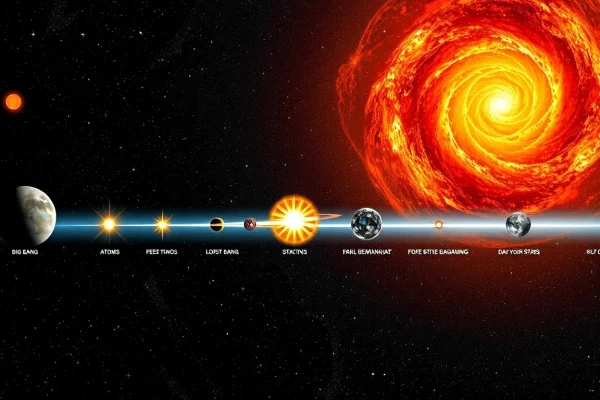
Did Space Exist Before the Big Bang? A Cosmic Timeline from Planck Epoch to Present
Explore the origin and evolution of the universe, from the Planck epoch to the present day, and examine the question of what—if anything—existed before the Big Bang.

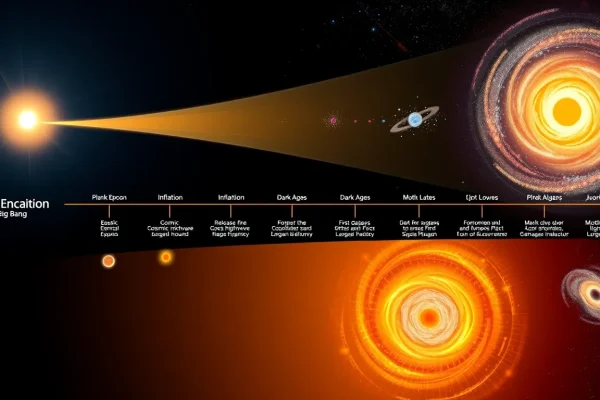
The interactive reference to the beginning and evolution of the universe.
Explore the origin and evolution of the universe, from the Planck epoch to the present day, and examine the question of what—if anything—existed before the Big Bang.
The electroweak epoch was a brief but crucial period in the early universe when the electromagnetic and weak nuclear forces were unified, until cooling triggered symmetry breaking. This article explains its timing, physics, and place in the cosmic timeline, from the Planck epoch to structure formation.
The last scattering surface is the sphere of light emitted about 380,000 years after the Big Bang, when the universe cooled enough for electrons and protons to form neutral hydrogen. This cosmic relic, observed as the cosmic microwave background, provides a snapshot of the infant universe and anchors our understanding of cosmic evolution from the Planck epoch to the present day.
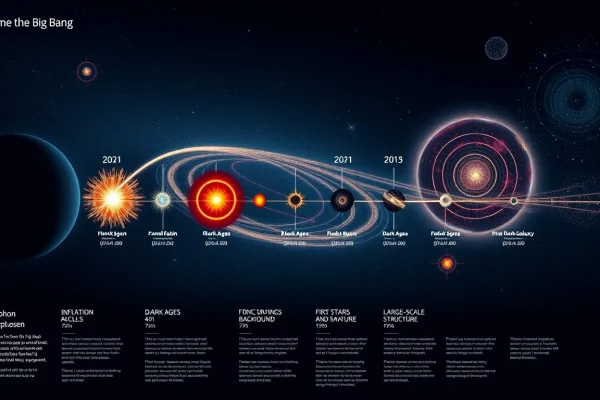
Explore the origin and evolution of the universe from the Planck epoch to the present day. This interactive reference covers cosmic inflation, the formation of the first elements, the cosmic microwave background, and the emergence of stars and galaxies, grounded in the Lambda-CDM model.
The first black holes emerged from the chaotic aftermath of the Big Bang, but their origins remain one of cosmology’s deepest puzzles. This guide explores the leading theories—light seeds from the first stars and heavy seeds from direct gas collapse—and places them in the full context of cosmic evolution, from the Planck epoch to the present day.
Cosmic reionization was the transformative period when ultraviolet light from the first stars and galaxies ionized the neutral hydrogen that filled the early universe, ending the cosmic dark ages and making space transparent to light. This article explores the full timeline from the Planck epoch to structure formation, the role of the cosmic microwave background, and the key missions that revealed this history.
The Big Bang theory is often misunderstood. This guide debunks common myths and explains the true origin and evolution of the universe, from the Planck epoch to the present day.
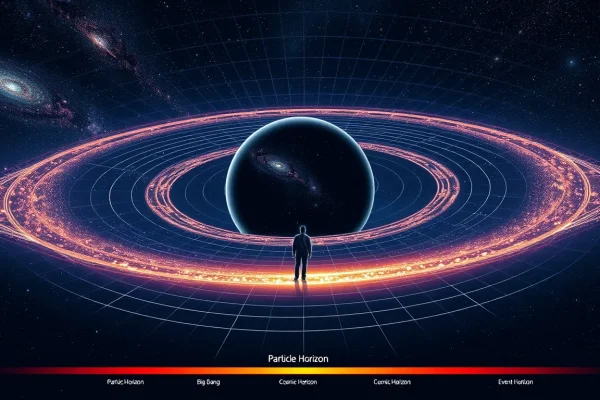
A cosmic horizon marks the boundary of what we can observe in an expanding universe. The particle horizon defines the edge of the observable universe, while the event horizon sets the limit of future observations. This guide explains the concept and traces the cosmic epochs from the Planck era to structure formation.
Recombination marks the moment about 378,000 years after the Big Bang when free electrons and protons combined to form neutral hydrogen, allowing photons to travel freely and making the universe transparent. This epoch gave birth to the cosmic microwave background and set the stage for the formation of stars and galaxies.
A comprehensive guide to the cosmic dark ages, the period when the universe was shrouded in neutral hydrogen, and how the first stars and galaxies emerged to end the darkness. This article covers the full cosmic timeline, key missions, and the evidence that shapes our understanding of this pivotal era.