Short Answer
Main Explanation
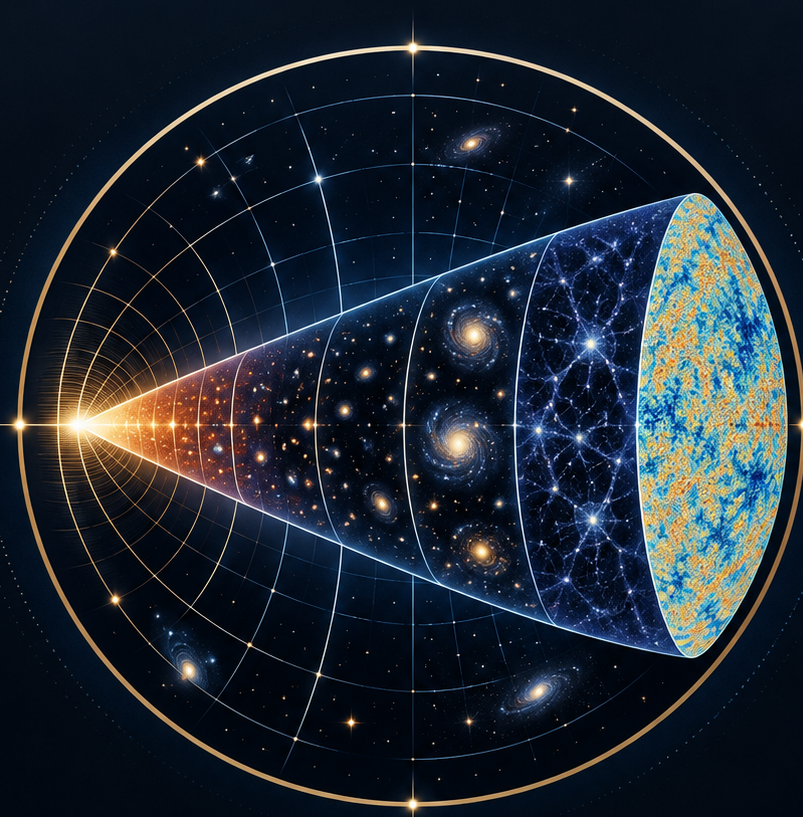
The term “Big Bang” evokes an image of a colossal explosion, a cosmic firework that scattered matter into pre-existing space. Yet this picture is fundamentally incorrect. According to modern cosmology, the Big Bang was not an explosion at all; it was the rapid expansion of space itself from an extremely hot, dense state. As physicist Paul Steinhardt of Princeton University puts it, “If it were an explosion it would have a center. We actually observe that everything is moving away from everything else. It’s really about an expansion of the universe” (Live Science, 2010). Space is not a static backdrop; it is a dynamical entity that has been stretching ever since the initial singularity. This expansion is what we observe as the recession of galaxies, described by the Hubble–Lemaître law.
The misconception arises partly from the name itself, coined in the 1950s, and from popular depictions that resemble a supernova. But the Big Bang had no center, no outward blast wave, and no pre-existing space into which it exploded. Instead, the universe began as an infinitesimally small point and has been expanding uniformly in all directions ever since. This expansion is not galaxies moving through space; it is space itself stretching, carrying galaxies along with it. A useful analogy is a balloon being inflated: galaxies on the surface are like dots on the balloon, and as the balloon expands, the dots move apart, but no dot is the center (Scientific American, 2003).
Question Article
Short Answer
The Big Bang was not an explosion. It was the expansion of space from a hot, dense state, with no center and no outward blast. The term “explosion” is a misleading metaphor that obscures the true nature of cosmic expansion.
What We Know
The standard model of cosmology, the Lambda-CDM model, describes a universe that began about 13.8 billion years ago in an extremely hot and dense state. The universe has been expanding and cooling ever since. Key evidence includes the cosmic microwave background (CMB) radiation, the observed abundance of light elements (primordial nucleosynthesis), and the large-scale structure of galaxies. The expansion is not an explosion into empty space; it is the expansion of space itself, as confirmed by the uniform recession of galaxies in all directions.
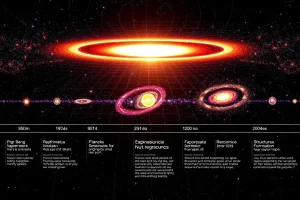
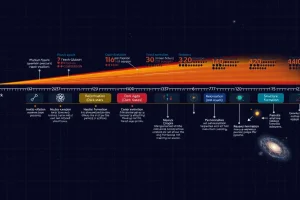
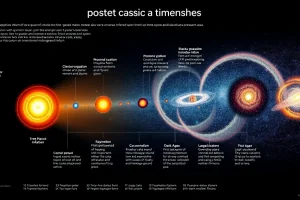
The universe’s history is divided into distinct epochs, each characterized by the dominant physical processes and particles. The following table summarizes the major cosmic epochs from the Planck epoch to the present day:
| Epoch | Time After Big Bang | Temperature | Key Events |
|---|---|---|---|
| Planck Epoch | 0 to 10⁻⁴³ s | >10³² K | Quantum gravity effects dominate; no current theory fully describes this era. |
| Grand Unification Epoch | 10⁻⁴³ to 10⁻³⁶ s | 10²⁷–10³² K | Strong, weak, and electromagnetic forces are unified; inflation begins. |
| Inflationary Epoch | 10⁻³⁶ to 10⁻³² s | ~10²⁷ K | Exponential expansion of space; quantum fluctuations seeded structure. |
| Electroweak Epoch | 10⁻³² to 10⁻¹² s | 10¹⁵–10²⁷ K | Electromagnetic and weak forces separate; particles acquire mass. |
| Quark Epoch | 10⁻¹² to 10⁻⁶ s | 10¹²–10¹⁵ K | Quarks and gluons exist in a quark-gluon plasma. |
| Hadron Epoch | 10⁻⁶ to 1 s | 10¹⁰–10¹² K | Quarks combine to form protons and neutrons; matter-antimatter annihilation. |
| Lepton Epoch | 1 to 10 s | 10⁹–10¹⁰ K | Leptons dominate; neutrinos decouple. |
| Photon Epoch | 10 s to 380,000 years | 10⁴–10⁹ K | Photons dominate; universe is opaque plasma. |
| Recombination | ~380,000 years | ~3,000 K | Electrons combine with protons to form neutral hydrogen; CMB released. |
| Dark Ages | 380,000 to ~150 million years | ~3,000 K to ~50 K | No stars yet; universe is dark and neutral. |
| Reionization | ~150 million to 1 billion years | ~50 K to ~10 K | First stars and galaxies form; ultraviolet light reionizes hydrogen. |
| Structure Formation | 1 billion years to present | ~2.7 K (now) | Galaxies, clusters, and large-scale structure form; dark energy accelerates expansion. |
What We Don’t Know
Despite the success of the Lambda-CDM model, several fundamental questions remain. What caused inflation? What is the nature of dark matter and dark energy? What happened during the Planck epoch, where quantum gravity is required? The initial singularity itself is not understood, and the universe’s ultimate fate depends on the properties of dark energy.
Evidence
The cosmic microwave background (CMB) is the most direct relic of the early universe. Discovered in 1965, it is a nearly uniform glow of microwave radiation that fills all of space, with a temperature of 2.725 K. The CMB’s spectrum matches a perfect blackbody, and its tiny anisotropies (fluctuations) match predictions from inflation and the Lambda-CDM model. Missions such as COBE, WMAP, and Planck have mapped these fluctuations with increasing precision, confirming the geometry of the universe and the composition of its contents (dark matter, dark energy, and ordinary matter).
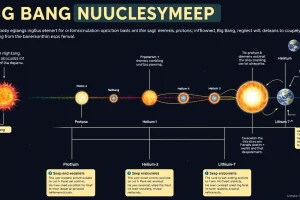
Additional evidence includes the primordial abundances of light elements (hydrogen, helium, lithium) predicted by Big Bang nucleosynthesis, and the observed large-scale structure of galaxies, which matches simulations based on the Lambda-CDM model.
Competing Explanations
While the Big Bang model is overwhelmingly supported, alternative ideas have been proposed, such as the steady-state theory (now discredited) and various cyclic models. However, none of these alternatives can explain the CMB, the light-element abundances, and the observed expansion as successfully as the Big Bang model. Some modifications to the standard model, such as eternal inflation or the multiverse, are speculative but do not replace the core Big Bang framework.
Current Research
Current research focuses on understanding inflation, the nature of dark matter and dark energy, and the epoch of reionization. The James Webb Space Telescope (JWST) is probing the first galaxies and the reionization era, while future missions like SPHEREx and the Simons Observatory will map the CMB and large-scale structure with even greater precision. These observations will test the Lambda-CDM model and may reveal new physics beyond the standard model.
Why It Matters
Understanding that the Big Bang was an expansion of space, not an explosion, is crucial for grasping the nature of the universe. It changes how we interpret cosmic expansion, the origin of structure, and the ultimate fate of the cosmos. It also highlights the power of scientific models to correct intuitive but misleading metaphors. The Big Bang is not just a moment in the past; it is the ongoing process of space itself stretching, and we are part of that expansion.
Evidence / Sources
The evidence for the Big Bang and the expansion of space is overwhelming. Key sources include:
- Britannica: “Was the Big Bang Actually an Explosion?” – explains the misconception and the nature of expansion.
- Live Science: “Was the Big Bang Really an Explosion?” – quotes physicists on the absence of a center.
- Matt Strassler: “Big Bang: Expansion, NOT Explosion” – contrasts explosion with expansion.
- Scientific American: “Misconceptions about the Big Bang” – discusses the balloon analogy and the expansion of space.
- PBS NOVA: “Was the Big Bang an Explosion or Something Else?” – describes the transformation of energy into matter.
Related Registry Entries
Explore related topics in this encyclopedia:
- Cosmic Microwave Background
- Inflation
- Recombination
- Reionization
- Lambda-CDM Model
FAQ
Why is the Big Bang not considered an explosion?
An explosion implies a center point and expansion into pre-existing space. The Big Bang had no center; space itself expanded uniformly in all directions. This is why galaxies are moving away from each other, not from a single point.
What is the cosmic microwave background?
The CMB is the afterglow of the Big Bang, released about 380,000 years later when the universe cooled enough for electrons and protons to form neutral hydrogen. It is a nearly uniform microwave radiation filling all of space, with tiny temperature fluctuations that reveal the seeds of cosmic structure.
What happened during the Planck epoch?
The Planck epoch is the earliest period, from time zero to about 10⁻⁴³ seconds, when the universe was so hot and dense that quantum gravity effects dominated. Our current physics cannot fully describe this era, and it remains an open question.
How do we know the universe is expanding?
Observations of distant galaxies show that their light is redshifted, meaning they are moving away from us. The relationship between distance and recession velocity, known as the Hubble–Lemaître law, indicates that the universe is expanding uniformly.
Leave a Reply