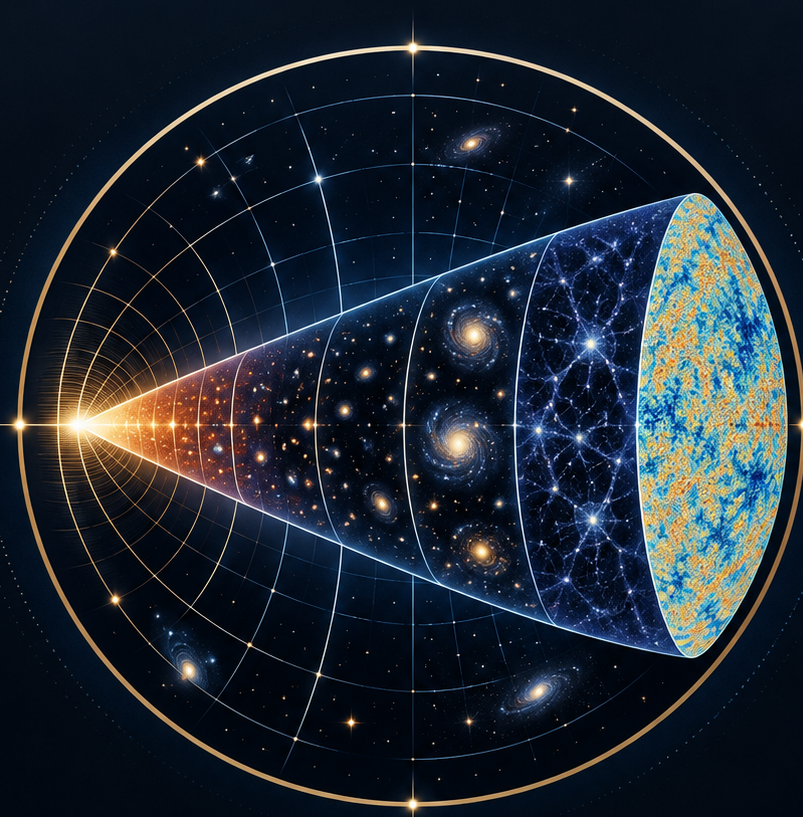
Mapping the Beginning of the Universe
Big Bang Registry is an independent educational reference dedicated to the Big Bang, the early universe, cosmic microwave background, cosmic evolution, and modern cosmology.
Our goal is to make some of the biggest questions in science easier to explore: How did the universe evolve from its earliest known state? What evidence supports the Big Bang model? What can the oldest light in the universe tell us about cosmic history? And which questions about our origins remain unanswered?
BigBangRegistry.com brings these subjects together through accessible guides, structured reference entries, timelines, maps, comparisons, and interactive tools.
Rather than treating cosmology as a collection of isolated articles, we aim to show how its ideas connect—from the earliest cosmic epochs to the formation of atoms, stars, galaxies, and the large-scale universe we observe today.
Exploring the Earliest Universe
Much of modern cosmology depends on observations that allow scientists to reconstruct the history of the universe.
One of the most important is the Cosmic Microwave Background, or CMB. It is the oldest light that can be directly observed. It was released when the young universe became transparent roughly 380,000 years after the Big Bang. Tiny variations within this radiation preserve information about the conditions from which later cosmic structures developed.
Space missions including NASA’s COBE and WMAP and ESA’s Planck progressively mapped this radiation with greater precision. COBE detected intrinsic temperature variations in the CMB, while Planck ultimately produced extraordinarily detailed measurements of these variations across the sky.
Big Bang Registry uses subjects like these as starting points for exploring the wider story of cosmology.
Our coverage includes:
- the Big Bang model and the evidence supporting it;
- cosmic inflation and the earliest epochs;
- Big Bang nucleosynthesis and the formation of the first atomic nuclei;
- recombination and the Cosmic Microwave Background;
- the cosmic dark ages and cosmic dawn;
- the formation of the first stars and galaxies;
- expansion, redshift, and the Hubble–Lemaître relationship;
- dark matter and dark energy;
- cosmological parameters and measurements;
- observatories, missions, experiments, and major discoveries;
- unanswered questions in modern cosmology.
More Than an Encyclopedia
Big Bang Registry is being developed as more than a collection of definitions.
The Registry concept is central to the project.
Cosmic epochs, observations, evidence, missions, experiments, measurements, parameters, and important concepts can be presented as connected reference entries. Readers can move from an event such as recombination to the Cosmic Microwave Background, then to missions such as COBE, WMAP, and Planck, and finally to the measurements those missions helped establish.
Interactive resources may also include cosmic timelines, calculators, maps, data explorers, and other tools designed to make abstract cosmological ideas easier to understand.
Our objective is simple:
help readers explore cosmology as a connected history of evidence, observation, and scientific discovery.
Science, Evidence, and Uncertainty
Cosmology contains both extraordinarily well-supported conclusions and major unanswered questions.
We believe that distinction matters.
Big Bang Registry aims to clearly separate:
- direct observations;
- conclusions strongly supported by evidence;
- interpretations that depend on particular cosmological models;
- areas of active scientific research;
- unresolved questions;
- speculative hypotheses.
For example, observations of the Cosmic Microwave Background provide a remarkably detailed picture of the early universe, but fundamental questions about topics such as the physical origin of inflation, dark matter, dark energy, and the earliest possible state of the universe remain subjects of research.
We do not present speculation as established fact.
Where appropriate, articles explain not only what scientists currently think, but also how they know, what observations support the conclusion, what assumptions are involved, and what remains uncertain.
Our Sources
Big Bang Registry prioritizes reliable scientific and educational sources.
Depending on the subject, these may include:
- peer-reviewed scientific papers;
- published research collaborations;
- mission documentation and datasets;
- NASA;
- the European Space Agency;
- observatories and research institutions;
- universities;
- scientific reviews and reference works.
ESA describes the CMB as relic radiation from the Big Bang and notes that its patterns contain information about the history and structure of the universe. NASA likewise describes it as the oldest observable light in the universe.
Whenever possible, readers should be able to trace important scientific claims back to the observations, research, or institutions behind them.
The History of BigBangRegistry.com
The name Big Bang Registry also has an earlier history.
In 2012, MinutePhysics presented BigBangRegistry.com alongside a video explaining the Cosmic Microwave Background. The original project offered an adventure-map-style visualization of the CMB, treating the oldest observable image of the universe almost like an unexplored geography that visitors could navigate.
That historical use is an interesting part of the domain’s story and fits naturally with its current focus on mapping and organizing knowledge about the early universe.
However, the current BigBangRegistry.com is an independent publication.
It should not be understood as the official continuation of the earlier MinutePhysics project, and it is not affiliated with MinutePhysics, Henry Reich, NASA, ESA, the Planck Collaboration, or other organizations discussed or referenced on this website.
The current project does not claim ownership of the original site’s databases, software, illustrations, maps, or other historical materials.
Our aim is to build a new educational resource around the broader idea suggested by the name: a registry for exploring the origins and evolution of the universe.
Our Mission
The universe has a history.
That history is written in light, matter, expansion, radiation, galaxies, and measurements collected across generations of scientific investigation.
Big Bang Registry exists to organize that story and make it easier to explore.
Whether you are trying to understand what the Big Bang theory actually says, examining a map of the Cosmic Microwave Background, learning what happened during a particular cosmic epoch, comparing major space missions, or investigating one of cosmology’s unresolved questions, our goal is to provide a useful starting point grounded in evidence.
Big Bang Registry — Mapping the Beginning of the Universe.