
Short Answer
Main Explanation
The cosmic microwave background (CMB) is the oldest light in the universe, a relic of the hot, dense state that existed about 380,000 years after the Big Bang. As this light travels toward us, it passes through and around massive structures—galaxies, galaxy clusters, and dark matter halos—whose gravity bends the path of the photons. This phenomenon, known as gravitational lensing, subtly distorts the CMB temperature and polarization maps, leaving a faint but detectable imprint. The effect was first predicted in the 1960s and has become a cornerstone of modern cosmology, allowing scientists to map the distribution of matter (including invisible dark matter) and to test models of cosmic evolution.
The lensing of the CMB is a weak-lensing effect: the deflections are small (typically a few arcminutes), but they are coherent across the sky and can be measured statistically. The lensing signal contains information about the growth of structure from the early universe to the present, and it is sensitive to the sum of neutrino masses, dark energy, and the primordial power spectrum. It also creates a nonzero B-mode polarization signal in the CMB, which is a source of confusion for searches for primordial gravitational waves, but also a valuable cosmological probe in its own right.
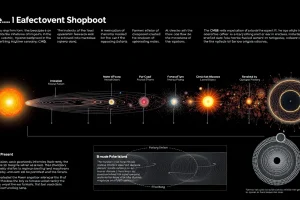
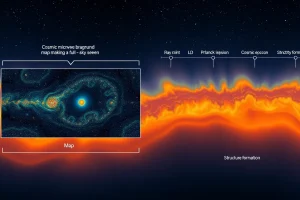
To understand how lensing fits into the cosmic story, consider the sequence of epochs that shaped our universe:
| Epoch | Time After Big Bang | Redshift (z) | Key Events |
|---|---|---|---|
| Planck epoch | < 10⁻⁴³ s | > 10³² | Quantum gravity dominates; all forces unified |
| Grand Unification epoch | 10⁻⁴³ – 10⁻³⁶ s | ~10²⁸ – 10³² | Strong and electroweak forces still unified |
| Inflationary epoch | 10⁻³⁶ – 10⁻³² s | ~10²⁵ – 10²⁸ | Exponential expansion; quantum fluctuations seeded |
| Electroweak epoch | 10⁻³² – 10⁻¹² s | ~10¹⁵ – 10²⁵ | Electromagnetic and weak forces separate |
| Quark epoch | 10⁻¹² – 10⁻⁶ s | ~10¹² – 10¹⁵ | Quarks and gluons exist in a quark–gluon plasma |
| Hadron epoch | 10⁻⁶ – 1 s | ~10¹⁰ – 10¹² | Protons and neutrons form; annihilation of baryons |
| Lepton epoch | 1 – 10 s | ~10⁹ – 10¹⁰ | Leptons dominate; neutrinos decouple |
| Photon epoch | 10 s – 380,000 yr | ~10³ – 10⁹ | Photons coupled to matter; Big Bang nucleosynthesis |
| Recombination | ~380,000 yr | ~1100 | Electrons combine with protons to form hydrogen; CMB released |
| Dark Ages | 380,000 yr – ~150 million yr | ~20 – 1100 | No luminous sources; matter collapses slowly |
| Reionization | ~150 million – 1 billion yr | ~6 – 20 | First stars and galaxies ionize hydrogen |
| Structure Formation | 1 billion yr – present | 0 – 6 | Galaxies, clusters, and large-scale structure develop |
The CMB originates at recombination, and the lensing we observe today is caused by all the matter structures that formed in later epochs—especially dark matter halos and galaxy clusters. By measuring the lensing deflection, we can reconstruct the projected matter distribution along the line of sight, effectively seeing the skeleton of cosmic structure.
Concept
Definition
Gravitational lensing of the CMB is the deflection of CMB photons by the gravitational potential of intervening matter, as described by general relativity. It changes the apparent positions and shapes of the temperature and polarization anisotropies, but it does not change the total intensity or the frequency spectrum of the CMB.
How It Works
Photons from the last scattering surface travel through a universe filled with density fluctuations. According to general relativity, mass and energy curve spacetime, and light follows the curved paths. The net effect is a remapping of the observed CMB sky: the temperature pattern at a given direction is the primordial pattern shifted by a deflection angle α (a two-dimensional vector). The deflection is the gradient of the lensing potential φ, which is a projection of the gravitational potential along the line of sight. The lensing potential is related to the matter distribution via a line-of-sight integral of the Weyl potential. For a flat universe, the deflection angle is typically a few arcminutes, with coherent structures on degree scales.
Equation
The lensed temperature field is approximately given by:
T̃(n̂) = T(n̂ + ∇φ(n̂))
where T is the unlensed temperature, φ is the lensing potential, and ∇φ is the deflection angle. The lensing potential itself obeys the Poisson equation in the projected sense: ∇²φ = -2 κ, where κ is the convergence (a measure of the magnification). In harmonic space, the lensing effect can be computed using the deflection power spectrum Clφφ, which is the main observable for cosmological analyses.
Example
A simple analogy: imagine looking at the surface of a swimming pool with a pattern on the bottom. If you place a glass of water on the surface, the pattern appears distorted—the glass acts like a lens. In the universe, clusters of galaxies and dark matter halos act as the glass, slightly shifting and magnifying the CMB pattern behind them. The effect is tiny, but by averaging over many clusters or using statistical techniques, we can detect it.
Observable Consequences
- Smoothing of the acoustic peaks: Lensing mixes power between scales, reducing the amplitude of the peaks in the temperature power spectrum and adding power to the damping tail.
- Non-Gaussianities: The lensing effect introduces a non-Gaussian signature (a four-point correlation) that can be used to reconstruct the lensing potential.
- B-mode polarization: Lensing converts a portion of the E-mode polarization into B-modes, which are a major foreground for primordial gravitational wave searches.
- Cross-correlation with other tracers: The lensing signal correlates with galaxy surveys and cosmic shear, providing a consistency check and additional cosmological constraints.
Common Misconceptions
- Lensing does not change the CMB’s blackbody spectrum: It only remaps the spatial pattern; the frequency distribution remains unchanged.
- Lensing is not the same as the Sunyaev–Zel’dovich effect: The latter involves scattering of CMB photons by hot gas, not gravitational bending.
- Lensing does not create or destroy photons: It conserves surface brightness, so the total intensity is unchanged.
- Lensing is not a sign of new physics: It is a well-understood consequence of general relativity, though its measurement can constrain new physics like massive neutrinos or modified gravity.
Why It Matters
The gravitational lensing of the CMB is a unique and powerful probe of the universe. It directly maps the distribution of dark matter, which dominates the mass budget of the cosmos, and it traces the growth of structure from the epoch of recombination to the present. This allows cosmologists to test the standard Lambda-CDM model with high precision. For example, the amplitude of the lensing signal is sensitive to the sum of neutrino masses (massive neutrinos suppress structure on small scales) and to the dark energy equation of state. Lensing also provides a way to calibrate the mass calibration of galaxy clusters, improving measurements of the Hubble constant and the amplitude of density fluctuations (σ8). Moreover, the lensing-induced B-modes are both a nuisance and a treasure: they must be carefully subtracted to detect primordial gravitational waves, but they also offer an independent route to measuring the lensing potential and thus the matter distribution.
In the context of cosmic epochs, lensing bridges the gap between the early universe (the CMB) and the late universe (structure formation). It tells us how the seeds of structure—the tiny fluctuations imprinted during inflation—grew into the vast cosmic web we observe today. Without lensing, our understanding of dark matter and the growth of structure would be far less complete.
Evidence / Sources
The first detections of CMB lensing came from cross-correlations with galaxy surveys (e.g., Hirata et al. 2004), but the first high-significance measurement was made by the Atacama Cosmology Telescope (ACT) in 2011 using the four-point function of the temperature field. The South Pole Telescope (SPT) soon followed. The Planck satellite provided the first all-sky detection of lensing in 2013, with a signal-to-noise of about 25, and later releases improved this to over 40. Planck’s lensing map, reconstructed from the temperature and polarization data, has become a standard reference for cosmology. More recently, ACT and SPT have provided high-resolution lensing measurements that are complementary to Planck, especially on small scales. The Simons Observatory and CMB-S4 are future experiments that will measure lensing with even greater precision, potentially resolving the current tensions in σ8 and the Hubble constant.
Key references include the review by Lewis and Challinor (2006) [arXiv:astro-ph/0601594], which provides a comprehensive theoretical treatment; the paper by Namikawa (2014) [arXiv:1403.3569] on cosmology from CMB lensing; and the thesis by Motloch (2018) [DOI:10.6082/30e2c-8mq33] which discusses lensing covariance and consistency relations.
Related Registry Entries
Last Reviewed / Updated: September 5, 2026
FAQ
Does gravitational lensing of the CMB change the temperature of the CMB?
No. Lensing only remaps the spatial pattern of the CMB; it conserves surface brightness, so the spectrum and total intensity remain unchanged. It redistributes power across angular scales but does not alter the blackbody nature.
How is CMB lensing detected?
Lensing is detected through the non-Gaussian signatures it induces, particularly the four-point correlation function (trispectrum) of the temperature and polarization fields. By measuring these correlations, cosmologists can reconstruct the lensing potential map and its power spectrum.
Why is CMB lensing important for cosmic inflation?
CMB lensing creates B-mode polarization that contaminates the signal from primordial gravitational waves (a key prediction of inflation). Accurate lensing subtraction is essential for detecting the faint inflationary B-mode signal. Additionally, lensing measurements can constrain the amplitude of primordial fluctuations and the growth of structure, complementing inflation probes.
Leave a Reply