
Short Answer
Main Explanation
Grand Unified Theories (GUTs) are theoretical frameworks in particle physics that aim to describe the strong, weak, and electromagnetic forces as different manifestations of a single unified force. These theories occupy a critical position in modern cosmology because they describe the physics of the universe during its earliest moments—specifically, the Grand Unification Epoch, when the universe was so hot and dense that three of the four fundamental forces were indistinguishable.
The Standard Model and the Need for Unification
The Standard Model (SM) of particle physics is defined by the gauge group GSM = SU(3)C × SU(2)L × U(1)Y, with three generations of fermions transforming under specific representations. The fermion content includes quark and lepton doublets along with charge-conjugate singlets, corresponding to the familiar set [Q, uc, dc, L, ec], where Q = (u, d) and L = (ν, e) are the quark and lepton SU(2)L doublets [1].
Despite its remarkable experimental success—particularly confirmed by the discovery of the Higgs boson—the Standard Model leaves fundamental questions unanswered. Neutrino masses are not explained, and the three gauge forces remain stubbornly separate [1]. Grand unification addresses this by embedding the Standard Model gauge group into a larger, simple gauge group, thereby relating the known interactions as different aspects of a simpler unified theory [3].
The Unification Idea
Grand unification refers to gauge field theories in which the strong, weak, and electromagnetic interactions are described by a simple gauge group, with quarks and leptons and their antiparticles combined in the same multiplets [3]. This approach is analogous to how Maxwell’s theory unified electricity and magnetism into a single electromagnetic interaction [3].
GUTs typically predict two key phenomena. First, they predict that the (distance-dependent) interaction strengths of the known interactions should become equal at short distance scales—a concept known as gauge coupling unification. Second, they predict proton and bound neutron decay, though with an extremely long lifetime (e.g., much larger than 1030 years) that has not yet been observed [3].
The Grand Unification Epoch in Cosmic History
In the standard cosmological timeline, the Grand Unification Epoch corresponds to the period from approximately 10−43 to 10−36 seconds after the Big Bang. During this era, the universe’s temperature exceeded approximately 1029 K, and the strong, weak, and electromagnetic forces were unified into a single interaction. As the universe expanded and cooled, the strong force separated from the electroweak force in a symmetry-breaking phase transition, marking the end of the Grand Unification Epoch and the beginning of the Inflationary Epoch.
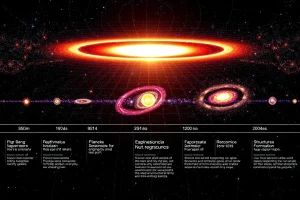
Cosmic Timeline: From Planck Epoch to Structure Formation
| Epoch | Time After Big Bang | Temperature | Key Events |
|---|---|---|---|
| Planck Epoch | < 10−43 s | > 1032 K | Quantum gravity dominates; all four forces unified |
| Grand Unification Epoch | 10−43 to 10−36 s | ~1029 K | Strong and electroweak forces unified; GUT symmetry breaking |
| Inflationary Epoch | ~10−36 to 10−32 s | Cooling rapidly | Exponential expansion; quantum fluctuations seeded structure |
| Electroweak Epoch | 10−36 to 10−12 s | 1015 to 1029 K | Electromagnetic and weak forces separate |
| Quark Epoch | 10−12 to 10−6 s | 1012 to 1015 K | Quarks and gluons form quark-gluon plasma |
| Hadron Epoch | 10−6 to 1 s | 1010 to 1012 K | Protons and neutrons form; baryogenesis |
| Lepton Epoch | 1 to 10 s | 109 to 1010 K | Leptons dominate; neutrinos decouple |
| Photon Epoch | 10 s to 380,000 yr | 3,000 to 109 K | Photons dominate; Big Bang nucleosynthesis |
| Recombination | ~380,000 yr | ~3,000 K | Electrons combine with nuclei; CMB released |
| Dark Ages | 380,000 to ~150 million yr | Cooling from ~3,000 K | No light sources; universe dark |
| Reionization | ~150 million to ~1 billion yr | Heating by first stars | First stars and galaxies ionize neutral hydrogen |
| Structure Formation | ~1 billion yr to present | Cooling to 2.7 K | Galaxies, clusters, and large-scale structure form |
Concept
Definition
A Grand Unified Theory is a gauge field theory in which the strong, weak, and electromagnetic interactions are described by a single simple gauge group, with quarks and leptons combined in the same multiplets [3]. GUTs thereby relate the known microscopic interactions as different aspects of a simpler unified theory, much as Maxwell’s theory unified electricity and magnetism [3].
How It Works
GUTs work by embedding the Standard Model gauge group SU(3)C × SU(2)L × U(1)Y into a larger simple group such as SU(5), SO(10), or E6. At high energies—typically around 1016 GeV—the symmetry is restored, and all three forces behave as one. At lower energies, the symmetry is spontaneously broken, giving rise to the distinct forces we observe. The unification condition requires that the gauge couplings g1, g2, and g3 (corresponding to U(1), SU(2), and SU(3) respectively) converge to a common value at the unification scale.
Equation
The unification of gauge couplings is expressed by the condition g1 = g2 = g3 at the unification scale, where g1, g2, and g3 are the U(1), SU(2), and SU(3) coupling constants respectively. The renormalization group equations describe how these couplings evolve with energy, and their apparent convergence near 1016 GeV is one of the key motivations for GUTs.
Example
The simplest GUT is the Georgi-Glashow SU(5) model, which embeds the Standard Model group into SU(5). In this model, each generation of quarks and leptons fits into a 5̄ and a 10 representation of SU(5). The X and Y bosons in this model mediate transitions between quarks and leptons, leading to baryon-number-violating processes such as proton decay.
Observable Consequences
The most distinctive prediction of GUTs is proton decay. Since quarks and leptons are in the same multiplets, baryon number is not conserved, allowing processes such as p → e+ + π0. Current experimental limits place the proton lifetime at greater than 1030 years [3]. GUTs also predict the existence of magnetic monopoles and the unification of gauge couplings at high energies [3].
Common Misconceptions
One common misconception is that GUTs are confirmed theories. In fact, GUTs remain hypothetical; no experimental evidence directly confirms them, and proton decay has not been observed [3]. Another misconception is that GUTs include gravity—they do not. Theories that unify all four forces, including gravity, are called Theories of Everything (ToEs) and remain even more speculative.
Cosmic Epoch: The Grand Unification Epoch
When It Happened
The Grand Unification Epoch occurred from approximately 10−43 to 10−36 seconds after the Big Bang, immediately following the Planck Epoch.
Temperature
The temperature during this epoch exceeded approximately 1029 K, corresponding to particle energies above 1016 GeV—far beyond anything achievable in terrestrial particle accelerators.
Approximate Redshift
While precise redshift values are not well-defined at such early times, the Grand Unification Epoch corresponds to redshifts far beyond z ~ 1028, when the observable universe was a fraction of a centimeter across.
Dominant Particles/Physics
During this epoch, the strong, weak, and electromagnetic forces were unified into a single GUT interaction. The relevant physics is described by the GUT gauge group, with X and Y bosons mediating transitions between quarks and leptons. The universe was filled with a hot, dense plasma of fundamental particles.
What Happened
As the universe expanded and cooled, the GUT symmetry was spontaneously broken. The strong force separated from the electroweak force, releasing energy and potentially generating a population of magnetic monopoles. This symmetry-breaking phase transition marks the end of the Grand Unification Epoch and may have provided the initial conditions for cosmic inflation.
What Came Before
Before the Grand Unification Epoch was the Planck Epoch (t < 10−43 s), during which quantum gravitational effects dominated and all four fundamental forces—including gravity—were unified. Our current understanding of physics breaks down at this scale, as a complete theory of quantum gravity remains elusive.
What Came Next
After the Grand Unification Epoch came the Inflationary Epoch, during which the universe underwent a period of exponential expansion driven by the energy released during GUT symmetry breaking. This rapid expansion stretched quantum fluctuations to cosmic scales, seeding the large-scale structure we observe today.
Evidence
There is currently no direct experimental evidence for the Grand Unification Epoch. However, indirect evidence comes from the observed values of the gauge couplings, which, when extrapolated to high energies using renormalization group equations, appear to converge toward a common value at approximately 1016 GeV—a hallmark prediction of GUTs. The absence of observed proton decay places constraints on specific GUT models but does not rule them out [3].
Why It Matters
Grand Unified Theories matter for several profound reasons. First, they provide a framework for understanding the earliest moments of the universe, connecting particle physics to cosmology in a way that no other theory does. Second, they address fundamental questions left unanswered by the Standard Model, such as the quantization of electric charge, the origin of neutrino masses, and the observed matter-antimatter asymmetry [1]. Third, GUTs predict observable phenomena—most notably proton decay—that could be detected in future experiments, providing a concrete, testable pathway to validate or falsify these theories [3].
The Grand Unification Epoch also connects directly to cosmic inflation. The energy released during GUT symmetry breaking may have driven the exponential expansion of the universe, and the quantum fluctuations generated during inflation seeded the density perturbations that eventually grew into galaxies and clusters. Understanding GUTs is therefore essential for a complete picture of cosmic origins.
Evidence / Sources
The primary sources for this article include the Particle Data Group’s review of Grand Unified Theories, revised August 2025 by N. Nagata, A. Hebecker, and J. Hisano [1]; the Scholarpedia article on Grand Unification by Paul Langacker (2012) [3]; the Wikipedia article on Grand Unified Theory [2]; and the Frontiers in Physics article “GUT Physics in the Era of the LHC” by Croon, Gonzalo, Gráf, Košnik, and White (2019) [4]. These sources provide authoritative, up-to-date grounding on the current state of GUT research and its cosmological implications.
Related Registry Entries
FAQ
What is a Grand Unified Theory?
A Grand Unified Theory (GUT) is a theoretical framework in particle physics that describes the strong, weak, and electromagnetic forces as different manifestations of a single unified force, characterized by a simple gauge group that contains the Standard Model group SU(3)C × SU(2)L × U(1)Y [3].
Have GUTs been experimentally confirmed?
No. GUTs remain hypothetical. While the observed convergence of gauge couplings at high energies provides indirect support, no direct experimental evidence exists, and proton decay—the most distinctive prediction—has not been observed, with experimental limits placing the proton lifetime at greater than 10^30 years [3].
What is proton decay?
Proton decay is a hypothetical process predicted by GUTs in which protons decay into lighter particles, such as a positron and a neutral pion (p → e+ + π0). This occurs because GUTs place quarks and leptons in the same multiplets, violating baryon number conservation. The predicted lifetime is extremely long—greater than 10^30 years—making it very difficult to observe [3].
How do GUTs relate to the Big Bang?
GUTs describe the physics of the Grand Unification Epoch, which occurred from approximately 10^-43 to 10^-36 seconds after the Big Bang. During this era, the strong, weak, and electromagnetic forces were unified. The symmetry-breaking phase transition at the end of this epoch may have driven cosmic inflation and seeded the large-scale structure of the universe.
Do GUTs include gravity?
No. Grand Unified Theories unify only three of the four fundamental forces: strong, weak, and electromagnetic. Theories that also include gravity are called Theories of Everything (ToEs) and remain highly speculative, requiring a complete theory of quantum gravity.
Leave a Reply