Short Answer
Main Explanation
The Cosmic Microwave Background: A Relic of the Big Bang
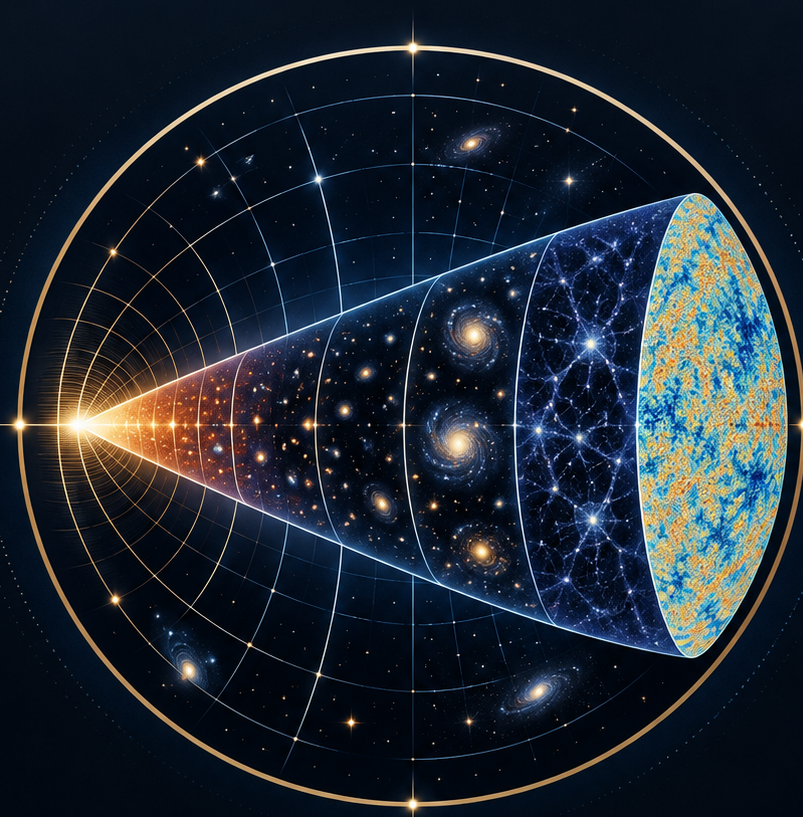
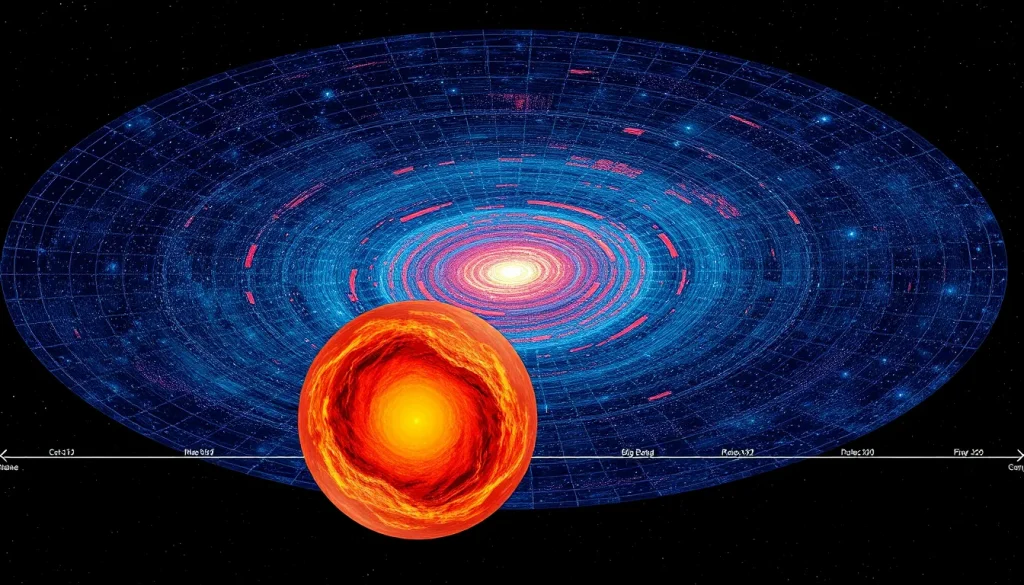
The cosmic microwave background (CMB) is the faint electromagnetic radiation that fills the universe, discovered in 1965 and now measured to have a perfect blackbody spectrum at a temperature of 2.7255 K (source: PDG review). This radiation is the afterglow of the hot, dense state of the early universe, released about 380,000 years after the Big Bang when electrons and protons combined to form neutral hydrogen—an event called recombination. Before recombination, photons were tightly coupled to matter; after it, they streamed freely, carrying an imprint of the density fluctuations that would later grow into galaxies and clusters.
The CMB is a cornerstone of the hot Big Bang model. Its uniformity across the sky (to one part in 100,000) and its tiny anisotropies encode a wealth of information about the composition, geometry, and evolution of the cosmos. But the CMB also provides one of the most direct confirmations of cosmic inflation, the theory that the universe underwent a brief period of exponential expansion in the first 10-32 seconds.
Cosmic Inflation: A Brief but Crucial Epoch
Inflation was proposed in the early 1980s to solve several puzzles of the standard Big Bang model, such as the horizon problem (why distant regions of the sky are so uniform) and the flatness problem (why the universe is so close to spatially flat). The idea is that a scalar field, the inflaton, drove a period of accelerated expansion, stretching quantum fluctuations to macroscopic scales. These fluctuations became the seeds of all structure we see today.
Inflation makes precise predictions: the universe should be nearly flat, the primordial fluctuations should be nearly scale-invariant and Gaussian, and there should be a specific pattern of temperature and polarization anisotropies in the CMB. The CMB is the ideal probe to test these predictions.
How Inflation Imprints on the CMB
During inflation, quantum fluctuations in the inflaton field were stretched to cosmological scales, creating small variations in density. After inflation ended, these fluctuations were imprinted as acoustic oscillations in the photon-baryon fluid before recombination. When the CMB was released, these oscillations were frozen into the temperature pattern we observe today. The statistical properties of these anisotropies—especially the power spectrum—depend on the parameters of inflation, such as the spectral index and the tensor-to-scalar ratio.
Observations of the CMB power spectrum by missions like COBE (which first detected anisotropies in 1992), WMAP (which made precise measurements of the angular power spectrum starting in 2003), and Planck (which delivered the most detailed all-sky maps) have confirmed the key predictions of inflation. The CMB spectrum shows a series of acoustic peaks that are exactly what inflation plus the standard model of cosmology predicts.
The Cosmic Epochs: A Timeline
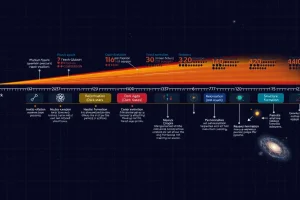
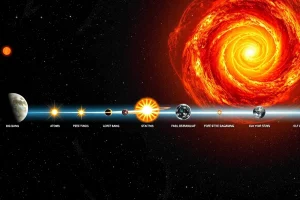
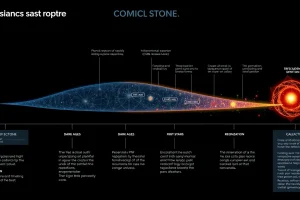
The history of the universe from the Planck epoch to the present day can be divided into distinct phases, each governed by different physical processes. The table below summarizes the major epochs, their approximate times, temperatures, and key events.
| Epoch | Time after Big Bang | Temperature | Key Events |
|---|---|---|---|
| Planck epoch | <10-43 s | >1032 K | Quantum gravity effects dominate; no known physics describes this era. |
| Grand Unification epoch | 10-43 to 10-36 s | 1032 to 1028 K | Strong and electroweak forces unify; possible symmetry breaking. |
| Inflationary epoch | 10-36 to 10-32 s | ~1027 K (decreasing) | Exponential expansion; quantum fluctuations stretched to cosmic scales. |
| Electroweak epoch | 10-32 to 10-12 s | 1028 to 1015 K | Electromagnetic and weak forces separate; W and Z bosons acquire mass. |
| Quark epoch | 10-12 to 10-6 s | 1015 to 1012 K | Quarks and gluons form a quark-gluon plasma. |
| Hadron epoch | 10-6 to 1 s | 1012 to 1010 K | Quarks combine into protons and neutrons; baryons and antibaryons annihilate. |
| Lepton epoch | 1 to 10 s | 1010 to 109 K | Leptons and antileptons dominate; neutrinos decouple. |
| Photon epoch | 10 s to 380,000 yr | 109 to 3000 K | Photons dominate; Big Bang nucleosynthesis forms light elements (H, He, Li). |
| Recombination | ~380,000 yr | ~3000 K | Electrons and protons combine to form neutral hydrogen; CMB released. |
| Dark Ages | 380,000 yr to ~150 million yr | 3000 to ~50 K | No stars yet; the universe is dark and neutral. |
| Reionization | ~150 million to 1 billion yr | ~50 to ~10 K | First stars and galaxies form; ultraviolet light reionizes hydrogen. |
| Structure Formation | 1 billion yr to present | <10 K | Gravity amplifies density fluctuations into galaxies, clusters, and large-scale structure. |
Evidence: How the CMB Confirms Inflation
Observation
The CMB is observed to be an almost perfect blackbody with a temperature of 2.7255 K (PDG, 2025). Its anisotropies—temperature variations of about one part in 100,000—have been mapped with increasing precision by COBE, WMAP, and Planck. The angular power spectrum of these fluctuations shows a series of acoustic peaks at specific multipole moments, with the first peak around ℓ≈200, corresponding to the horizon size at recombination.
Prediction
Inflation predicts that the primordial fluctuations are nearly scale-invariant (spectral index ns ≈ 0.96), adiabatic, and Gaussian. It also predicts a universe that is spatially flat (Ωtotal ≈ 1) and the existence of a stochastic background of gravitational waves (tensor modes) that would imprint a specific pattern of B-mode polarization in the CMB. These predictions were made before the precise measurements.
Measurement
Planck’s 2018 release measured ns = 0.9649 ± 0.0042 and confirmed the universe is flat to within 0.4% (Planck Collaboration). The acoustic peaks in the CMB power spectrum match the predictions of inflationary ΛCDM models with remarkable precision. The damping tail at high multipoles also agrees with the expected Silk damping. While B-modes from primordial gravitational waves have not yet been definitively detected, upper limits from BICEP/Keck and Planck are consistent with simple inflation models.
Why It Supports the Model
The CMB’s near-scale-invariant, adiabatic fluctuations are exactly what inflation produces from quantum fluctuations stretched across the sky. The flat geometry is a natural consequence of the exponential expansion. The absence of excess non-Gaussianity (Planck measured fNL consistent with zero) further supports the simplest single-field slow-roll inflation models. No alternative theory has yet matched this combination of predictions with such precision.
Limitations
The CMB alone cannot determine the exact inflaton potential or the energy scale of inflation. The lack of detected B-modes leaves the tensor-to-scalar ratio unconstrained (r < 0.036 at 95% CL from BICEP/Keck). Additionally, the CMB only probes the last scattering surface; it cannot directly observe the inflationary era itself. Degeneracies with other cosmological parameters (e.g., the optical depth) also introduce some uncertainty.
Alternative Explanations
Some alternatives to inflation, such as cyclic models or string gas cosmology, attempt to explain the CMB’s properties without a period of exponential expansion. However, these models often fail to reproduce the precise pattern of acoustic peaks or the near-scale-invariant spectrum. The ekpyrotic/cyclic model predicts a blue-tilted spectrum, which is ruled out by observations. No alternative has gained broad acceptance.
Current Scientific Consensus
The overwhelming majority of cosmologists accept the inflationary paradigm as part of the standard ΛCDM model. The CMB data, combined with BAO and supernova observations, strongly support inflation as the mechanism that generated the initial fluctuations and set up the initial conditions of the Big Bang. Future experiments, such as CMB-S4 and LiteBIRD, aim to detect primordial B-modes to further test inflation.
Why It Matters
Confirming inflation through the CMB is not just about validating a theory—it connects quantum mechanics on microscopic scales to the largest structures in the universe. The CMB’s anisotropies are a direct snapshot of quantum fluctuations at 10-32 seconds after the Big Bang, magnified to cosmic scales. Understanding inflation also helps us probe physics at energy scales far beyond particle accelerators, offering a window into the Grand Unification and possibly quantum gravity. Moreover, the CMB’s precision measurements have established the ΛCDM model, which includes dark matter and dark energy, shaping our current view of cosmic evolution.
Evidence / Sources
Key evidence for inflation from the CMB includes: (1) the flat geometry of the universe, measured to ΩK = 0.001 ± 0.002 by Planck; (2) the near-scale-invariant spectral index ns ≈ 0.96; (3) the acoustic peak structure matching adiabatic, Gaussian fluctuations; (4) the absence of large non-Gaussianity; and (5) the damping tail consistent with standard recombination. These results come from COBE (1992), WMAP (2003–2013), and Planck (2013–2018). The CMB also provides the strongest constraints on the sum of neutrino masses and the effective number of relativistic species.
Related Registry Entries
- Cosmic Microwave Background
- Inflation
- Big Bang Nucleosynthesis
- Recombination
- ΛCDM Model
- Planck Mission
- WMAP Mission
- COBE Mission
FAQ
What exactly is the cosmic microwave background?
The CMB is the oldest light in the universe, emitted about 380,000 years after the Big Bang when the universe cooled enough for electrons and protons to form neutral hydrogen. It appears as a nearly uniform glow across the sky at a temperature of 2.7255 K, with tiny fluctuations that reveal the seeds of cosmic structure.
How does the CMB confirm inflation?
Inflation predicts that the universe is spatially flat, that primordial fluctuations are nearly scale-invariant and adiabatic, and that they follow a Gaussian distribution. The CMB power spectrum measured by COBE, WMAP, and Planck matches these predictions with high precision, including the specific pattern of acoustic peaks. The absence of non-Gaussianity and the measured spectral index further support inflation.
What did COBE, WMAP, and Planck each discover?
COBE (1992) first detected the CMB anisotropies, confirming the blackbody spectrum. WMAP (2003) precisely mapped the temperature fluctuations and measured key cosmological parameters, establishing the ΛCDM model. Planck (2013–2018) provided even higher-resolution maps, tightening constraints on inflation parameters and ruling out many alternative models.
Are there any alternative explanations to inflation for the CMB's properties?
Some alternatives like cyclic models or string gas cosmology have been proposed, but they generally fail to reproduce the observed near-scale-invariant spectrum and acoustic peak structure. No alternative has gained wide acceptance, and inflation remains the consensus explanation.

Leave a Reply