
Short Answer
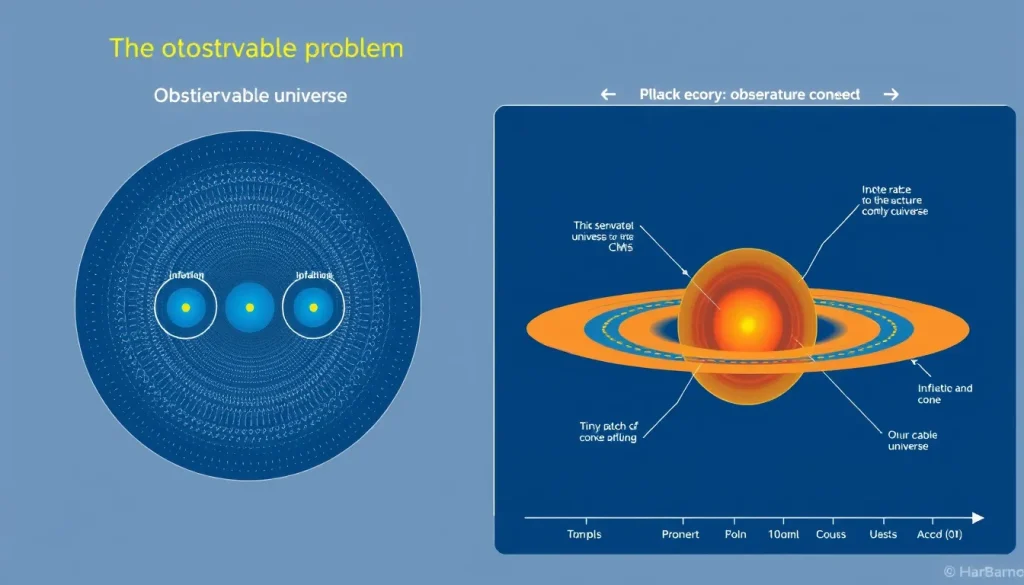
The horizon problem is a cosmological fine-tuning issue in the Big Bang model: observations show that widely separated regions of the universe have nearly identical temperatures, yet they have never been in causal contact given the finite speed of light and the age of the universe. The leading solution is cosmic inflation, a period of exponential expansion in the first 10^-32 seconds that stretched a tiny, causally connected patch to become the entire observable universe, explaining the uniformity of the cosmic microwave background.
| Property | Value |
|---|---|
| Type | Cosmological fine-tuning problem |
| First noted | 1956 by Wolfgang Rindler (per Wikipedia) |
| Observational evidence | Uniform CMB temperature (2.725 K) across the sky |
| Proposed solution | Cosmic inflation (Alan Guth, 1980) |
| Key missions | COBE, WMAP, Planck |
Main Explanation
The Big Bang model describes the universe as expanding and cooling from an extremely hot, dense state. About 380,000 years after the Big Bang, the universe had cooled enough for electrons and protons to combine into neutral hydrogen, allowing photons to travel freely. This cosmic microwave background (CMB) is a relic of that moment, and it is remarkably uniform: its temperature is 2.725 K with fluctuations of only one part in 100,000. This uniformity is puzzling because, according to standard Big Bang cosmology, regions on opposite sides of the sky have never been in causal contact—they are separated by distances greater than the particle horizon, the maximum distance light could have traveled since the Big Bang. This is the horizon problem, first pointed out by Wolfgang Rindler in 1956 (per Wikipedia).
The problem arises because the CMB we observe today comes from regions that were outside each other’s light cones at the time of emission. As Trodden and Carroll explain, the comoving horizon size is the distance a photon can travel since the Big Bang, and in a matter-dominated universe, this grows with time, but at recombination, the horizon was much smaller than the scale of the observed uniformity. Thus, no physical process traveling at or below the speed of light could have smoothed out temperature differences across the entire sky.
Cosmic inflation, proposed by Alan Guth and others in the early 1980s, offers a solution. Inflation postulates that the universe underwent a period of exponential expansion driven by a scalar field, inflating a tiny patch of space by at least a factor of e^60 or more. This rapid expansion would have taken a region that was initially in causal contact and stretched it to enormous scales, so that the entire observable universe we see today originated from a small, homogeneous patch. After inflation, the universe continued to expand and cool in the standard Big Bang way, but the initial conditions were set by the inflationary epoch.
Cosmic Timeline
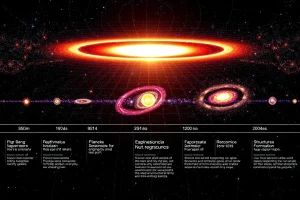
| Epoch | Time after Big Bang | Temperature | Key Events |
|---|---|---|---|
| Planck epoch | 0 to 10^-43 s | >10^32 K | Quantum gravity effects dominate; no known physics |
| Grand Unification epoch | 10^-43 to 10^-36 s | >10^28 K | Fundamental forces unified except gravity |
| Inflationary epoch | 10^-36 to 10^-32 s | ~10^27 K | Exponential expansion; quantum fluctuations stretched |
| Electroweak epoch | 10^-32 to 10^-12 s | >10^15 K | Electromagnetic and weak forces separate |
| Quark epoch | 10^-12 to 10^-6 s | >10^12 K | Quarks and gluons form a quark-gluon plasma |
| Hadron epoch | 10^-6 to 1 s | >10^10 K | Protons and neutrons form; matter-antimatter annihilation |
| Lepton epoch | 1 to 10 s | ~10^10 to 10^9 K | Leptons dominate; neutrinos decouple |
| Photon epoch | 10 s to 380,000 yr | >3000 K | Photons dominate; nucleosynthesis occurs |
| Recombination | ~380,000 yr | ~3000 K | Electrons and protons combine; CMB released |
| Dark Ages | 380,000 yr to ~150 million yr | 3000 K to ~50 K | No stars yet; universe filled with neutral hydrogen |
| Reionization | ~150 million yr to 1 billion yr | ~50 K to ~10 K | First stars and galaxies form; ionize hydrogen |
| Structure Formation | 1 billion yr to present | 10 K to 2.7 K | Galaxies, clusters, and large-scale structure develop |
Concept
Definition
The horizon problem is the observation that the CMB is uniform across the entire sky, despite the fact that regions separated by more than the particle horizon have never exchanged information. This requires either that the universe started with incredibly fine-tuned homogeneous initial conditions or that some mechanism smoothed it out.
How It Works
Inflation solves the horizon problem by positing a period of accelerated expansion. During inflation, the scale factor grew exponentially, so a region that was causally connected at the start of inflation was stretched to a size much larger than the observable universe today. Thus, all points we see in the CMB originated from a single causal patch, allowing them to reach thermal equilibrium before inflation.
Equation
The key equation is the scale factor evolution: ( a(t) propto e^{H t} ) during inflation, where H is the Hubble parameter. This exponential growth means the comoving distance that can be causally connected grows dramatically.
Example
Imagine a balloon with a small dot drawn on it. If the balloon is inflated rapidly, the dot expands to cover the whole surface. Similarly, inflation expands a tiny, uniform patch to become the entire observable universe.
Observable Consequences
Inflation also predicts a nearly flat universe, a spectrum of primordial density fluctuations consistent with observations, and the absence of magnetic monopoles. The CMB temperature fluctuations measured by COBE, WMAP, and Planck match these predictions.
Common Misconceptions
One misconception is that inflation explains the Big Bang itself; rather, it describes a very early epoch after the initial singularity. Another is that the horizon problem implies the universe is not homogeneous; it is precisely the opposite—it highlights why it is so homogeneous.
Why It Matters
The horizon problem is a critical test of the Big Bang model. Without a solution, the observed uniformity of the CMB would require an extraordinary coincidence. Inflation not only resolves this but also provides a mechanism for generating the small density perturbations that seeded galaxies and large-scale structure. It is a cornerstone of the Lambda-CDM model, the current standard model of cosmology.
Evidence / Sources
The uniformity of the CMB has been confirmed by multiple experiments, including COBE (1989), WMAP (2001), and the Planck satellite (2009). These missions measured the CMB temperature and polarization with increasing precision, showing that the fluctuations are consistent with inflationary predictions. The horizon problem is discussed in standard textbooks and reviews, such as Trodden & Carroll’s TASI lectures and the Wikipedia article on the horizon problem.
Related Registry Entries
Last Reviewed: September 5, 2026
FAQ
What is the horizon problem?
The horizon problem is the puzzle of why regions of the universe that have never been in causal contact have nearly identical temperatures, as observed in the cosmic microwave background. It arises because the particle horizon at recombination was much smaller than the scale of observed uniformity.
How does inflation solve the horizon problem?
Inflation posits a period of exponential expansion that stretched a tiny, causally connected patch of space to become the entire observable universe. This allows all observed regions to have been in thermal contact before inflation, explaining the uniform CMB.
What missions have studied the CMB?
Key missions include COBE (1989), WMAP (2001), and the Planck satellite (2009), which measured the CMB temperature and polarization with increasing precision, confirming the predictions of inflation.



Leave a Reply