Skip to content
BigBangRegistry.com
  • Big Bang
  • Cosmic
  • Cosmic Timeline
  • Cosmology
  • Early Universe
  • Observations
  • Experiments
  • Tools
    • Universe Age at Redshift Calculator
    • Interactive Cosmic Timeline
    • Cosmological Distance Calculator

Recent Posts

  • What Role Did Dark Matter Halos Play in the Formation of the First Black Holes?
  • What Is the Lyman-Alpha Forest? Probing the Intergalactic Medium
  • What Is the Flatness Problem? Why the Universe Is So Close to Critical Density
  • Why Is There More Matter Than Antimatter in the Universe?
  • How Did Electron-Positron Annihilation Shape the Early Universe?

Recent Comments

No comments to show.

Archives

  • October 2026
  • September 2026
  • August 2026

Categories

  • Acoustic Peaks
  • Anisotropies
  • BAO
  • BBN
  • Big Bang
  • CMB
  • CMB Explained
  • CMB Maps
  • Cosmic horizon
  • Cosmic Microwave Background
  • Cosmic Timeline
  • Cosmological principle
  • Cosmology Concepts
  • Critical density
  • Curvature
  • Dark Ages
  • Discovery of CMB
  • Early Universe
  • Evidence & Observations
  • Expansion
  • First Stars & Galaxies
  • Hadron Epoch
  • Hubble constant
  • Hubble–Lemaître law
  • Inflation
  • JWST
  • Large-scale structure
  • Lepton Epoch
  • Misconceptions
  • Missions & Experiments
  • Nucleosynthesis
  • Observable universe
  • Particle Physics
  • Photon Epoch
  • Planck
  • Planck Epoch
  • Planck Mission
  • Polarization
  • Power Spectrum
  • Quark Epoch
  • Questions
  • Recombination
  • Redshift
  • Reionization
  • Scale factor
  • Simons Observatory
  • SPHEREx
  • Supernova evidence
  • Temperature of CMB
  • Theory
  • Uncategorized
  • ΛCDM

Early Universe

The interactive reference to the beginning and evolution of the universe, focusing on the earliest epochs from the Big Bang to the formation of the first stars and galaxies.

What Role Did Dark Matter Halos Play in the Formation of the First Black Holes?

What Role Did Dark Matter Halos Play in the Formation of the First Black Holes?

October 17, 2026 | Early Universe | Earnest S. Carroll

Dark matter halos provided the gravitational scaffolding for the first black holes. Their mass, spin, and merger history determined whether primordial gas collapsed directly into massive seeds or formed smaller stellar remnants that later grew.
Read More →
Why Is There More Matter Than Antimatter in the Universe?

Why Is There More Matter Than Antimatter in the Universe?

October 17, 2026 | Early Universe | Earnest S. Carroll

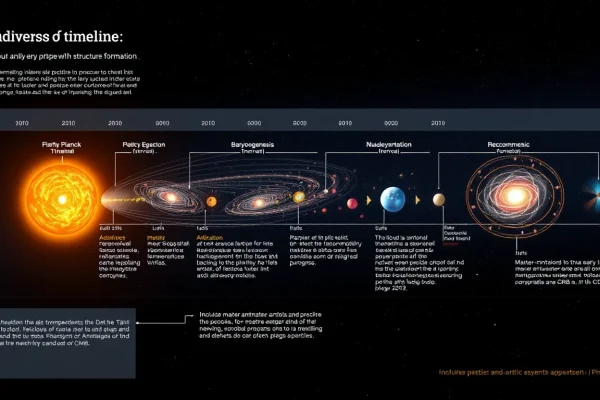
The universe is made almost entirely of matter, yet the Big Bang should have produced equal amounts of matter and antimatter. This article explores the baryon asymmetry problem, the cosmic epochs from the Planck era to structure formation, and the ongoing search for answers.

Read More →
How Did Electron-Positron Annihilation Shape the Early Universe?

How Did Electron-Positron Annihilation Shape the Early Universe?

October 16, 2026 | Early Universe | Earnest S. Carroll

Electron-positron annihilation was a pivotal event in the first second after the Big Bang, transferring entropy to photons and neutrinos, setting the stage for nucleosynthesis and the cosmic microwave background. This article explores its role in the cosmic timeline, from the lepton epoch to recombination.

Read More →
What Is the Quark–Gluon Plasma? A Cosmic Timeline from the Big Bang to Today

What Is the Quark–Gluon Plasma? A Cosmic Timeline from the Big Bang to Today

October 14, 2026 | Early Universe | Earnest S. Carroll

The quark–gluon plasma is the hottest, densest state of matter ever created, existing just after the Big Bang. This article explores its role in the universe’s evolution, from the Planck epoch to the formation of stars and galaxies, and how experiments like those at CERN recreate it.

Read More →
What Is Electroweak Symmetry Breaking? A Cosmic Timeline from Planck to Present

What Is Electroweak Symmetry Breaking? A Cosmic Timeline from Planck to Present

October 11, 2026 | Early Universe | Earnest S. Carroll

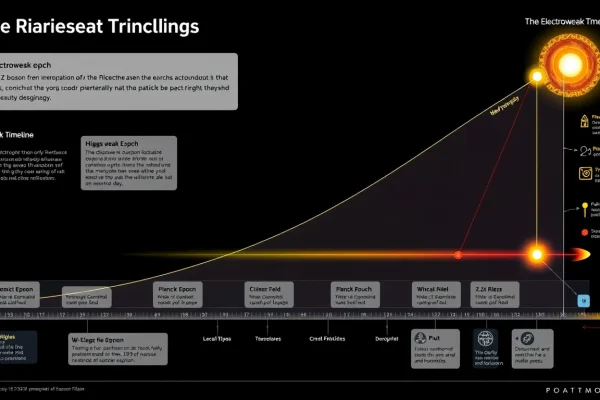
Explore the electroweak epoch, the Higgs mechanism, and the full cosmic timeline from the Planck epoch to structure formation. This definitive guide explains how the universe evolved, how particles gained mass, and what evidence supports our current model.

Read More →
What Is Baryogenesis? How Did Matter Win Over Antimatter?

What Is Baryogenesis? How Did Matter Win Over Antimatter?

October 9, 2026 | Early Universe | Earnest S. Carroll

Baryogenesis is the hypothetical process that generated the observed imbalance between matter and antimatter in the early universe. This article explains the Sakharov conditions, the leading scenarios, and how this asymmetry shaped the cosmic timeline from the Planck epoch to the formation of galaxies.

Read More →
What Is Baryogenesis? How Did Matter Come to Dominate Antimatter?

What Is Baryogenesis? How Did Matter Come to Dominate Antimatter?

October 9, 2026 | Early Universe | Earnest S. Carroll

Baryogenesis is the hypothesized process that created the observed excess of matter over antimatter in the early universe. This article explains the problem, Sakharov’s conditions, candidate mechanisms, and the cosmic timeline from the Planck epoch to structure formation.

Read More →
What Is Symmetry Breaking in the Early Universe?

What Is Symmetry Breaking in the Early Universe?

October 5, 2026 | Early Universe | Earnest S. Carroll

Symmetry breaking in the early universe describes how the unified forces of nature separated as the cosmos cooled, shaping the particles and structure we observe today. This article explores the key epochs from the Planck era to structure formation, the role of inflation, and the cosmic microwave background as a relic of that transformative time.

Read More →
What Are Pair-Instability Supernovae and How Did They Shape the Early Universe?

What Are Pair-Instability Supernovae and How Did They Shape the Early Universe?

October 2, 2026 | Early Universe | Earnest S. Carroll

Pair-instability supernovae are colossal explosions predicted to have occurred among the first-generation stars, known as Population III. These events may have enriched the early universe with heavy elements, influenced reionization, and left a unique observational signature that telescopes like JWST are now seeking.

Read More →
What Is the Spectral Index (n_s) in Cosmology?

What Is the Spectral Index (n_s) in Cosmology?

September 30, 2026 | Early Universe | Earnest S. Carroll

The scalar spectral index (n_s) quantifies how primordial density fluctuations vary with scale. A value of 1 indicates perfect scale invariance, while observations from Planck and earlier missions show n_s ≈ 0.96, a key confirmation of inflationary cosmology and a crucial input to the ΛCDM model.

Read More →

Posts pagination

1 2 3 4 Next →

About This Site

Recent Articles

  • What Role Did Dark Matter Halos Play in the Formation of the First Black Holes?
  • What Is the Lyman-Alpha Forest? Probing the Intergalactic Medium
  • What Is the Flatness Problem? Why the Universe Is So Close to Critical Density
  • Why Is There More Matter Than Antimatter in the Universe?
  • How Did Electron-Positron Annihilation Shape the Early Universe?
  • Home
  • Privacy Policy
  • About Us
  • Contact Us
  • Disclaimer
  • Terms of Service
© 2026 BigBangRegistry.com. All rights reserved. Powered by WordPress