
Short Answer
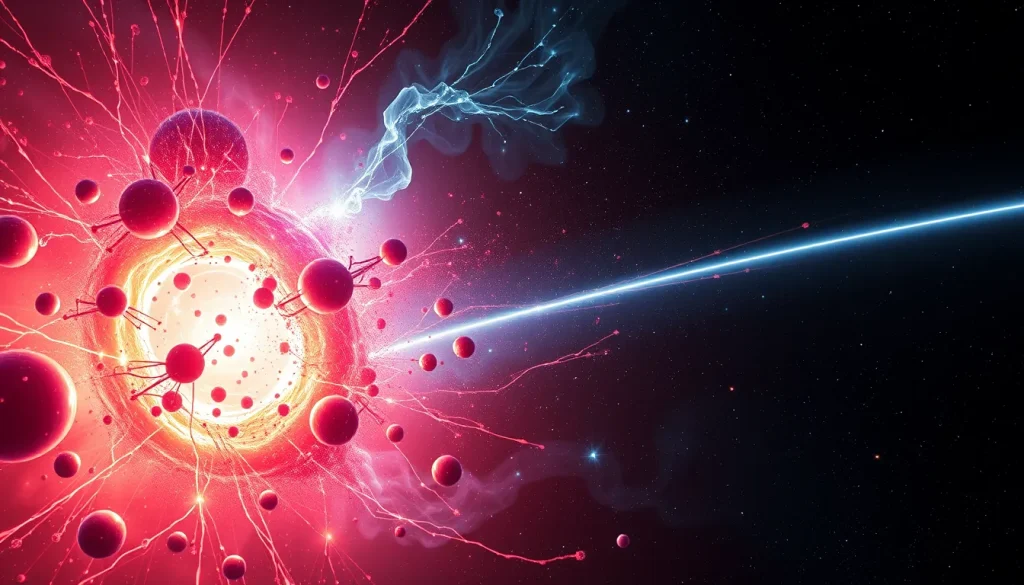
Short answer: Baryogenesis is the physical process that generated the observed excess of baryonic matter (protons and neutrons) over antibaryonic matter in the early universe, resulting in the matter-dominated cosmos we see today. It requires violation of baryon number conservation, C and CP violation, and departure from thermal equilibrium—the three Sakharov conditions.
| Property | Value |
|---|---|
| Also known as | Baryosynthesis |
| Definition | Process producing baryon–antibaryon asymmetry |
| Key conditions | Sakharov conditions (B violation, C/CP violation, out-of-equilibrium) |
| Observed asymmetry | ~1 excess baryon per 1.63 billion particles |
| Epoch | Electroweak epoch (or earlier, depending on model) |
| Outcome | Nonzero baryon number density in the observable universe |
Main Explanation
The universe began as a hot, dense, and nearly symmetric sea of particles. Yet today, we live in a cosmos overwhelmingly made of matter: stars, planets, and interstellar gas contain no significant antimatter. This asymmetry—the fact that baryons outnumber antibaryons by roughly one part in a billion—is one of the deepest puzzles in cosmology. Baryogenesis is the theoretical framework that explains how this imbalance arose during the first fractions of a second after the Big Bang.
To understand baryogenesis, we must place it within the standard cosmological timeline. The universe has gone through a series of distinct epochs, each governed by different physical laws and particle populations. The following table summarizes the major epochs from the Planck era to the present day.
| Epoch | Time after Big Bang | Temperature | Key Events |
|---|---|---|---|
| Planck epoch | < 10⁻⁴³ s | > 10³² K | Quantum gravity dominates; no known physics. |
| Grand Unification epoch | 10⁻⁴³ – 10⁻³⁶ s | 10³² – 10²⁸ K | GUT forces unify; possible baryogenesis via GUT bosons. |
| Inflationary epoch | 10⁻³⁶ – 10⁻³² s | ~10²⁸ K | Exponential expansion; seeds of structure created. |
| Electroweak epoch | 10⁻³² – 10⁻¹² s | 10²⁸ – 10¹⁵ K | Electromagnetic and weak forces separate; electroweak baryogenesis possible. |
| Quark epoch | 10⁻¹² – 10⁻⁶ s | 10¹⁵ – 10¹² K | Quarks and gluons form quark–gluon plasma. |
| Hadron epoch | 10⁻⁶ – 1 s | 10¹² – 10¹⁰ K | Quarks combine into hadrons; protons and neutrons form. |
| Lepton epoch | 1 – 10 s | 10¹⁰ – 10⁹ K | Leptons dominate; neutrinos decouple. |
| Photon epoch | 10 s – 380,000 yr | 10⁹ – 3,000 K | Photons dominate; Big Bang nucleosynthesis occurs. |
| Recombination | ~380,000 yr | ~3,000 K | Electrons combine with nuclei; CMB released. |
| Dark Ages | 380,000 – 150 million yr | 3,000 – 50 K | No luminous sources; hydrogen gas fills space. |
| Reionization | 150 million – 1 billion yr | ~50 – 10 K | First stars and galaxies ionize neutral hydrogen. |
| Structure Formation | 1 billion yr – present | < 10 K | Galaxies, clusters, and large-scale structure form. |
Baryogenesis likely occurred during the electroweak epoch (or possibly earlier during the Grand Unification epoch) when the universe was still hot enough for the relevant particle interactions. The observed asymmetry is tiny—about one extra baryon for every 1.63 billion particle–antiparticle pairs (HandWiki, 2026). This small surplus, frozen into the expanding universe, is what allowed matter to survive annihilation and eventually form atoms, stars, and galaxies.
Concept
Definition
Baryogenesis (also called baryosynthesis) is the hypothetical process that produces a nonzero baryon number density in the universe. In the standard model of particle physics, matter and antimatter are produced symmetrically, so baryogenesis requires physics beyond simple symmetric production.
How It Works
The Russian physicist Andrei Sakharov formulated three conditions necessary for baryogenesis (nLab, 2026):
- Baryon number violation: There must be interactions that change the number of baryons.
- C and CP violation: The laws of physics must treat particles and antiparticles differently, allowing matter to be favored.
- Departure from thermal equilibrium: The universe must not be in perfect thermal equilibrium, otherwise any asymmetry would be washed out.
In the standard model, baryon number is conserved classically, but quantum anomalies (the chiral anomaly) allow nonperturbative processes (sphalerons) that violate baryon number. However, the Standard Model’s CP violation is insufficient to produce the observed asymmetry, so new physics is required.
Equation
The divergence of the baryon current is not zero due to the axial anomaly. In traditional notation (nLab, 2026):
∂μjbμ = ∂μjLμ = nf (g²/32π² WαμνW̃αμν − g′²/32π² εμνρσFμνFρσ)
This equation shows that baryon number is not conserved in the presence of nonperturbative electroweak effects.
Example
A simple illustrative model: if a heavy particle decays into quarks and leptons with a slight preference for quarks over antiquarks (due to CP violation), and the decay occurs out of equilibrium, a net baryon excess can develop. This is analogous to the GUT baryogenesis scenario, where X bosons decay asymmetrically.
Observable Consequences
The most direct consequence is the baryon-to-photon ratio, η ≈ 6×10⁻¹⁰, measured from the cosmic microwave background (CMB) and Big Bang nucleosynthesis. The abundance of light elements (hydrogen, helium, lithium) depends on this ratio, and observations confirm a matter-dominated universe with no significant antimatter regions.
Common Misconceptions
- Baryogenesis created all matter from nothing: It created a tiny asymmetry; most matter and antimatter annihilated early on.
- It violates energy conservation: The process obeys all conservation laws except baryon number (which is violated).
- It happened during the Big Bang itself: It occurred a fraction of a second later, during the electroweak epoch or after inflation.
Why It Matters
Without baryogenesis, the universe would contain equal amounts of matter and antimatter, which would have annihilated almost completely, leaving a cosmos of photons and neutrinos with no atoms, stars, or life. The existence of galaxies and our own bodies depends on the tiny surplus of matter created during the first instants of cosmic history.
Evidence / Sources
The evidence for baryogenesis is indirect but compelling:
- The observed baryon-to-photon ratio from CMB measurements (e.g., Planck satellite) matches predictions from Big Bang nucleosynthesis.
- No significant antimatter regions have been found in the observable universe.
- The Sakharov conditions are satisfied in the Standard Model, but quantitatively insufficient, pointing to new physics.
- Missions like COBE, WMAP, and Planck have precisely measured the CMB, providing constraints on the asymmetry.
Related Registry Entries
Last Reviewed / Updated: September 5, 2026
FAQ
Why is there more matter than antimatter in the universe?
Baryogenesis is the proposed process that created a tiny excess of baryons over antibaryons in the early universe. If the asymmetry had been exactly zero, all matter would have annihilated with antimatter, leaving a universe with no atoms.
What are the Sakharov conditions?
They are three conditions required for baryogenesis: (1) baryon number violation, (2) C and CP violation, and (3) departure from thermal equilibrium. All three must be satisfied to generate a net baryon asymmetry.
When did baryogenesis occur?
The exact timing is uncertain, but it likely occurred during the electroweak epoch (around 10⁻¹² seconds after the Big Bang) or possibly earlier during the Grand Unification epoch. The conditions for baryogenesis existed only when the universe was extremely hot and dense.
How do we know baryogenesis happened?
We observe that the universe is made of matter with no significant antimatter regions. The baryon-to-photon ratio, measured from the cosmic microwave background and primordial element abundances, confirms a small but nonzero excess of baryons, which baryogenesis explains.
Leave a Reply