
Short Answer
Main Explanation
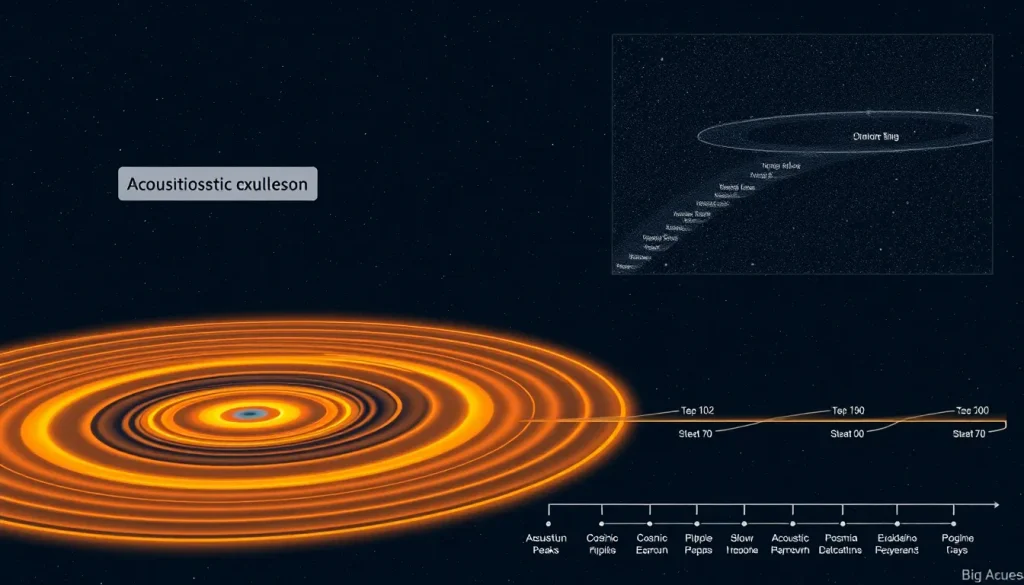
The sound horizon is a fundamental scale in cosmology, set by the physics of the early universe. It represents the maximum comoving distance that a pressure (sound) wave could have traveled through the hot, dense plasma of photons and baryons from the moment of the Big Bang until the epoch of recombination, when the universe became transparent. This distance is approximately 150 megaparsecs (about 500 million light-years) and is imprinted in the cosmic microwave background (CMB) as a series of acoustic peaks and in the distribution of galaxies as baryon acoustic oscillations (BAO).
The concept arises because the early universe was not perfectly uniform. Small quantum fluctuations, stretched to cosmic scales by inflation, created regions of slightly higher and lower density. In the dense plasma, gravity pulled matter inward while radiation pressure pushed it outward, setting up longitudinal oscillations—sound waves—in the photon-baryon fluid. These oscillations propagated outward from each initial overdensity until recombination, when photons decoupled from baryons and the waves froze into the CMB. The maximum distance a wave could travel by that moment is the sound horizon.
Because the sound horizon is a fixed physical scale at the last scattering surface, its apparent angular size today depends on the geometry and expansion history of the universe. Measuring this angle in the CMB power spectrum provides a powerful constraint on cosmological parameters such as the Hubble constant, the curvature of space, and the density of matter and dark energy.
Definition
The sound horizon is the comoving distance that a sound wave in the photon-baryon fluid could have traveled from the Big Bang to the recombination epoch. It is often denoted rs and is computed by integrating the sound speed cs over conformal time from the initial singularity to recombination:
rs = ∫₀trec cs(t) / a(t) dt
where a(t) is the scale factor. In the standard ΛCDM model, this yields about 150 Mpc (comoving) or roughly 500 million light-years.
How It Works
In the early universe, photons and baryons were tightly coupled through Thomson scattering, forming a single fluid. Dark matter, being collisionless, did not participate in the sound waves but provided gravitational potential wells. When a density perturbation compressed the fluid, radiation pressure increased and pushed back, causing the fluid to expand and rarefy. This oscillation—compression and rarefaction—propagated as a spherical wave at the local sound speed. The wave continued until recombination, when the drop in temperature allowed electrons and protons to form neutral hydrogen, and photons streamed freely. The last scattering of photons left a snapshot of the oscillations: regions where the fluid was compressed appear as slightly hotter spots in the CMB, while rarefied regions appear cooler.
Because the waves had a maximum distance to travel, there is a characteristic angular scale on the sky—the first acoustic peak—corresponding to the sound horizon. Higher-order peaks arise from harmonics of the fundamental oscillation. The relative heights of these peaks encode the baryon density and other parameters.
Equation
The sound speed in the pre-recombination plasma is approximately cs = c / √3(1 + 3ρb/4ργ)-1/2, where ρb and ργ are the baryon and photon energy densities. In the radiation-dominated era, the sound speed approaches c/√3. The comoving sound horizon is then:
rs = ∫₀ηrec cs(η) dη
where η is conformal time. The precise value depends on the expansion history and the baryon-to-photon ratio. In the standard model, rs ≈ 147–150 Mpc.
Example
To visualize the sound horizon, imagine dropping a pebble into a still pond. Ripples expand outward at a fixed speed. If the pond freezes after a few seconds, the largest ripple marks the maximum distance the wave traveled. In the early universe, the “pebbles” were density fluctuations, and the “freezing” occurred at recombination. The largest ripple—the sound horizon—is now observed as the first peak in the CMB angular power spectrum at a multipole of ℓ ≈ 220, corresponding to an angular scale of about 1 degree.
This scale also appears in the clustering of galaxies today as baryon acoustic oscillations—a slight excess of galaxies separated by roughly 150 Mpc. Measuring this scale at different redshifts allows cosmologists to trace the expansion history of the universe.
Observable Consequences
The sound horizon leaves two key observable imprints:
- CMB acoustic peaks: The angular position and heights of the peaks in the CMB power spectrum are directly related to the sound horizon and the geometry of the universe. The Planck mission measured these peaks with extraordinary precision, confirming the flat ΛCDM model.
- Baryon acoustic oscillations (BAO): After recombination, the sound waves left a shell of slightly enhanced baryon density at a radius equal to the sound horizon. This shell seeded the formation of galaxies and clusters, producing a characteristic correlation function with a bump at ~150 Mpc. Surveys like the Sloan Digital Sky Survey (SDSS) and the Dark Energy Spectroscopic Instrument (DESI) use BAO to measure dark energy.
Common Misconceptions
Sound horizon vs. particle horizon: The particle horizon is the maximum distance light could travel since the Big Bang, while the sound horizon is the distance sound (pressure waves) could travel. They are different because the sound speed is less than the speed of light, and the sound horizon is defined only up to recombination.
Sound horizon is not a physical boundary: It is not a wall or edge; it simply marks the maximum propagation distance of a particular type of wave. It is a scale, not a location.
It is not the same as the cosmic horizon: The cosmic horizon refers to the limit of observable universe due to the finite speed of light. The sound horizon is a smaller, fixed scale imprinted on the CMB and galaxy distribution.
Why It Matters
The sound horizon is a cornerstone of modern cosmology. It provides a standard ruler that, when compared with its observed angular size, reveals the geometry of the universe. The precise measurement of the acoustic peaks by COBE, WMAP, and Planck confirmed that the universe is spatially flat to within a percent, supporting the inflationary paradigm and the ΛCDM model.
Moreover, the sound horizon connects the early universe to the formation of structure. The acoustic oscillations seeded the large-scale distribution of matter. After recombination, the overdense regions (compressions) attracted dark matter and baryons, eventually forming the first stars and galaxies. The epoch table below summarizes the major phases of cosmic evolution, from the Planck epoch to the present:
| Epoch | Time after Big Bang | Redshift z | Key Events |
|---|---|---|---|
| Planck epoch | <10⁻⁴³ s | >10³² | Quantum gravity effects dominate; no known physics. |
| Grand unification epoch | 10⁻⁴³ – 10⁻³⁶ s | 10³² – 10²⁸ | Fundamental forces (except gravity) unify. |
| Inflationary epoch | 10⁻³⁶ – 10⁻³² s | ~10²⁸ | Exponential expansion; quantum fluctuations stretched to cosmic scales. |
| Electroweak epoch | 10⁻³² – 10⁻¹² s | 10²⁸ – 10¹⁵ | Unification of electromagnetic and weak forces; symmetry breaking. |
| Quark epoch | 10⁻¹² – 10⁻⁶ s | 10¹⁵ – 10¹² | Quarks and gluons form a quark-gluon plasma. |
| Hadron epoch | 10⁻⁶ – 1 s | 10¹² – 10¹⁰ | Protons and neutrons form; matter-antimatter annihilation. |
| Lepton epoch | 1 – 10 s | 10¹⁰ – 10⁹ | Electrons and positrons dominate; neutrinos decouple. |
| Photon epoch | 10 s – 380,000 yr | 10⁹ – 1100 | Photons dominate; nucleosynthesis creates light elements. |
| Recombination | ~380,000 yr | ~1100 | Electrons and protons combine to form neutral hydrogen; photons decouple → CMB. |
| Dark Ages | 380,000 yr – ~150 million yr | 1100 – ~20 | No luminous sources; universe filled with neutral hydrogen. |
| Reionization | ~150 million – 1 billion yr | 20 – 6 | First stars and galaxies ionize intergalactic hydrogen. |
| Structure formation | 1 billion yr – present | <6 | Galaxies, clusters, and large-scale structure emerge; dark energy accelerates expansion. |
The CMB, released at recombination, is the most direct relic of the sound horizon. Missions such as COBE (1989), WMAP (2001), and Planck (2009) mapped the CMB with increasing precision, revealing the acoustic peaks and confirming the predictions of the standard model. The James Webb Space Telescope (JWST) now probes the era of reionization and the first galaxies, connecting the early-universe physics to the large-scale structure we observe today.
Evidence / Sources
The concept of the sound horizon is firmly grounded in observations of the cosmic microwave background and the large-scale distribution of galaxies. Key evidence includes:
- The angular power spectrum of the CMB, measured by COBE, WMAP, and Planck, shows a series of acoustic peaks whose positions and heights match the predictions of ΛCDM with a sound horizon of ~150 Mpc.
- Baryon acoustic oscillations, detected in galaxy surveys such as SDSS and DESI, show a characteristic excess in the correlation function at a scale of ~150 Mpc, directly tracing the sound horizon at later times.
- The consistency of the sound horizon inferred from CMB and BAO measurements provides a stringent test of the standard cosmological model.
For further reading, see the sources listed in the References section below.
Related Registry Entries
FAQ
How is the sound horizon measured?
The sound horizon is measured indirectly by observing the acoustic peaks in the cosmic microwave background and the baryon acoustic oscillations in the galaxy distribution. The angular size of the first peak and the scale of BAO both encode the sound horizon, which is then compared with theoretical predictions to constrain cosmological parameters.
Why is the sound horizon about 150 Mpc?
The value arises from the physics of the early universe: the sound speed in the plasma (roughly c/√3) and the expansion history from the Big Bang to recombination (age ~380,000 years). Integrating the sound speed over conformal time gives approximately 150 Mpc in comoving units.
Does the sound horizon change with time?
The physical size of the sound horizon is fixed at recombination. However, its comoving scale remains constant as the universe expands, so it serves as a standard ruler. Its apparent angular size changes with the geometry and expansion rate, which is why measuring it at different redshifts probes cosmic evolution.
What is the difference between the sound horizon and the particle horizon?
The particle horizon is the maximum distance light (or any causal signal) could have traveled since the Big Bang, expanding at the speed of light. The sound horizon is the distance sound waves traveled, which is smaller because the sound speed is less than the speed of light and only defined up to recombination.
Leave a Reply