
Short Answer
Main Explanation
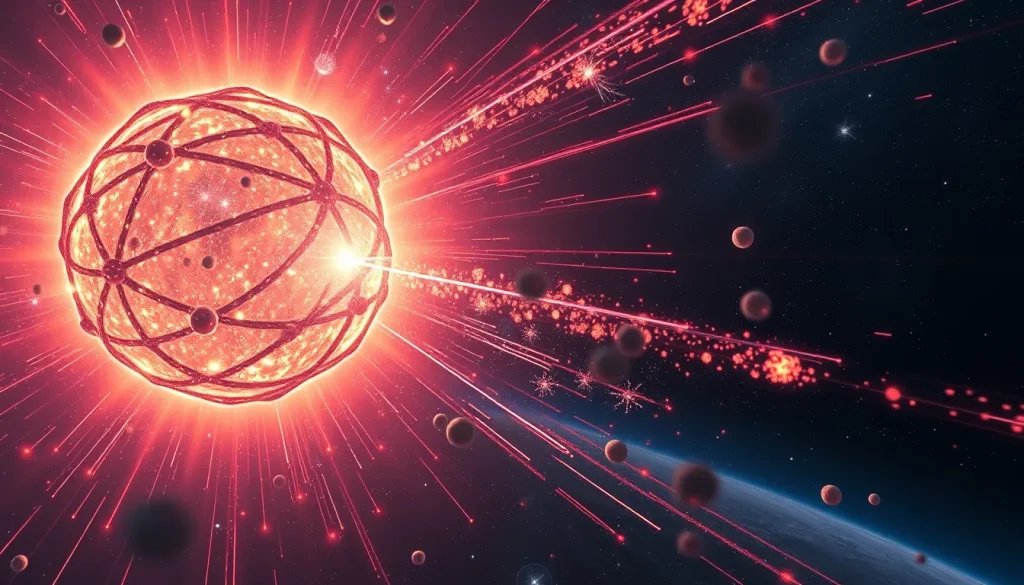
Baryogenesis is the hypothetical physical process that produced the observed asymmetry between baryonic matter and antibaryonic matter in the universe. In the standard Big Bang model, matter and antimatter should have been created in nearly equal amounts, yet today matter overwhelmingly dominates. This imbalance—sometimes called the baryon asymmetry—is one of the great unsolved mysteries in cosmology. The problem was first formalized by Andrei Sakharov in 1967, who identified three necessary conditions for any baryon-generating interaction.
Definition
Baryogenesis refers to the set of mechanisms that generate a net baryon number (the number of baryons minus antibaryons) in the early universe. The observed baryon-to-photon ratio is approximately 6 × 10⁻¹⁰, meaning that for every billion photons there is about one baryon. This tiny but crucial asymmetry allowed matter to survive annihilation with antimatter during the first fractions of a second after the Big Bang.
How It Works
According to Sakharov’s conditions, three ingredients are required for baryogenesis:
- Baryon number violation: Processes that change the number of baryons must exist, so that a net baryon number can be generated from an initially symmetric state.
- C and CP violation: Charge conjugation (C) and combined charge-parity (CP) symmetry must be violated, so that baryons and antibaryons are treated differently.
- Departure from thermal equilibrium: The universe must be out of equilibrium, so that the baryon-number-violating reactions do not simply run in reverse and erase the asymmetry.
In the Standard Model, baryon number is conserved in perturbation theory, but non-perturbative processes called sphalerons can violate baryon and lepton number at high temperatures. However, the Standard Model’s CP violation is too weak to explain the observed asymmetry, and the electroweak phase transition might not be strongly first-order as required. This motivates physics beyond the Standard Model.
The Cosmic Timeline and Baryogenesis
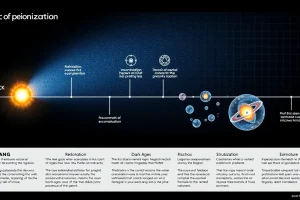
Baryogenesis likely occurred during the first moments of the universe, possibly during the electroweak epoch (around 10−12 seconds) or earlier during the Grand Unification epoch (around 10−36 seconds). The exact epoch depends on the specific model. Below is a timeline of the early universe’s key epochs:
| Epoch | Time after Big Bang | Temperature | Key Events |
|---|---|---|---|
| Planck epoch | < 10−43 s | > 1032 K | Quantum gravity effects dominate; no current theory. |
| Grand Unification epoch | 10−43 to 10−36 s | 1032 to 1028 K | GUT forces unify; possible baryogenesis via leptoquark decays. |
| Inflationary epoch | 10−36 to 10−32 s | Dropping rapidly | Exponential expansion; quantum fluctuations seeded structure. |
| Electroweak epoch | 10−12 to 10−6 s | 1016 to 1013 K | Electroweak symmetry breaking; sphalerons active; possible baryogenesis. |
| Quark epoch | 10−6 to 10−4 s | 1013 to 1012 K | Quarks and gluons form quark-gluon plasma. |
| Hadron epoch | 10−4 to 1 s | 1012 to 1010 K | Quarks combine into hadrons; baryon asymmetry fixed. |
| Lepton epoch | 1 to 10 s | 1010 to 109 K | Leptons and antileptons annihilate; neutrinos decouple. |
| Photon epoch | 10 s to 380,000 yr | 109 to 3000 K | Photons dominate; nucleosynthesis produces light elements. |
| Recombination | ~380,000 yr | ~3000 K | Electrons combine with nuclei; photons decouple – CMB released. |
| Dark Ages | 380,000 to ~150 million yr | 3000 to ~50 K | No stars yet; neutral hydrogen fills space. |
| Reionization | ~150 million to 1 billion yr | ~50 to 20 K | First stars and galaxies ionize hydrogen. |
| Structure Formation | 1 billion yr to present | 20 K to 2.725 K | Galaxies, clusters, and large-scale structure form. |
After baryogenesis, the asymmetry was frozen in once sphaleron processes became ineffective (around the electroweak scale). The subsequent evolution of the universe—nucleosynthesis, recombination, and structure formation—depended on this initial imbalance.
Observable Consequences
The baryon asymmetry is directly observable through:
- Cosmic Microwave Background (CMB): The temperature and polarization anisotropies of the CMB, measured by COBE, WMAP, and Planck, constrain the baryon density and thus the baryon-to-photon ratio.
- Big Bang Nucleosynthesis (BBN): The primordial abundances of helium-4, deuterium, and lithium depend on the baryon density; observations agree with the same baryon-to-photon ratio inferred from the CMB.
- Matter–antimatter annihilation: If the asymmetry were zero, matter and antimatter would have annihilated completely, leaving a universe of only photons and neutrinos. The existence of matter is direct evidence for baryogenesis.
Common Misconceptions
One common misconception is that baryogenesis created matter from nothing. In fact, the asymmetry is a tiny surplus of matter over antimatter—about one part in a billion. Another misconception is that the asymmetry is permanent; in reality, it could have been erased by sphaleron processes if the universe remained in equilibrium long enough. Finally, some think baryogenesis is a solved problem, but no definitive theory has been confirmed; the Standard Model alone cannot account for the observed asymmetry.
Why It Matters
The matter–antimatter asymmetry is a fundamental puzzle that connects particle physics, cosmology, and thermodynamics. Explaining baryogenesis would reveal physics beyond the Standard Model, such as new sources of CP violation or new particles at high energies. It also underpins our existence: without the asymmetry, the universe would contain no atoms, stars, or life. The problem is a key driver for experiments at the LHC, searches for electric dipole moments, and cosmological observations of the CMB and large-scale structure.
Evidence / Sources
The leading review of baryogenesis is the 2021 article by Bödeker and Buchmüller in Reviews of Modern Physics, which covers electroweak baryogenesis and leptogenesis. The Sakharov conditions are described in Wikipedia’s baryon asymmetry article. Additional evidence comes from measurements of the CMB by COBE, WMAP, and Planck, and from primordial nucleosynthesis calculations. The observed baryon-to-photon ratio is consistent across these independent probes.
Related Registry Entries
For further exploration, see the entries on Cosmic Inflation, Big Bang Nucleosynthesis, Cosmic Microwave Background, and Recombination and the Dark Ages in this encyclopedia.
FAQ
What is baryogenesis?
Baryogenesis is the process that generated the observed imbalance between matter and antimatter in the early universe. It requires baryon number violation, C and CP violation, and departure from thermal equilibrium, as first outlined by Sakharov in 1967.
Why is there more matter than antimatter?
The exact reason is unknown, but leading theories include electroweak baryogenesis (during the electroweak phase transition) and leptogenesis (where a lepton asymmetry is converted to a baryon asymmetry). The Standard Model alone cannot explain the observed asymmetry.
How do we know the baryon asymmetry exists?
We observe that the universe is made of matter, not antimatter. The baryon-to-photon ratio is inferred from Big Bang nucleosynthesis and the cosmic microwave background, both giving consistent values around 6 × 10⁻¹⁰.
What are the Sakharov conditions?
They are three necessary conditions for baryogenesis: (1) baryon number violation, (2) C and CP violation, and (3) departure from thermal equilibrium. These allow a net baryon number to be generated from an initially symmetric state.
Leave a Reply