
Short Answer
Main Explanation
Redshift is a fundamental tool in cosmology. As space expands, light from distant objects is stretched to longer wavelengths, shifting toward the red end of the spectrum. The redshift z measures how much expansion has occurred since the light was emitted. For a given epoch, a higher z means earlier in cosmic history. The Epoch of Reionization is defined by the reionization of hydrogen in the intergalactic medium (IGM) — the last major phase transition of the universe.
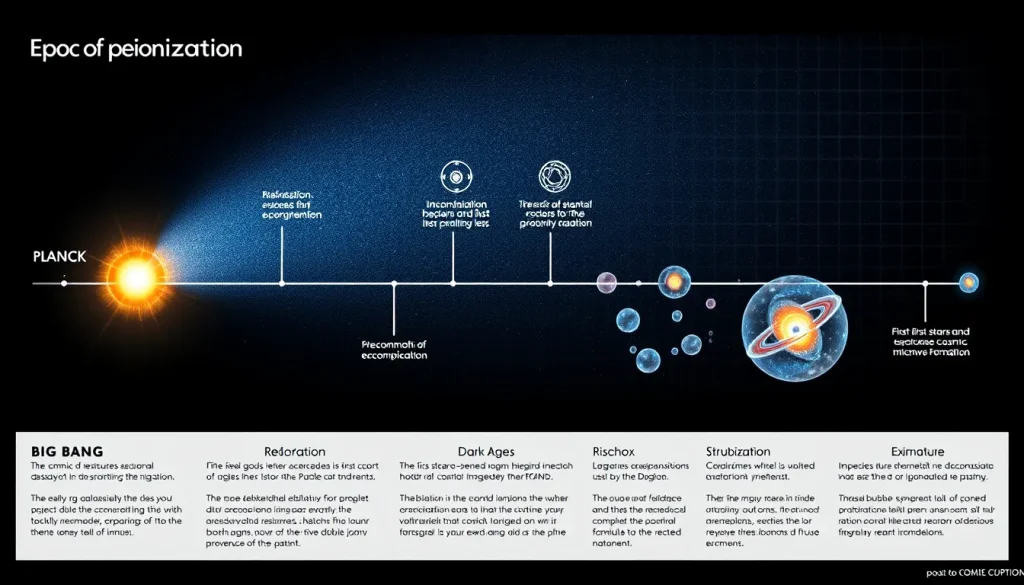
After the Big Bang, the universe was a hot, dense plasma. About 380,000 years later, during recombination, electrons and protons combined to form neutral hydrogen, releasing the cosmic microwave background (CMB). The universe entered the Cosmic Dark Ages, with no luminous sources. Gravity slowly amplified density fluctuations, and around 100–500 million years after the Big Bang, the first stars and galaxies formed. These objects emitted intense ultraviolet radiation, which gradually ionized the surrounding neutral hydrogen, turning the IGM from opaque to transparent. This process is called reionization.
The redshift of reionization is not a single instant but a range, because the process was patchy and extended. Observations of high-redshift quasars show that by z ≈ 6, the IGM was almost fully ionized, while at z > 10 it was mostly neutral. The midpoint — when half the hydrogen was reionized — is often quoted as z ≈ 7–8. The exact value depends on the sources of ionizing photons and the clumpiness of the IGM.
The Epoch of Reionization in Cosmic Context
When It Happened
Reionization began with the formation of the first stars (Population III) around z ≈ 20–30 and ended around z ≈ 5–6, with the midpoint near z ≈ 7–8. The Sloan Digital Sky Survey quasars at z > 6 show a sharp increase in Lyα absorption, indicating the tail end of reionization.
Temperature
The IGM during reionization was heated to ~104 K by the photoionization of hydrogen. After reionization, the IGM remained highly ionized and warm.
Approximate Redshift
The characteristic redshift of reionization is z ≈ 6.2 from the analysis of quasar Lyα transmission (Gnedin 2001), though the process spans z ≈ 6–10. The Planck satellite measurements of CMB optical depth suggest a reionization redshift of z ≈ 7.8 ± 0.7 (when combined with other data).
Dominant Particles and Physics
The universe was dominated by dark matter, baryons, and radiation. The key physics involved gravitational collapse of dark matter halos, star formation, and the emission of ionizing photons (mostly from massive stars). The escape fraction of these photons from galaxies and the clumping factor of the IGM are critical parameters.
What Happened
First stars and galaxies formed, emitting UV photons that ionized hydrogen. Ionized bubbles grew and overlapped, eventually filling the entire IGM with ionized gas. This ended the Dark Ages and made the universe transparent to Lyα radiation, allowing later galaxies to be observed.
What Came Before
Before reionization was the Cosmic Dark Ages (z ≈ 30 to 20), when the universe was neutral and dark, except for the CMB and the 21-cm line of neutral hydrogen.
What Came Next
After reionization, the universe continued to form galaxies and large-scale structure. The IGM remained ionized, and the first quasars and massive galaxies assembled, leading to the universe we observe today.
Evidence
Key evidence includes: (1) The Gunn-Peterson trough in quasar spectra at z > 6, indicating neutral hydrogen absorption. (2) The optical depth to electron scattering of the CMB, measured by WMAP and Planck, which constrains the integrated ionization history. (3) The 21-cm signal from neutral hydrogen, which is being probed by arrays like LOFAR and HERA. (4) Observations of high-redshift galaxies by JWST that show ionizing photon production.
Why It Matters
The redshift of reionization is a key marker in cosmic history. It tells us when the first stars and galaxies formed, how they interacted with the intergalactic medium, and how the universe became transparent. It also affects measurements of the CMB and the growth of large-scale structure. Understanding reionization helps constrain the physics of early star formation, the escape of ionizing radiation, and the properties of dark matter halos. It is a bridge between the simple early universe and the complex cosmos we see today.
Evidence / Sources
The primary evidence for the redshift of reionization comes from spectroscopy of high-redshift quasars and the CMB. The Sloan Digital Sky Survey discovered quasars at z > 6, showing a dramatic increase in Lyα absorption (Becker et al. 2001). Gnedin (2001) compared these observations with simulations to derive z_REI = 6.2 ± 0.1 ± 0.2. Subsequent analyses, including those by the Planck collaboration, have refined the constraints. For a comprehensive review, see the Annual Review article by Xiaohui Fan et al. (2006) and the A&A paper by Choudhury et al. (2018).
Related Registry Entries
- Cosmic Microwave Background
- Recombination
- Dark Ages
- First Stars & Galaxies
- Structure Formation
FAQ
What is the exact redshift of the Epoch of Reionization?
There is no single exact redshift; reionization was a gradual process. Observations suggest it lasted from about z ≈ 10 to z ≈ 6, with a midpoint near z ≈ 7–8. Early estimates from quasar spectra gave z ≈ 6.2.
How is the redshift of reionization measured?
It is measured through the Lyα absorption in quasar spectra (Gunn-Peterson effect), the optical depth to electron scattering of the CMB, and the 21-cm signal from neutral hydrogen. These probes constrain the ionization state of the IGM.
Why is reionization important for cosmology?
Reionization marks the end of the Dark Ages and the emergence of the first luminous sources. It affects the ionization state of the IGM, influences galaxy formation, and leaves imprints on the CMB and large-scale structure.
What role did JWST play in studying reionization?
JWST has detected galaxies at z > 10 that are likely responsible for reionization, providing direct observations of the sources that ionized the universe. It also studies the escape of ionizing photons from these galaxies.
Leave a Reply