
Short Answer
Main Explanation
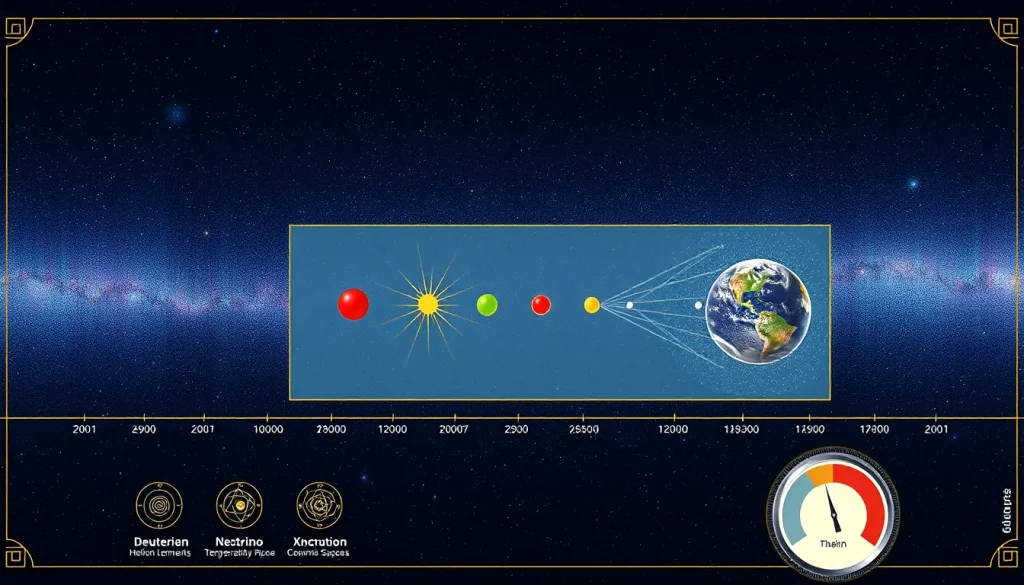
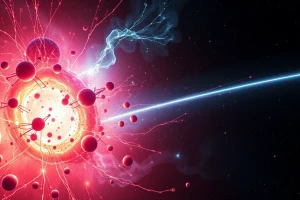
Big Bang Nucleosynthesis (BBN) is the process by which the lightest elements—deuterium, helium-3, helium-4, and lithium-7—were synthesized during the first three minutes after the Big Bang. This epoch, occurring when the Universe was about one second old and had a temperature near 1 MeV, is one of the most reliable probes of the early cosmos because it relies on well-understood Standard Model physics. BBN predictions agree with observed primordial abundances across nine orders of magnitude, from helium-4 at about 8% by number to lithium-7 at about 10−10. This remarkable agreement validates the standard hot Big Bang model and provides stringent constraints on new physics beyond the Standard Model, including the number of neutrino species.
The number of neutrino species influences BBN through the expansion rate of the Universe. During the radiation-dominated era, the total energy density includes photons, electrons, positrons, and neutrinos. If there are more neutrino species (or other relativistic particles), the energy density increases, causing the Universe to expand faster. A faster expansion rate means neutrons and protons drop out of weak equilibrium earlier, leaving a higher neutron-to-proton ratio. Since nearly all neutrons end up in helium-4, a higher neutron fraction leads to a larger primordial helium mass fraction (Yp). Thus, by measuring the primordial helium abundance, we can infer the effective number of relativistic species, conventionally denoted Neff. In the Standard Model, Neff = 3.046, which accounts for three neutrino flavors plus small corrections from neutrino decoupling and QED effects.
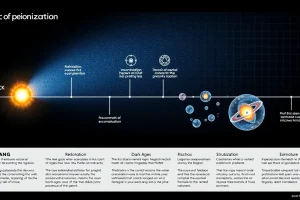
The cosmic timeline from the Planck epoch to the present day provides essential context for BBN. The table below summarizes the major epochs and their key features.
| Epoch | Time | Temperature | Key Physics |
|---|---|---|---|
| Planck epoch | < 10−43 s | > 1032 K | Quantum gravity effects dominate |
| Grand Unification epoch | 10−43 – 10−36 s | 1027 – 1032 K | Strong and electroweak forces unify |
| Inflationary epoch | 10−36 – 10−32 s | Dropping rapidly | Exponential expansion, seeds for structure |
| Electroweak epoch | 10−12 – 10−6 s | 1015 – 1016 K | Electromagnetic and weak forces separate |
| Quark epoch | 10−6 – 10−4 s | 1012 – 1015 K | Quarks and gluons form quark-gluon plasma |
| Hadron epoch | 10−4 – 1 s | 1010 – 1012 K | Protons and neutrons form |
| Lepton epoch | 1 – 10 s | 109 – 1010 K | Neutrinos decouple, electron-positron annihilation |
| Photon epoch | 10 s – 380,000 yr | 104 – 109 K | Photons dominate, BBN occurs |
| Recombination | ~380,000 yr | ~3000 K | First atoms form, CMB released |
| Dark Ages | 380,000 yr – ~150 million yr | Cooling | No stars yet, neutral hydrogen |
| Reionization | ~150 million – 1 billion yr | Warming | First stars and galaxies ionize hydrogen |
| Structure Formation | 1 billion yr – present | Cooling | Galaxies, clusters, large-scale structure |
The cosmic microwave background (CMB) is a relic of the photon epoch, released at recombination. Observations from COBE, WMAP, and Planck have measured the CMB with exquisite precision, confirming the predictions of BBN and providing independent constraints on Neff through the damping tail of the power spectrum. The James Webb Space Telescope (JWST) now probes the epoch of reionization, offering clues about the first stars and galaxies.
What We Know
We know that BBN occurred between roughly 1 second and 3 minutes after the Big Bang, when the temperature fell from about 1 MeV to 0.1 MeV. At these temperatures, weak interactions interconverted neutrons and protons, but as the Universe cooled, these reactions froze out. The neutron-to-proton ratio at freeze-out determines the helium abundance. The observed primordial helium mass fraction is Yp ≈ 0.245, which matches the Standard Model prediction for Neff ≈ 3. The deuterium abundance provides a sensitive baryometer, fixing the baryon-to-photon ratio η, and together with helium-4 gives a consistent picture. The CMB from Planck independently measures η and Neff, and the two probes agree, reinforcing the standard cosmological model.
What We Don’t Know
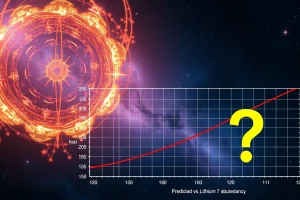
Despite the agreement, there are open questions. The primordial lithium-7 abundance predicted by BBN is about a factor of 2–3 higher than observed in old stars, a discrepancy known as the “lithium problem.” This could indicate new physics (e.g., decaying particles) or systematic uncertainties in stellar abundance measurements. Also, while Neff is consistent with 3, the current uncertainties allow for a range of about 2.5 to 3.5, leaving room for extra relativistic species such as sterile neutrinos or axions. The exact value of Neff at the 1% level remains a target for future experiments.
Evidence
The primary evidence comes from measurements of primordial light element abundances. Helium-4 is measured in low-metallicity extragalactic H II regions, giving Yp = 0.245 ± 0.003. Deuterium is measured in high-redshift quasar absorption systems, yielding D/H ≈ 2.5 × 10⁻⁵. These measurements, combined with BBN theory, constrain η and Neff. The CMB power spectrum from Planck provides an independent measurement of Neff = 2.99 ± 0.17, consistent with the BBN value. The agreement between BBN and CMB is a powerful confirmation of the standard model of cosmology.
Competing Explanations
If Neff were significantly larger than 3, it would imply the existence of additional relativistic particles. Candidates include sterile neutrinos, axions, or other dark radiation. However, the current data do not require such extensions. The lithium problem might be resolved by stellar physics (e.g., atomic diffusion, turbulent mixing) or by new physics that alters BBN, such as a time-varying fundamental constant or the decay of a massive particle. None of these alternatives are currently favored over the standard model, but they remain active areas of research.
Current Research
Ongoing and future experiments aim to improve the precision of primordial abundance measurements and CMB observations. The Simons Observatory and CMB-S4 will measure the CMB polarization and damping tail to pin down Neff to better than 1%. The James Webb Space Telescope is probing the epoch of reionization, which can indirectly constrain the helium abundance in the early Universe. Additionally, new theoretical calculations of BBN including higher-order corrections are being refined. These efforts will either confirm the Standard Model or reveal hints of new physics beyond it.
Why It Matters
Understanding how BBN constrains the number of neutrino species is not just a historical curiosity; it is a cornerstone of modern cosmology. It provides a direct test of the Standard Model of particle physics at energies far above those accessible to accelerators, and it constrains the properties of dark radiation and other exotic particles. The consistency between BBN and CMB measurements validates the ΛCDM model, while any deviation would signal new physics. As precision improves, BBN remains a powerful tool to probe the first moments of the Universe.
Evidence / Sources
The scientific basis for this article is drawn from the Particle Data Group review on Big Bang Nucleosynthesis (Fields, Molaro, & Sarkar, 2025), which summarizes the theoretical framework and observational data. Additional constraints and discussions of beyond-standard-model neutrino physics are provided by Kirilova et al. (2024) and Olive & Steigman (1995). These sources are cited in the references below.
Related Registry Entries
For further exploration, see the entries on Big Bang Nucleosynthesis, Cosmic Microwave Background, Inflation, and the Planck Mission in this encyclopedia.
FAQ
Why does the number of neutrino species affect Big Bang Nucleosynthesis?
The expansion rate during BBN depends on the total energy density. More neutrino species (or other relativistic particles) increase the energy density, making the Universe expand faster. This causes weak interactions to freeze out earlier, leaving a higher neutron-to-proton ratio, which leads to more helium-4 being produced.
What is the measured value of N_eff from BBN and CMB?
BBN observations of helium and deuterium give N_eff consistent with the Standard Model value of 3.046. The Planck CMB mission independently measures N_eff = 2.99 ± 0.17, in excellent agreement with BBN and the Standard Model.
Could there be more than three neutrino species?
The current data allow for a small range of N_eff values, but they are consistent with three neutrino flavors. If N_eff were significantly larger, it would indicate new physics such as sterile neutrinos or other dark radiation. No such evidence exists yet, but future precision measurements may reveal deviations.
Leave a Reply