
Short Answer
Main Explanation
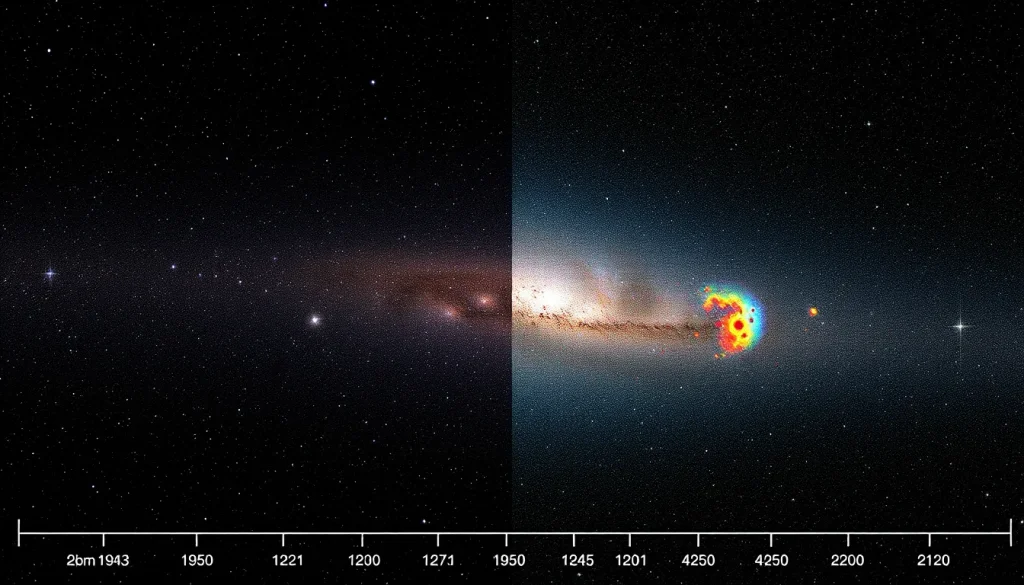
The 21-centimeter line, also known as the hydrogen line, is a spectral line emitted by neutral hydrogen atoms when the electron’s spin flips relative to the proton’s spin. This radiation, with a frequency of 1420.405 MHz and a wavelength of about 21.1 cm in vacuum, penetrates dust clouds and allows astronomers to map the distribution of cold neutral hydrogen across the cosmos. More than just a galactic tracer, the 21-cm line is a key probe of the early universe, promising to reveal the cosmic Dark Ages and the first stars and galaxies.
Definition
The 21-cm line arises from the hyperfine splitting of the ground state (1s) of hydrogen. The proton and electron each possess intrinsic spin. When the spins are antiparallel, the atom is in its lowest energy state; when parallel, it is slightly higher. The transition from the parallel to the antiparallel state releases a photon with energy equivalent to 5.87 micro-electronvolts, corresponding to a wavelength of 21.106 cm and a frequency of 1.42 GHz (Britannica; Wikipedia).
How It Works
In the ground state of hydrogen, the interaction between the electron’s and proton’s magnetic moments splits the energy level into two hyperfine levels. The upper level (spins parallel) has slightly higher energy than the lower level (spins antiparallel). Collisions with other atoms or electrons can excite hydrogen to the upper state; when it decays back, it emits a photon at 1420 MHz. This transition is extremely rare—a typical hydrogen atom may go thousands of years before emitting such a photon—but the sheer abundance of hydrogen in the universe makes the line observable.
Equation
The photon energy is given by the Planck–Einstein relation: E = hν, where h is the Planck constant and ν is the frequency. For the 21-cm line, ν = 1420.405751768 MHz, so E = 5.874326184 μeV (Wikipedia). The precise frequency is known to better than one part in 10^12, making it an excellent standard for precision measurements.
Example
In our own galaxy, the 21-cm line has been used to map the spiral structure of the Milky Way. Because radio waves penetrate dust, the 21-cm emission reveals hydrogen clouds that are invisible in visible light. This mapping, pioneered in the 1950s, gave astronomers one of the first complete pictures of our galaxy’s structure (HyperPhysics).
Observable Consequences
Beyond the Milky Way, the 21-cm line is a cosmological probe. The redshifted 21-cm signal from neutral hydrogen in the early universe can be used to study the epoch of reionization, when the first stars and galaxies ionized the intergalactic medium. Observatories like the Hydrogen Epoch of Reionization Array (HERA) and the Square Kilometre Array (SKA) are currently searching for this signal. The 21-cm line also offers a way to map the large-scale structure of the universe at high redshifts, complementing cosmic microwave background (CMB) observations.
Common Misconceptions
One misconception is that the 21-cm line comes from ionized hydrogen. In fact, it requires neutral hydrogen—ionized hydrogen (H II) does not emit this line. Another is that the line is a strong emission; in reality, it is extremely faint, which is why sensitive radio telescopes are needed. Finally, the 21-cm line is not the same as the 21-cm radiation from the cosmic microwave background—the CMB is a thermal blackbody spectrum, while the 21-cm line is a discrete spectral line.
Cosmic Epochs: From Planck to Structure Formation
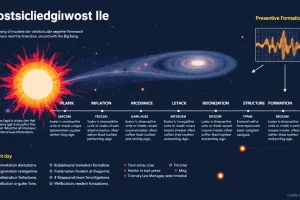
The 21-cm line is intimately connected to the evolution of the universe. The standard cosmological model (ΛCDM) describes a sequence of epochs that shaped the cosmos. The table below summarizes the major epochs, their times, redshifts, and dominant physics.
| Epoch | Time after Big Bang | Redshift (z) | Key Events |
|---|---|---|---|
| Planck epoch | 0 to 10^-43 s | ∞ | Quantum gravity effects dominate; no known physics. |
| Grand Unification epoch | 10^-43 to 10^-36 s | ~10^32 | Strong, weak, and electromagnetic forces unify; inflation begins. |
| Inflationary epoch | 10^-36 to 10^-32 s | ~10^28 | Exponential expansion; quantum fluctuations seeded large-scale structure. |
| Electroweak epoch | 10^-32 to 10^-12 s | ~10^15 | Electromagnetic and weak forces separate; W/Z bosons acquire mass. |
| Quark epoch | 10^-12 to 10^-6 s | ~10^12 | Quarks and gluons form quark-gluon plasma. |
| Hadron epoch | 10^-6 to 1 s | ~10^10 | Quarks combine into protons and neutrons; baryogenesis. |
| Lepton epoch | 1 to 10 s | ~10^9 | Leptons dominate; neutrinos decouple. |
| Photon epoch | 10 s to 380,000 yr | ~10^9 to 1100 | Photons dominate; nucleosynthesis (BBN) produces light elements. |
| Recombination | ~380,000 yr | ~1100 | Electrons combine with protons to form neutral hydrogen; CMB released. |
| Dark Ages | 380,000 yr to ~150 million yr | 1100 to ~20 | No stars yet; neutral hydrogen fills the universe; 21-cm signal from this era is a key target. |
| Reionization | ~150 million to ~1 billion yr | 20 to 6 | First stars and galaxies ionize the intergalactic medium; 21-cm signal fades. |
| Structure Formation | ~1 billion yr to present | 6 to 0 | Galaxies cluster; dark energy accelerates expansion; present-day universe. |
The 21-cm line is particularly valuable for probing the Dark Ages and Reionization. During the Dark Ages, before the first stars formed, the universe was filled with neutral hydrogen. The 21-cm signal from that era, redshifted to low frequencies, can reveal the density fluctuations that later seeded galaxies. During Reionization, the 21-cm signal becomes patchy as ionized bubbles grow around the first sources of light.
The cosmic microwave background (CMB) is a separate but complementary relic of the early universe. Emitted at recombination, the CMB provides a snapshot of the universe when it was ~380,000 years old. Missions like COBE, WMAP, and Planck have mapped the CMB’s temperature fluctuations with exquisite precision, confirming the predictions of inflation and ΛCDM. The James Webb Space Telescope (JWST) is now observing the first galaxies, bridging the gap between the CMB and the present-day universe.
FAQ
Why is the 21-cm line important for cosmology?
The 21-cm line allows astronomers to map neutral hydrogen at high redshifts, providing a direct probe of the Dark Ages and the epoch of reionization. It can reveal the density fluctuations that seeded galaxy formation and the timing of the first stars and galaxies.
How does the 21-cm line penetrate dust?
Radio waves have long wavelengths that are not scattered or absorbed by interstellar dust, unlike visible light. Therefore, the 21-cm emission can pass through dusty regions, giving a complete view of hydrogen in the Milky Way and other galaxies.
What is the spin-flip transition?
In a hydrogen atom, the electron and proton have intrinsic spins. When the spins are parallel, the atom is in a slightly higher energy state than when they are antiparallel. The transition from parallel to antiparallel releases a photon with a wavelength of 21 cm.
Can the 21-cm line be observed from the ground?
Yes, the 21-cm line lies in the radio spectrum, and many ground-based radio telescopes observe it. However, the cosmological signal from the early universe is extremely faint and redshifted to lower frequencies, requiring highly sensitive arrays and careful foreground subtraction.

Leave a Reply