
Short Answer
Short Answer: The flatness problem is the puzzling observation that the density of the universe is extremely close to the critical density (Ω ≈ 1), making space nearly flat. In the standard Big Bang model, any tiny deviation from flatness would grow over time, so the early universe must have been fine-tuned to an extraordinary degree—within 1 part in 1057 at the Planck time. Cosmic inflation, a period of exponential expansion in the first fraction of a second, naturally explains this flatness by stretching any initial curvature to near-zero.
| Property | Value / Fact |
|---|---|
| Full name | Flatness problem (also known as the oldness problem) |
| Category | Cosmological fine-tuning problem |
| Key parameter | Density parameter Ω (Ω = ρ/ρc) |
| Observed value | Ω0 ≈ 1 (within 0.001 from Planck 2018) |
| Required precision at Planck time | Ω within 1 part in 1057 of 1 |
| Proposed solution | Cosmic inflation (Alan Guth, 1981) |
| Key missions | COBE, WMAP, Planck |
| Consensus model | ΛCDM (Lambda-Cold Dark Matter) |
Main Explanation
Definition
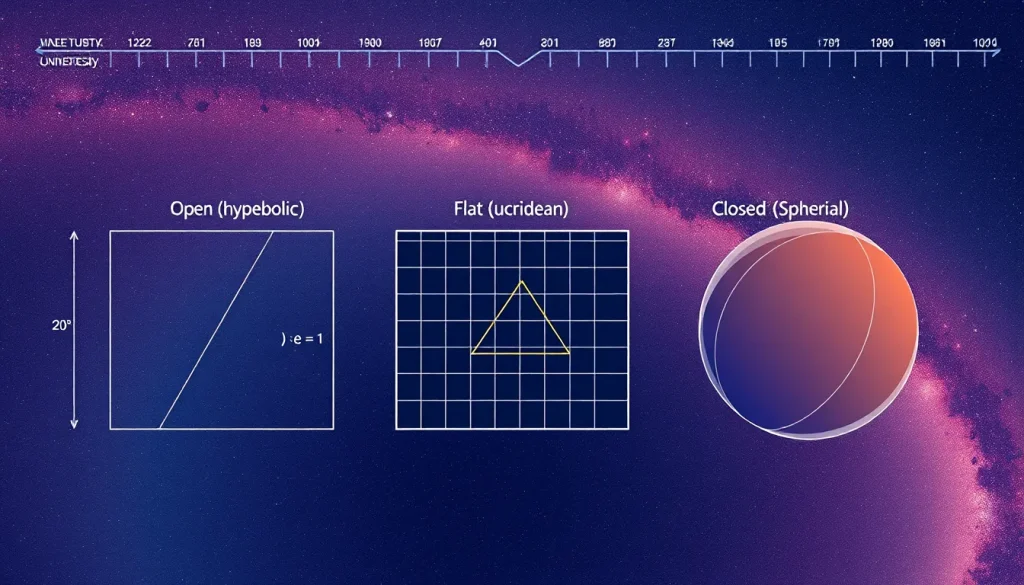
The flatness problem arises because the geometry of the universe—whether it is open, closed, or flat—depends on the density parameter Ω, the ratio of the actual density to the critical density. If Ω > 1, space is positively curved (closed); if Ω < 1, it is negatively curved (open); if Ω = 1 exactly, space is flat. Measurements from the cosmic microwave background (CMB) and large-scale structure show that Ω0 is very close to 1, meaning our universe is spatially flat to within a few percent. This flies in the face of the natural expectation that Ω should drift away from 1 over cosmic time.
How It Works
In standard Friedmann cosmology, the curvature term in the Friedmann equation evolves as the universe expands. If Ω is not exactly 1, the deviation grows with time. Specifically, |Ω – 1| ∝ a2 during radiation domination and ∝ a during matter domination, where a is the scale factor. Since the universe has expanded by a factor of ~1028 since the Planck time, any initial deviation would be amplified enormously. To observe Ω ≈ 1 today, the early universe must have been fine-tuned to an absurd precision—within 1 part in 1057 at the Planck time (10-43 s after the Big Bang). This seems like an extraordinary coincidence, hence the term “problem.”
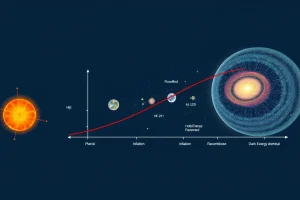
Cosmic inflation, proposed by Alan Guth in 1981, solves this by postulating a period of exponential expansion driven by a hypothetical inflaton field. During inflation, the scale factor grew by at least a factor of e60 (~1026), which would have driven any initial curvature to near zero, just as inflating a balloon makes its surface locally flat. After inflation, the universe is left with Ω extremely close to 1, and subsequent evolution preserves that near-flatness because the curvature term is negligible compared to matter and radiation.
Cosmic Epochs and the Flatness Problem
To understand the flatness problem, it helps to place it within the broader history of the universe. The table below outlines the major epochs from the Planck epoch to the present day, showing how each phase connects to the density parameter and the evolution of structure.
| Epoch | Time after Big Bang | Approx. Temperature | Redshift (z) | Key Events |
|---|---|---|---|---|
| Planck epoch | < 10-43 s | > 1032 K | — | Quantum gravity effects dominate; classical physics breaks down. |
| Grand Unification epoch | 10-43 to 10-36 s | 1028 – 1032 K | — | Strong and electroweak forces unify; inflation likely begins near the end. |
| Inflationary epoch | 10-36 to 10-32 s | Dropping rapidly | — | Exponential expansion stretches universe, flattening space and diluting monopoles. |
| Electroweak epoch | 10-32 to 10-12 s | 1015 – 1028 K | — | Electromagnetic and weak forces separate; quarks and leptons acquire mass. |
| Quark epoch | 10-12 to 10-6 s | 1012 – 1015 K | — | Quarks, gluons, and leptons form a quark-gluon plasma. |
| Hadron epoch | 10-6 to 1 s | 1010 – 1012 K | — | Quarks combine into hadrons (protons, neutrons); matter-antimatter asymmetry emerges. |
| Lepton epoch | 1 s to 10 s | 109 – 1010 K | — | Leptons dominate; neutrinos decouple; electron-positron annihilation. |
| Photon epoch | 10 s to 380,000 yr | 3000 – 109 K | z ~ 1090 | Photons dominate; Big Bang nucleosynthesis creates light elements (H, He, Li). |
| Recombination | ~380,000 yr | ~3000 K | z ~ 1090 | Electrons combine with nuclei to form neutral atoms; CMB released. |
| Dark Ages | 380,000 yr – 150 million yr | ~3000 K down to ~50 K | z ~ 20–1090 | No stars yet; neutral hydrogen fills the universe; gravity slowly amplifies density fluctuations. |
| Reionization | ~150 million – 1 billion yr | ~50 K – 10 K | z ~ 6–20 | First stars and quasars ionize neutral hydrogen; universe becomes transparent again. |
| Structure Formation | 1 billion yr – present | ~2.7 K (today) | z = 0 – 6 | Galaxies, clusters, and large-scale structure form under gravity; dark energy accelerates expansion. |
Equation
The Friedmann equation can be written as:
H2 = (8πG/3)ρ – k/a2
where H is the Hubble parameter, G is Newton’s constant, ρ is the energy density, k is the spatial curvature (0 for flat, ±1 for open/closed), and a is the scale factor. The density parameter is Ω = ρ/ρc, with ρc = 3H2/8πG. The evolution of Ω is given by:
|Ω – 1| = |k| / (a2H2)
Since aH grows with time in a decelerating universe, |Ω – 1| must have been extremely small in the past to remain small today.
Example
Imagine standing on a tightrope. If you start perfectly balanced, you can stay upright, but any tiny deviation grows as you continue. To still be balanced after an hour, your initial position must have been adjusted to an absurdly precise degree. Similarly, the universe’s density parameter Ω must have been set to within 1 part in 1057 at the Planck time to be near 1 today—a fine-tuning that inflation naturally explains by “flattening” the rope.
Observable Consequences
The flatness of the universe has direct observational consequences:
- The cosmic microwave background temperature anisotropies are consistent with a flat geometry (the first acoustic peak in the CMB power spectrum appears at the scale expected for Ω=1).
- Large-scale structure surveys (e.g., BAO measurements) constrain Ω0 to 1.002 ± 0.003 (Planck 2018).
- Combined with dark energy, the flat ΛCDM model fits supernova distances, CMB, and galaxy clustering.
Common Misconceptions
Misconception 1: “Flat” means the universe is two-dimensional. Actually, flatness refers to the geometry of space being Euclidean—parallel lines never meet, and the angles of triangles sum to 180°—but the universe still has three spatial dimensions (plus time).
Misconception 2: The flatness problem is solved by the universe being exactly critical density by chance. Inflation provides a mechanism, not a coincidence.
Misconception 3: The universe is flat because it is infinite. Flatness and finiteness are separate: a flat universe can be finite (e.g., a 3-torus) or infinite.
Why It Matters
The flatness problem is not just an abstract puzzle—it reveals a deep connection between the initial conditions of the universe and the physics of the very early universe. If inflation is correct, it implies that the universe underwent a period of exponential expansion driven by a quantum field, and that the seeds of cosmic structure (quantum fluctuations) were stretched to astronomical scales. The near-flatness we observe today is a direct relic of that inflationary epoch. Moreover, the flatness problem highlights the power of the scientific method: a puzzling observation led to a testable theory (inflation) that made predictions (e.g., a nearly scale-invariant spectrum of CMB fluctuations) later confirmed by COBE, WMAP, and Planck. Understanding why the universe is flat is therefore central to our understanding of its origin and evolution.
Evidence / Sources
The flatness of the universe is supported by multiple independent observations:
- CMB temperature anisotropies measured by COBE (1992), WMAP (2003–2013), and Planck (2013–2018) show the first acoustic peak at a multipole ℓ ≈ 200, consistent with Ω = 1.
- Baryon acoustic oscillations (BAO) in galaxy surveys (e.g., SDSS, DES) measure the expansion history and constrain Ω0 to be within 0.3% of 1.
- Type Ia supernova distances combined with CMB data yield a consistent picture of a flat universe dominated by dark energy and dark matter (ΛCDM).
Related Registry Entries
FAQ
Why is the universe so flat?
Inflation stretches any initial curvature to near zero, making the observable universe indistinguishable from flat. This is analogous to inflating a balloon: any local patch becomes flat.
What would happen if the universe were not flat?
If Ω were significantly different from 1, the geometry would be open (hyperbolic) or closed (spherical). This would affect the fate of the universe—closed universes recollapse, open universes expand forever—and the angular size of CMB fluctuations would differ, which we do not observe.
How do we know the universe is flat?
The most precise evidence comes from the CMB. The angular scale of the first acoustic peak in the power spectrum is directly related to the total energy density. Planck data show the peak at ℓ ≈ 200, matching a flat geometry with Ω = 1.00 ± 0.01.
Does the flatness problem prove inflation?
Inflation is the leading explanation, but it is not the only possible one. Alternatives include cyclic models or anthropic reasoning, but none are as well-supported by observations (e.g., the nearly scale-invariant spectrum of CMB fluctuations).

Leave a Reply