
Short Answer
Main Explanation
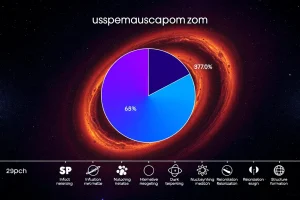
Dark energy is the largest single component of the modern universe. According to NASA, it accounts for approximately 68.3 to 70% of the total energy density, and it is the reason the expansion of the universe is not slowing down but speeding up. In the standard Lambda-CDM model, dark energy is described as a cosmological constant: a fixed energy density that belongs to empty space itself. Yet the ultimate fate of the cosmos depends on whether that description is exactly right.
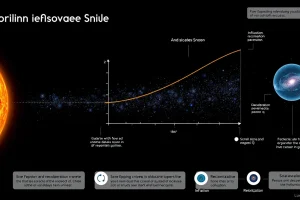
To see why, it helps to place dark energy in the full history of the universe. The Big Bang model divides cosmic history into a series of epochs, each defined by the dominant physical processes and the temperature of the expanding universe.
| Epoch | Time after Big Bang | Approximate temperature | Approximate redshift | Key events |
|---|---|---|---|---|
| Planck epoch | <10⁻⁴³ s | >10³² K | — | Quantum gravity dominates; known physics breaks down. |
| Grand Unification epoch | 10⁻⁴³–10⁻³⁶ s | ~10²⁹ K | — | Strong and electroweak forces may be unified. |
| Inflationary epoch | 10⁻³⁶–10⁻³² s | ~10²⁷ K | — | Exponential expansion smooths and flattens the universe. |
| Electroweak epoch | 10⁻³²–10⁻¹² s | 10²⁸–10¹⁵ K | — | W and Z bosons mediate the weak force. |
| Quark epoch | 10⁻¹²–10⁻⁶ s | ~10¹² K | — | Quarks and gluons form a hot plasma. |
| Hadron epoch | 10⁻⁶–1 s | ~10¹⁰ K | — | Protons and neutrons form from quarks. |
| Lepton epoch | 1–10 s | ~10⁹ K | — | Electrons and neutrinos dominate. |
| Photon epoch | 10 s–380,000 yr | 10⁹–3000 K | — | Radiation dominates; Big Bang nucleosynthesis creates light elements. |
| Recombination | ~380,000 yr | ~3000 K | ~1100 | First neutral atoms form; CMB released. |
| Dark Ages | 380,000–~150 million yr | <3000 K | ~1100–20 | Universe is neutral and dark; no stars yet. |
| Reionization | ~150 million–1 billion yr | — | ~20–6 | First stars and galaxies ionize intergalactic gas. |
| Structure Formation | ~100 million yr–present | — | <30 | Galaxies, clusters, and large-scale structure grow. |
At recombination, about 380,000 years after the Big Bang, the universe had cooled enough for protons and electrons to combine into neutral hydrogen. This made the universe transparent for the first time, and the light that escaped is now observed as the cosmic microwave background, or CMB. Missions such as COBE, WMAP, and Planck measured the CMB’s temperature and tiny anisotropies, turning it into one of the strongest pillars of modern cosmology. The CMB shows that the early universe was almost perfectly uniform, with small density fluctuations that later grew into galaxies and clusters under the influence of dark matter.
After the Dark Ages, the first stars and galaxies formed, and their ultraviolet light reionized the intergalactic medium. The James Webb Space Telescope has been observing some of the earliest galaxies in this era, providing direct evidence for how structure formation began. Throughout this history, the expansion of space has been stretching light to longer wavelengths, a phenomenon called redshift. For most of cosmic history, gravity from matter was slowing the expansion. But about nine billion years after the Big Bang, dark energy became dominant, and the expansion began to accelerate.
How Does Dark Energy Affect the Ultimate Fate of the Universe?
Short Answer
Dark energy controls the long-term expansion of the universe. If it behaves as a constant cosmological constant, the universe will expand forever, cooling toward a “Big Freeze.” If dark energy weakens over time, gravity could eventually reverse the expansion and cause a “Big Crunch.” If it strengthens, a “Big Rip” could tear apart galaxies, stars, and even atoms.
What We Know
Dark energy was discovered in the late 1990s when astronomers used Type Ia supernovae as standard candles and found that distant supernovae were fainter than expected in a decelerating universe. This implied that cosmic expansion has been speeding up for the past several billion years. Subsequent measurements of the CMB and the large-scale distribution of galaxies have confirmed that dark energy makes up about 70% of the universe and that its pressure is negative, which is what drives acceleration.
In the standard Lambda-CDM model, dark energy is a cosmological constant, meaning its energy density does not change as space expands. This model fits a wide range of observations, from the CMB power spectrum to baryon acoustic oscillations and supernova distances.
What We Don’t Know
The central unknown is whether dark energy is truly constant. A cosmological constant would remain the same everywhere and at all times. But some recent analyses, including results presented at the American Physical Society in March 2025, suggest that dark energy may be weakening. A South Korean team reported in late 2025 that their analysis hints the expansion could eventually reverse, leading to a Big Crunch. These results are not yet confirmed, and other astronomers have questioned them, but they have not been completely dismissed.
We also do not know what dark energy is made of. It could be vacuum energy, a dynamical field sometimes called quintessence, or a sign that general relativity needs modification on cosmic scales.
Evidence
- Type Ia supernovae: Distant supernovae appear dimmer than expected, indicating accelerated expansion.
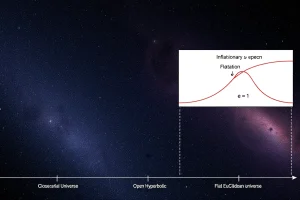
- Cosmic microwave background: Planck and WMAP data show a flat universe with a total energy density close to critical, requiring a dark energy component.
- Large-scale structure: The pattern of galaxy clustering and baryon acoustic oscillations is consistent with dark energy dominating the recent universe.
- Recent hints: Some 2025 analyses suggest dark energy may be weakening, though this is not yet established.
Competing Explanations
The main competing scenarios for dark energy are:
- Cosmological constant: A fixed vacuum energy, leading to eternal expansion and a Big Freeze.
- Quintessence: A dynamic field that can change over time; if it weakens, a Big Crunch is possible.
- Modified gravity: The acceleration may indicate that general relativity fails on the largest scales, rather than a new energy component.
- Big Rip: If dark energy grows stronger, it could eventually overcome all bound structures.
Current Research
Ongoing and future surveys, including DESI, Euclid, and the Nancy Grace Roman Space Telescope, are measuring the expansion history with greater precision. The goal is to determine whether dark energy’s equation of state is exactly -1, as expected for a cosmological constant, or whether it varies with time. The answer will decide which fate is most likely.
Why It Matters
The fate of the universe is not just a philosophical question; it is a test of fundamental physics. If dark energy is a cosmological constant, it may be a property of the quantum vacuum, connecting cosmology to quantum field theory. If it changes, it may point to new particles or fields, or to a deeper theory of gravity. Understanding dark energy also helps us interpret the CMB, the growth of cosmic structure, and the age and geometry of the universe. The same observations that reveal dark energy also tell us about dark matter, inflation, and the conditions of the early universe.
Evidence / Sources
The following sources were used to ground the factual statements in this article:
- BBC News: Dark Energy may be changing and with it the fate of the Universe
- Phys.org: How will the universe end? A changing understanding of dark energy may provide a new answer
- NASA Science: What is Dark Energy? Inside Our Accelerating, Expanding Universe
- Particle Data Group: 28. Dark Energy
Related Registry Entries
- Dark energy
- ΛCDM
- Cosmic Microwave Background
- Recombination
- Reionization
- Inflation
- Large-scale structure
- Supernova evidence
Last reviewed / updated: September 8, 2026.
FAQ
What is dark energy?
Dark energy is the unknown form of energy that makes up about 68–70% of the universe and causes the expansion of space to accelerate.
How does dark energy affect the universe's fate?
If dark energy remains constant, the universe will likely expand forever and cool in a Big Freeze. If it weakens, expansion could reverse into a Big Crunch. If it strengthens, a Big Rip could tear structures apart.
Is dark energy the same as the cosmological constant?
In the standard Lambda-CDM model, dark energy is treated as a cosmological constant, but recent observations hint it may vary over time.
What evidence supports dark energy?
Type Ia supernova distances, cosmic microwave background measurements, and large-scale structure surveys all indicate accelerated expansion driven by dark energy.
Leave a Reply