
Short Answer
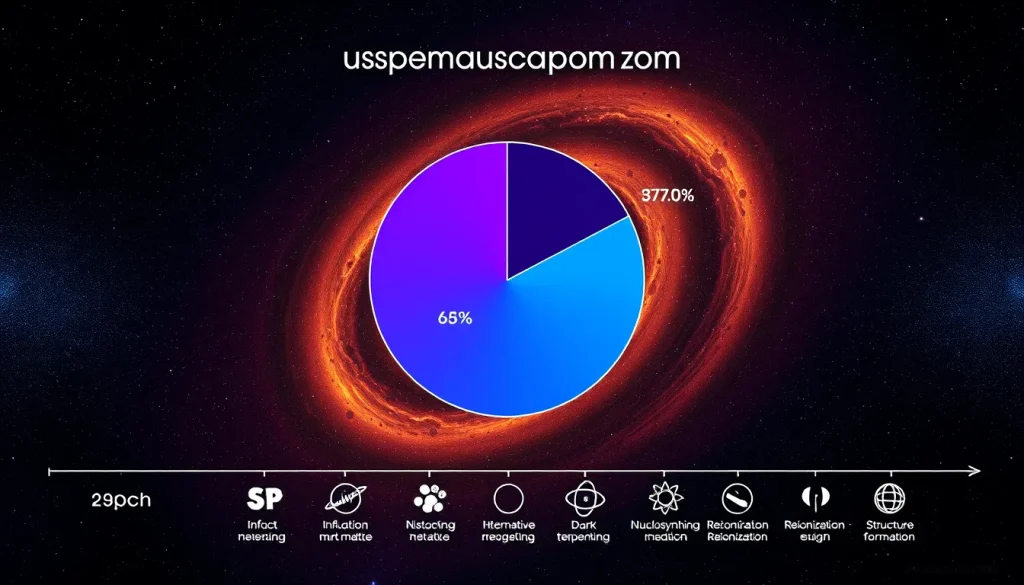
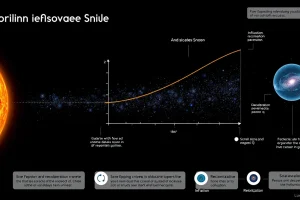
Infographic: The Universe’s Composition
| Component | Fraction of Total Density | Description |
|---|---|---|
| Normal matter | ~5% | Atoms, gas, dust, stars, planets, and all visible structures |
| Dark matter | ~27% | Non-luminous matter that interacts gravitationally but not electromagnetically |
| Dark energy | ~68% | Mysterious energy causing the accelerated expansion of the universe |
These percentages come from the Planck satellite’s measurements of the cosmic microwave background and other cosmological probes (NASA, 2025).
Main Explanation
The Critical Density and Cosmic Geometry
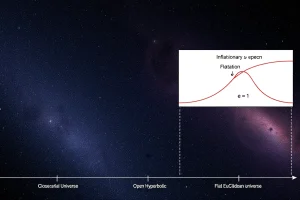
In cosmology, the critical density (ρc) is the density that would make the universe spatially flat. It is given by the Friedmann equation: ρc = 3H²/(8πG), where H is the Hubble constant and G is Newton’s gravitational constant. If the total density exceeds ρc, the universe would eventually collapse (closed); if it is less, the universe expands forever (open). Observations from the cosmic microwave background (CMB) show that the total density is extremely close to ρc, with the curvature parameter Ωk consistent with zero.
Components of the Cosmic Density Budget
According to the standard Lambda-CDM model, the universe’s energy budget is dominated by dark energy (68%), followed by dark matter (27%), and only a small fraction (5%) is normal matter (NASA, 2025; OpenStax, 2025). Normal matter includes protons, neutrons, and electrons, which form atoms, gas, and stars. Dark matter does not emit or absorb light, but its gravitational influence is seen in galaxy rotation curves and gravitational lensing. Dark energy is inferred from the accelerated expansion of the universe, first discovered in 1998 via Type Ia supernovae.
The Density of the Universe Over Time
The density of the universe is not constant; it changes as the universe expands. Radiation density scales as a⁻⁴, matter density as a⁻³, and dark energy remains roughly constant (if it is a cosmological constant). In the early universe, radiation dominated; later, matter dominated; and today, dark energy dominates. The epoch of matter-radiation equality occurred about 50,000 years after the Big Bang.
Cosmic Epochs: A Timeline
The universe evolved through distinct phases, each characterized by its dominant particles and physical processes. The following table summarizes the major epochs from the Planck epoch to the present day.
| Epoch | Time after Big Bang | Temperature | Key Events |
|---|---|---|---|
| Planck epoch | 0 to 10⁻⁴³ s | >10³² K | Quantum gravity effects; no known physics describes this era |
| Grand Unification epoch | 10⁻⁴³ to 10⁻³⁶ s | 10³² to 10²⁸ K | Strong and electroweak forces unified; inflation begins |
| Inflationary epoch | 10⁻³⁶ to 10⁻³² s | ~10²⁸ K | Exponential expansion; seeds of large-scale structure formed |
| Electroweak epoch | 10⁻³² to 10⁻¹² s | 10²⁸ to 10¹⁵ K | Electromagnetic and weak forces separate; Higgs mechanism |
| Quark epoch | 10⁻¹² to 10⁻⁶ s | 10¹⁵ to 10¹² K | Quarks and gluons exist in a quark-gluon plasma |
| Hadron epoch | 10⁻⁶ to 1 s | 10¹² to 10¹⁰ K | Quarks combine into protons and neutrons; matter-antimatter annihilation |
| Lepton epoch | 1 to 10 s | 10¹⁰ to 10⁹ K | Leptons dominate; neutrinos decouple |
| Photon epoch | 10 s to 380,000 yr | 10⁹ to 3000 K | Photons dominate; nucleosynthesis produces light elements |
| Recombination | ~380,000 yr | ~3000 K | Electrons combine with protons to form neutral hydrogen; CMB released |
| Dark Ages | 380,000 yr to ~150 million yr | 3000 to ~60 K | No stars; universe filled with neutral hydrogen and helium |
| Reionization | ~150 million to 1 billion yr | ~60 to ~20 K | First stars and galaxies ionize the intergalactic medium |
| Structure Formation | 1 billion yr to present | ~20 K to 2.7 K | Galaxies cluster into filaments and superclusters; dark energy dominates |
This timeline is based on the standard Big Bang model, which is supported by observations of the CMB, light-element abundances, and the large-scale distribution of galaxies (OpenStax, 2025).
The Cosmic Microwave Background: A Relic of the Early Universe
The CMB is the afterglow of the hot, dense early universe. It was emitted at recombination, when the universe became transparent to radiation. The CMB has a nearly perfect blackbody spectrum at 2.725 K and contains tiny temperature anisotropies that reflect the density fluctuations that seeded galaxies and clusters. Missions like COBE, WMAP, and Planck have measured these anisotropies with increasing precision, confirming the Lambda-CDM model and determining the density parameters with high accuracy.
How the First Atoms and Stars Formed
During Big Bang nucleosynthesis (about 3 minutes after the Big Bang), protons and neutrons fused into deuterium, helium-4, and trace amounts of lithium. After recombination, the universe was filled with neutral hydrogen and helium. Gravity amplified the small density fluctuations imprinted by inflation, causing gas to collapse into the first stars and galaxies during the epoch of reionization. These first stars were massive and short-lived, producing heavier elements through nuclear fusion and enriching the interstellar medium.
Cosmic Epochs: A Detailed Look
The flexible module for this article focuses on the cosmic epochs as the key framework for understanding how the universe evolved from an extremely hot, dense state to the large-scale structure we observe today.
When It Happened
The epochs span from the Planck epoch (t = 0 to 10⁻⁴³ s) to the present day (13.8 billion years).
Temperature and Redshift
Temperatures range from >10³² K at the Planck epoch to 2.7 K today. The redshift z decreases from effectively infinite at the Big Bang to 0 at present; recombination corresponds to z ≈ 1100.
Dominant Particles and Physics
Each epoch is defined by the dominant particles and interactions: quantum gravity in the Planck epoch, grand unified forces, inflation scalar field, electroweak interactions, quarks and gluons, hadrons, leptons, photons, and finally atoms, radiation, and dark matter.
What Happened
A brief description of each epoch is given in the table above. The key transitions include inflation, baryogenesis, nucleosynthesis, recombination, and reionization.
Evidence
Evidence for these epochs comes from the CMB, which shows the imprint of recombination and the earlier plasma phase; the abundances of light elements, which match Big Bang nucleosynthesis predictions; and the large-scale structure, which reflects the initial density fluctuations from inflation.
Why It Matters
Understanding the density of the universe is fundamental to cosmology. It tells us the geometry of space, the fate of the universe (whether it will expand forever or eventually collapse), and the nature of the invisible components that dominate it. The precise measurements of density parameters have transformed cosmology from a speculative field into a precision science, and they guide future research into dark matter and dark energy, which remain among the biggest mysteries in physics.
Evidence / Sources
- Cosmic Microwave Background anisotropies measured by COBE, WMAP, and Planck
- Type Ia supernova distance measurements showing cosmic acceleration
- Baryon acoustic oscillations in galaxy surveys
- Gravitational lensing studies of dark matter distribution
- Big Bang nucleosynthesis predictions matching observed light-element abundances
These lines of evidence converge on the Lambda-CDM model with a total density very close to the critical density.
Related Registry Entries
- Critical Density — the density that separates open, closed, and flat universes
- Lambda-CDM Model — the standard cosmological model with a cosmological constant and cold dark matter
- Cosmic Microwave Background — the relic radiation from recombination
- Inflation — the epoch of rapid expansion that seeded structure
FAQ
What is the exact value of the critical density?
The critical density depends on the Hubble constant. With H₀ ≈ 67.4 km/s/Mpc (from Planck), ρc ≈ 8.5 × 10⁻²⁷ kg/m³, equivalent to about 5.5 protons per cubic meter.
Why is dark energy the largest component?
Dark energy is inferred from the accelerated expansion of the universe. Its energy density remains roughly constant as the universe expands, so it becomes relatively more important over time.
How do we know dark matter exists?
Dark matter is evidenced by galaxy rotation curves, gravitational lensing, the CMB power spectrum, and the large-scale structure of the universe. It does not interact with light but exerts gravitational effects.
What is the universe's total density compared to the critical density?
Observations from Planck and other probes show that the total density parameter Ω_total = 1.00 ± 0.01, meaning the universe is spatially flat to high precision.
Leave a Reply