
Short Answer
Main Explanation
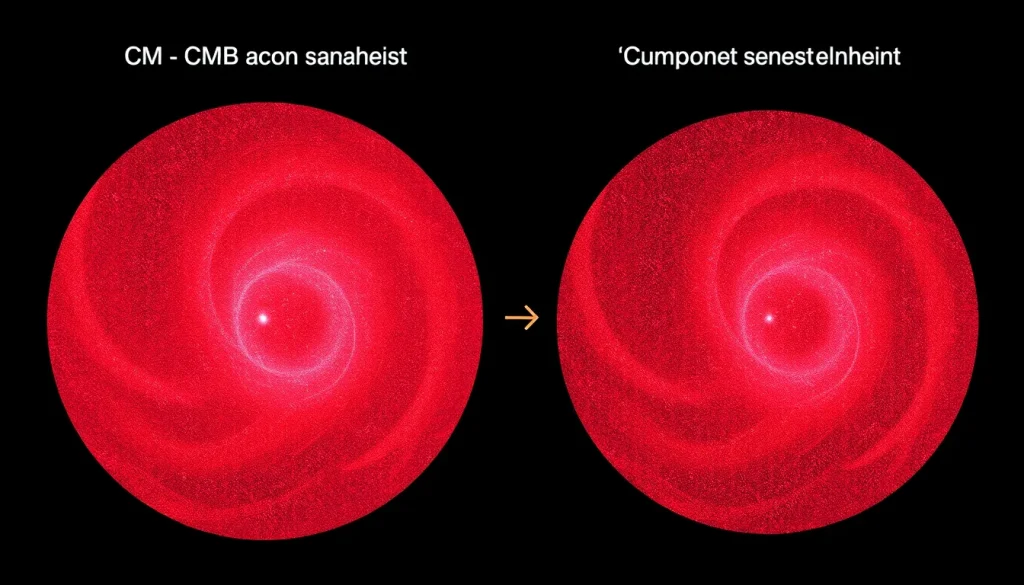
The Cosmic Microwave Background (CMB) is the oldest light in the universe, a relic of the hot, dense state that existed shortly after the Big Bang. But between the surface of last scattering and our detectors, this faint signal passes through a veil of astrophysical emissions—foregrounds—that can obscure or mimic cosmological information. Understanding and removing these foregrounds is a central challenge in modern CMB cosmology.
Understanding CMB Foregrounds
Definition
CMB foregrounds consist of all radiation between the surface of last scattering and the detectors that interferes with the cosmological interpretation of CMB data. They include diffuse Galactic emissions such as synchrotron radiation, free-free (thermal bremsstrahlung), and thermal dust emission, as well as extragalactic sources like radio galaxies and the cosmic infrared background. In temperature maps, foregrounds are complex but relatively easy to mitigate; in polarization, however, diffuse Galactic radiation can be polarized at levels of 10% or more, making them a far greater challenge.
How It Works
Foregrounds contaminate CMB measurements across a wide range of frequencies. Each physical process has a distinct spectral energy distribution: synchrotron radiation dominates at low frequencies (below ~100 GHz), thermal dust dominates at high frequencies (above ~300 GHz), and free-free emission peaks in between. The CMB itself follows a blackbody spectrum with a temperature of about 2.725 K, which is constant across frequencies. This spectral distinction allows scientists to separate foregrounds from the CMB by observing the sky at multiple frequencies and fitting models to each component.
Example
Imagine trying to hear a faint whisper (the CMB) in a crowded room (the foregrounds). The whisper is the same volume no matter where you stand, but the background chatter varies in pitch and loudness. By listening at several different pitches (frequencies), you can identify and subtract the chatter, leaving the whisper clear. In CMB analysis, this is done via component separation algorithms such as ILC (Internal Linear Combination), SEVEM, and SMICA, which use multi-frequency maps to isolate the CMB component.
Observable Consequences
Foregrounds can produce spurious signals that mimic the CMB’s temperature and polarization anisotropies. In particular, they can generate B-mode polarization patterns that are a smoking-gun signature of cosmic inflation. If not removed, these foregrounds could be misinterpreted as evidence of inflationary gravitational waves. Accurate foreground removal is therefore critical for future CMB polarization missions, requiring many channels covering a wide range of frequencies to ensure that modelling errors are minimized.
Common Misconceptions
A common misconception is that foregrounds are simply noise that can be averaged away. In reality, they are structured, polarized, and vary across the sky, and their spectral behavior is not perfectly known. Another misconception is that a single frequency map can be used alone to measure the CMB; in practice, no single frequency is free of foreground contamination. Moreover, foregrounds are not only a nuisance—they also provide valuable astrophysical information about the Milky Way and other galaxies, making their study a rich field in its own right.
The Cosmic Microwave Background as a Relic
The CMB originated about 380,000 years after the Big Bang, when the universe cooled enough for protons and electrons to combine into neutral hydrogen—a process called recombination. Before that, the universe was a hot plasma of photons, baryons, and electrons, and photons were constantly scattered by free electrons. After recombination, photons streamed freely, carrying an imprint of the density fluctuations that later grew into galaxies and clusters. This relic radiation is the CMB, and its measurement has transformed cosmology.
Timeline of Cosmic Epochs
| Epoch | Time After Big Bang | Key Events |
|---|---|---|
| Planck Epoch | 0 to 10-43 s | Quantum gravity effects dominate; physics unknown |
| Grand Unification Epoch | 10-43 to 10-36 s | Strong and electroweak forces unify |
| Inflationary Epoch | 10-36 to 10-32 s | Rapid exponential expansion; seeds for structure |
| Electroweak Epoch | 10-32 to 10-12 s | Electromagnetic and weak forces separate |
| Quark Epoch | 10-12 to 10-6 s | Quarks and gluons form quark-gluon plasma |
| Hadron Epoch | 10-6 to 1 s | Protons and neutrons form; baryogenesis |
| Lepton Epoch | 1 to 10 s | Leptons dominate; neutrinos decouple |
| Photon Epoch | 10 s to 380,000 years | Photons dominate; nucleosynthesis occurs |
| Recombination | ~380,000 years | Atoms form; CMB released |
| Dark Ages | 380,000 to ~150 million years | No stars; neutral hydrogen fills space |
| Reionization | ~150 million to 1 billion years | First stars and galaxies ionize hydrogen |
| Structure Formation | 1 billion years to present | Galaxies, clusters, and large-scale structure evolve |
Why It Matters
CMB foregrounds are not just an annoyance; they are the primary obstacle to extracting the faint polarization signal that could reveal the physics of cosmic inflation. The B-mode signal from inflation is expected to be at the level of a few nano-Kelvin, while foregrounds can be orders of magnitude larger. Removing them with precision is essential for testing the Lambda-CDM model and for probing the earliest moments of the universe. Moreover, foreground studies themselves yield insights into the interstellar medium, magnetic fields, and star formation in galaxies.
Evidence / Sources
The importance of foregrounds has been highlighted in numerous reviews and technical papers. The overview by Dickinson (2016) summarizes the current understanding of foreground components and their impact on CMB measurements. Ichiki (2014) provides a concise review of foreground subtraction methods and the need for accurate component separation. Delabrouille and Cardoso (2007) discuss blind source separation techniques used in CMB analysis, while Tristram and Ganga (2007) offer a broader overview of CMB data analysis methods. These works collectively underscore the critical role of foreground removal in modern cosmology.
Related Registry Entries
FAQ
Why can't we simply subtract foregrounds using a single frequency map?
No single frequency is free of foreground contamination; each foreground component has a unique spectral signature, so observations at multiple frequencies are needed to separate them from the CMB, which has a constant blackbody spectrum.
What are the main types of CMB foregrounds?
The main diffuse Galactic foregrounds are synchrotron radiation (from cosmic-ray electrons), free-free emission (from ionized gas), and thermal dust emission. Extragalactic sources like radio galaxies and the cosmic infrared background also contribute.
How do scientists test that foreground removal is successful?
They compare results from different component separation algorithms, check for consistency across frequency channels, and validate using simulations and independent data such as polarization maps from other experiments.
What is the impact of foregrounds on measuring inflationary B-modes?
Foregrounds can produce spurious B-mode signals that mimic the inflationary signal. Without accurate removal, the detection of primordial B-modes could be false or severely biased, so foreground cleaning is a top priority for next-generation CMB experiments.
Leave a Reply