
Short Answer
Main Explanation
The universe began in an incredibly hot, dense state known as the Big Bang. In the first fractions of a second, it underwent rapid expansion (inflation) and cooled through a series of phase transitions. As it expanded, the universe passed through distinct epochs defined by the dominant particles and physical processes. Around 380,000 years after the Big Bang, the universe had cooled enough for electrons and protons to combine into neutral hydrogen atoms—a period called recombination. This released the cosmic microwave background (CMB) radiation that we detect today. For the next several hundred million years, the universe entered the Dark Ages, when no stars or galaxies existed to emit light.
Then, gravity began to pull matter together. Dense regions of dark matter and gas collapsed to form the first stars and galaxies. These objects emitted intense ultraviolet radiation—photons with energies high enough to strip electrons from neutral hydrogen atoms. This process, called reionization, gradually converted the neutral intergalactic medium back into ionized plasma. The reionization of hydrogen was not instantaneous; it proceeded patchily over hundreds of millions of years, driven by the growing population of star-forming galaxies. By a redshift of about 6 (roughly 1 billion years after the Big Bang), the universe was almost fully reionized, and the intergalactic medium became transparent to ultraviolet light, allowing us to observe distant galaxies.
Cosmic Epoch: Reionization
When It Happened
Reionization began around 150 million years after the Big Bang (redshift z ≈ 15) and concluded around 1 billion years after the Big Bang (z ≈ 6). The exact timeline is an active area of research, with recent observations from the James Webb Space Telescope (JWST) pushing the start of reionization to earlier times.
Temperature
The gas temperature during reionization was not uniform. The intergalactic medium was heated by the ionizing radiation, reaching temperatures of tens of thousands of kelvin, but the CMB temperature at that epoch was around 30–70 K (depending on redshift).
Approximate Redshift
Reionization spans redshifts from about 6 to 15. The end of reionization is often set at z ≈ 6, when the intergalactic medium became fully ionized.
Dominant Particles/Physics
The dominant particles were hydrogen and helium nuclei, free electrons, and photons. The physics is governed by radiative transfer of ionizing photons, recombination, and the growth of structure via gravitational collapse.
What Happened
First-generation stars (Population III) formed from primordial gas, emitting hard ultraviolet radiation. These photons ionized the surrounding hydrogen, creating ionized bubbles that expanded and merged. Eventually, the entire intergalactic medium became ionized.
What Came Before
Before reionization was the Dark Ages, after recombination. The universe was filled with neutral hydrogen and no luminous sources. The CMB was the only radiation, redshifted to longer wavelengths.
What Came Next
After reionization, the universe became transparent, allowing light to travel freely. Galaxies continued to grow and evolve, leading to the large-scale structure we observe today, including clusters of galaxies and the cosmic web.
Evidence
Key evidence includes the Gunn-Peterson trough in quasar spectra (indicating neutral hydrogen absorption), the polarization of the CMB measured by WMAP and Planck, and deep observations by JWST that reveal galaxies at z > 10, which are likely responsible for reionization.
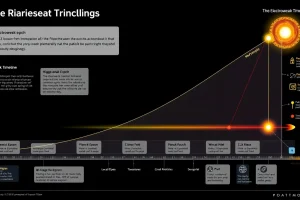
Timeline of Cosmic Epochs
| Epoch | Time After Big Bang | Redshift | Key Events |
|---|---|---|---|
| Planck Epoch | < 10⁻⁴³ s | ∞ | Quantum gravity effects |
| Grand Unification Epoch | 10⁻⁴³ to 10⁻³⁶ s | ∞ | Fundamental forces unify |
| Inflationary Epoch | 10⁻³⁶ to 10⁻³² s | ∞ | Exponential expansion |
| Electroweak Epoch | 10⁻³² to 10⁻¹² s | ∞ | Electromagnetic and weak forces separate |
| Quark Epoch | 10⁻¹² to 10⁻⁶ s | ∞ | Quarks and gluons form plasma |
| Hadron Epoch | 10⁻⁶ to 1 s | ∞ | Protons and neutrons form |
| Lepton Epoch | 1 to 10 s | ∞ | Leptons dominate |
| Photon Epoch | 10 s to 380,000 yr | z ≈ 10⁹ to 1100 | Photons dominate; nucleosynthesis |
| Recombination | 380,000 yr | z ≈ 1100 | Neutral atoms form; CMB released |
| Dark Ages | 380,000 yr to ~150 Myr | z ≈ 1100 to 15 | No luminous sources |
| Reionization | ~150 Myr to ~1 Gyr | z ≈ 15 to 6 | First stars ionize gas |
| Structure Formation | ~1 Gyr to present | z < 6 | Galaxies, clusters, cosmic web |
Why It Matters
Reionization is the last major phase transition of the universe. It marks the end of the cosmic Dark Ages and the emergence of the first luminous sources. Understanding reionization tells us about the properties of the first stars and galaxies, the role of dark matter in structure formation, and the interplay between radiation and matter in the intergalactic medium. It also affects our ability to observe the early universe: the neutral gas before reionization absorbs ultraviolet light, so studying reionization helps us interpret observations of distant galaxies and quasars. Moreover, the polarization of the CMB provides a unique probe of the reionization history, linking the CMB to the epoch of structure formation. Missions like JWST, Planck, and WMAP have transformed our understanding of this era, and ongoing and future experiments (e.g., the Simons Observatory, SPHEREx) will continue to refine the timeline.
Evidence / Sources
Observational evidence for reionization comes from several independent lines:
- The Gunn-Peterson trough in spectra of high-redshift quasars (z > 6) shows strong absorption by neutral hydrogen, indicating the end of reionization.
- The CMB polarization signal measured by WMAP and Planck shows a reionization optical depth of τ ≈ 0.054, consistent with reionization at z ≈ 8.
- Deep JWST observations have discovered galaxies at z = 10–14, providing direct evidence of early star formation that could drive reionization.
- Cosmic microwave background temperature and polarization anisotropies also constrain the reionization history.
These observations are consistent with the standard ΛCDM model, which predicts that reionization was driven by star-forming galaxies. The sources for this article include the Wikipedia page on Reionization, NASA’s Cosmic Reionization page, Rennan Barkana’s introduction to reionization, and the review by T. Roy Choudhury (2022).
Related Registry Entries
- Cosmic Microwave Background
- Dark Ages
- First Stars & Galaxies
- Recombination
- Inflation
FAQ
What is the difference between recombination and reionization?
Recombination is when electrons and protons combined to form neutral hydrogen atoms about 380,000 years after the Big Bang, releasing the CMB. Reionization is the later process when the first stars ionized that neutral hydrogen again, about 150 million to 1 billion years later.
How did reionization affect the universe's transparency?
Before reionization, neutral hydrogen absorbed ultraviolet light, making the universe opaque to such radiation. After reionization, the gas became ionized, allowing ultraviolet light to travel freely, which is why we can now see distant galaxies.
What role does JWST play in studying reionization?
JWST observes galaxies at redshifts greater than 10, directly probing the epoch of reionization. It helps identify the sources of ionizing radiation and measure the timeline of reionization.
Leave a Reply