
Short Answer
Main Explanation
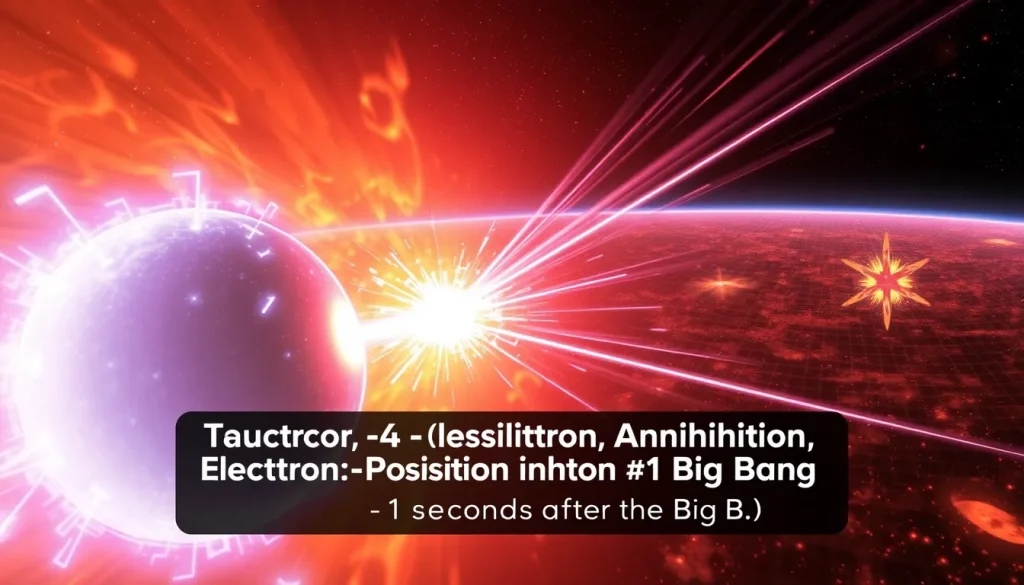
The early universe was a seething plasma of particles and radiation, cooling as it expanded. Among the most transformative events in the first second after the Big Bang was the annihilation of electrons and positrons—the lightest charged particles and their antimatter counterparts. This process not only eliminated most antimatter but also injected energy into the primordial soup, influencing the neutrino background, the synthesis of light elements, and the relic radiation we observe today as the cosmic microwave background (CMB).
Electron-positron annihilation occurred at the boundary between the lepton epoch and the photon epoch, roughly one second after the Big Bang. At that time, the universe had cooled to about 5 × 10⁹ K (approximately 0.5 MeV), allowing electrons and positrons to combine and annihilate into photons. Because the universe had a slight excess of matter over antimatter—one part in a billion—a small residue of electrons survived, eventually forming atoms during recombination.
This annihilation was not merely a curiosity; it had profound consequences. It reheated the photon gas relative to the neutrinos, which had already decoupled, creating a difference in temperature that persists today. It also set the stage for Big Bang nucleosynthesis (BBN), as the surviving protons and neutrons could then combine into deuterium and helium without being constantly disrupted by electron-positron pairs. The energy released also contributed to the radiation density that governs the expansion rate during BBN, affecting the primordial abundances of helium-4 and deuterium.
Cosmic Epoch: The Lepton Era and Electron-Positron Annihilation
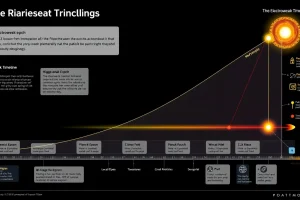
To understand electron-positron annihilation, we must place it within the broader cosmic timeline. The early universe passed through several distinct epochs, each characterized by the dominant particles and physical processes. The table below summarizes these epochs, with the electron-positron annihilation occurring at the end of the lepton epoch.
| Epoch | Time | Temperature | Dominant Physics |
|---|---|---|---|
| Planck epoch | < 10−43 s | > 1032 K | Quantum gravity effects |
| Grand Unification epoch | 10−43 – 10−36 s | 1028 – 1032 K | Unified forces, possible inflation |
| Inflationary epoch | 10−36 – 10−32 s | Dropping rapidly | Exponential expansion |
| Electroweak epoch | 10−32 – 10−12 s | 1015 – 1028 K | Electromagnetic and weak forces separate |
| Quark epoch | 10−12 – 10−6 s | 1012 – 1015 K | Quarks and gluons form plasma |
| Hadron epoch | 10−6 – 1 s | 1010 – 1012 K | Protons and neutrons form; hadron–antihadron annihilation |
| Lepton epoch | 1 – 10 s | 109 – 1010 K | Electrons, positrons, neutrinos; electron-positron annihilation |
| Photon epoch | 10 s – 380,000 yr | 109 K down to 3000 K | Photons dominate; nucleosynthesis; recombination |
| Recombination | ~380,000 yr | ~3000 K | Electrons and protons form hydrogen; CMB released |
| Dark Ages | 380,000 yr – 150 million yr | 3000 K down to ~50 K | No luminous sources; neutral hydrogen |
| Reionization | 150 million – 1 billion yr | ~50 K – 10 K | First stars and galaxies reionize hydrogen |
| Structure Formation | 1 billion yr – present | Cooling further | Galaxies, clusters, large-scale structure |
When It Happened
Electron-positron annihilation took place between approximately 1 and 10 seconds after the Big Bang, at the end of the lepton epoch. The process was not instantaneous; it occurred as the temperature fell below the rest-mass energy of the electron (0.511 MeV), causing the equilibrium abundance of electron–positron pairs to drop exponentially.
Temperature
The annihilation began when the temperature was about 5 × 10⁹ K (roughly 0.5 MeV). At this temperature, the thermal energy of photons was insufficient to create new electron–positron pairs through pair production, so existing pairs annihilated without replacement.
Approximate Redshift
The corresponding redshift is approximately z ≈ 2 × 10⁹, reflecting the enormous expansion since that time. This is not directly observable, but it is inferred from the standard cosmological model.
Dominant Particles/Physics
The universe was filled with a plasma of electrons, positrons, photons, and neutrinos. Neutrinos had already decoupled from the thermal bath about a second earlier, meaning they no longer interacted frequently with electrons or photons. The annihilation of electron–positron pairs produced high-energy photons, which then interacted with the remaining particles, but not with the decoupled neutrinos.
What Happened
As the universe cooled, electron–positron pairs annihilated into two photons (e+e− → γγ). Because there was a tiny excess of electrons over positrons (the baryon asymmetry), a small number of electrons survived. The energy released by the annihilation reheated the photon gas, but not the neutrinos, which had already decoupled. This created a temperature difference: the photon temperature became higher than the neutrino temperature by a factor of (11/4)1/3 ≈ 1.4. This ratio is a key prediction of the standard model and is confirmed by observations of the cosmic neutrino background and BBN.
What Came Before
Before the annihilation, during the hadron epoch, protons and neutrons had formed from quarks, and hadron–antihadron annihilations had already removed most antimatter. Neutrinos decoupled at about the same time, leaving a background of relic neutrinos. The universe was still hot enough for electrons and positrons to be in thermal equilibrium with photons.
What Came Next
After the annihilation, the universe entered the photon epoch, where photons dominated the energy density. The surviving electrons, protons, and neutrons went on to form light elements during Big Bang nucleosynthesis (BBN), which began at about 3 minutes and lasted until about 20 minutes. The photons released during annihilation became part of the primordial photon gas that eventually cooled to form the CMB at recombination, about 380,000 years later.
Evidence
Direct evidence for electron-positron annihilation comes from the measured temperature ratio between the CMB and the cosmic neutrino background. The standard model predicts that the effective number of relativistic species, Neff, is about 3.044 (including the small effect of non-instantaneous annihilation). Observations of the CMB power spectrum from Planck and other experiments are consistent with this value, supporting the occurrence of electron-positron annihilation. Additionally, BBN predictions for light element abundances depend on the expansion rate at the time, which was affected by the energy density of electron–positron pairs; the agreement between predicted and observed abundances (e.g., helium-4 and deuterium) provides strong confirmation.
Why It Matters
Electron-positron annihilation is a cornerstone of the standard model of cosmology (ΛCDM). It set the stage for nucleosynthesis by removing the lepton population that would otherwise have interfered with nuclear reactions. It also established the precise relationship between the photon and neutrino temperatures, a prediction that can be tested with future observations of the cosmic neutrino background. Moreover, the annihilation contributed to the radiation density that drives the expansion rate during BBN, making it essential for accurate predictions of primordial abundances. Understanding this process helps us trace the evolution of matter and radiation from the first second to the present day, linking particle physics to cosmology.
Evidence / Sources
The scientific understanding of electron-positron annihilation is based on theoretical modeling and observational constraints. Key sources include:
- Rafelski, J., Birrell, J., Steinmetz, A., & Yang, C. T. (2023). A Short Survey of Matter-Antimatter Evolution in the Primordial Universe. Universe, 9(7), 309. doi:10.3390/universe9070309
- Thomas, L. C., Dezen, T., Grohs, E., & Kishimoto, C. T. (2020). Electron-positron annihilation freeze-out in the early universe. Physical Review D, 101(6), 063507. doi:10.1103/physrevd.101.063507
- Cooke, R. (2024). Big Bang Nucleosynthesis. arXiv:2409.06015. doi:10.48550/arxiv.2409.06015
- Schwarz, D. J. (2003). The first second of the Universe. Annalen der Physik, 15(1-2), 78–88. doi:10.1002/andp.200310010
Related Registry Entries
This article connects to several core concepts in cosmology:
- Lepton Epoch – The period when leptons dominated the universe’s energy density.
- Big Bang Nucleosynthesis – The production of light elements, which was affected by electron-positron annihilation.
- Cosmic Neutrino Background – The relic neutrinos that decoupled just before annihilation.
- Cosmic Microwave Background – The relic photons that eventually formed after annihilation and recombination.
FAQ
Why did electron-positron annihilation happen in the early universe?
As the universe expanded and cooled, the thermal energy dropped below the rest-mass energy of electrons and positrons (0.511 MeV). At that point, pair production (photons converting to electron-positron pairs) ceased, while existing pairs continued to annihilate into photons, leading to the disappearance of most electrons and positrons.
How does electron-positron annihilation affect the cosmic microwave background?
The annihilation released energy that reheated the photon gas, but not the neutrinos, which had already decoupled. This created a slight temperature difference between photons and neutrinos, which influenced the expansion rate and the details of BBN. The photons from annihilation contributed to the background radiation that later became the CMB after recombination.
What evidence do we have for electron-positron annihilation?
The primary evidence comes from measurements of the effective number of relativistic species (N_eff) and the primordial abundances of light elements. The predicted value of N_eff ≈ 3.044, which accounts for the annihilation's effects, matches CMB observations from Planck and other experiments. Additionally, the agreement of BBN predictions with observed helium and deuterium abundances confirms the energy density at that time.
Leave a Reply