Short Answer
Main Explanation
The cosmic microwave background (CMB) is the remnant heat from the Big Bang, a nearly uniform glow that fills the entire universe [2][3]. If human eyes could see microwaves, the sky would look almost the same in every direction. A CMB map makes the invisible visible: it is a two-dimensional representation of the three-dimensional sky, with colors encoding tiny differences in temperature from point to point [1]. These small variations, called temperature anisotropies, were first detected by the COBE satellite in 1992 [1]. Later missions—WMAP and Planck—sharpened the picture, turning the CMB into one of the most powerful tools in cosmology.
What does a CMB map actually show? It is not a photograph of an explosion or a fireball. It is a snapshot of the universe at the moment it became transparent, roughly 380,000 years after the Big Bang. Before that time, the cosmos was a hot, dense plasma of free electrons and nuclei. Photons could not travel far without scattering. When the universe cooled enough for electrons to combine with protons and helium nuclei to form neutral atoms—an epoch called recombination—the photons decoupled and streamed freely. Those photons, stretched by the expansion of space over billions of years, are what we detect today as microwaves. The map therefore shows the last scattering surface: the farthest back we can see using light.
The average temperature of the CMB is about 2.725 kelvins, or minus 455 degrees Fahrenheit [4]. The color differences on a CMB map are not large; they represent fluctuations of only about one part in 100,000. Yet those tiny hot and cold spots are the seeds of all structure in the universe—galaxies, clusters, and the cosmic web. A CMB map is thus a baby picture of the cosmos, encoding information about its age, composition, geometry, and initial conditions [4].
Cosmic Epochs: From Planck to Present
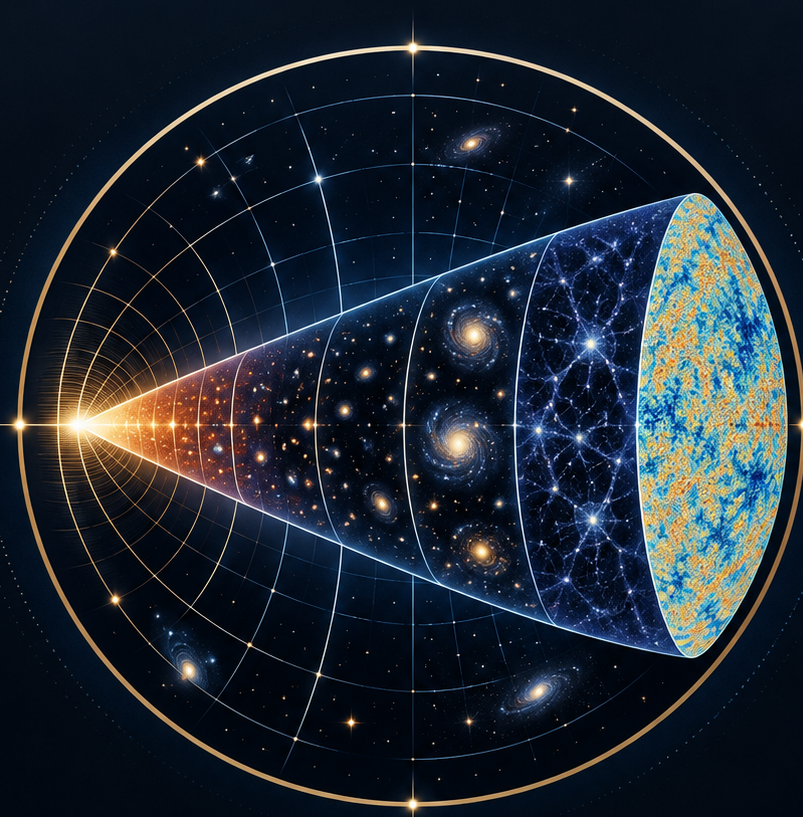
To understand what a CMB map shows, it helps to trace the major epochs that led to the release of the CMB and the growth of structure afterward. The standard cosmological model, known as Lambda-CDM, describes a universe that began hot and dense, underwent a brief burst of exponential expansion called inflation, and has been expanding and cooling ever since. The table below summarizes the key epochs.
| Epoch | Time After Big Bang | Approx. Temperature | Approx. Redshift | Key Events |
|---|---|---|---|---|
| Planck | 0 to 10⁻⁴³ s | >10³² K | Effectively infinite | Quantum gravity regime; all forces possibly unified |
| Grand Unification | 10⁻⁴³ to 10⁻³⁶ s | 10²⁹–10²⁷ K | Enormous | Strong force separates; possible inflation onset |
| Inflationary | 10⁻³⁶ to 10⁻³² s | Drops, then reheats | Scale factor grows >10²⁶ | Exponential expansion; quantum fluctuations become seeds |
| Electroweak | 10⁻³² to 10⁻¹² s | 10²⁸–10¹⁵ K | ~10¹⁵ | Electroweak symmetry breaks; W and Z gain mass |
| Quark | 10⁻¹² to 10⁻⁶ s | ~10¹² K | ~10¹² | Quark-gluon plasma; matter-antimatter asymmetry |
| Hadron | 10⁻⁶ to 1 s | ~10¹⁰ K | ~10¹⁰ | Quarks bind into protons and neutrons |
| Lepton | 1 to 10 s | ~10⁹ K | ~10⁹ | Lepton annihilation; neutrinos decouple |
| Photon | 10 s to 380,000 yr | 10⁹ to 3,000 K | 10⁹ to 1,100 | Big Bang nucleosynthesis; universe remains opaque |
| Recombination | ~380,000 yr | ~3,000 K | ~1,100 | Neutral atoms form; CMB released |
| Dark Ages | 380,000 to 150 million yr | 3,000 to 60 K | 1,100 to 20 | No stars; neutral hydrogen fills universe |
| Reionization | 150 million to 1 billion yr | 60 to 10,000 K in ionized regions | 20 to 6 | First stars and galaxies ionize intergalactic gas |
| Structure Formation | 150 million yr to present | CMB at 2.725 K; structures vary | 20 to 0 | Galaxies, clusters, and cosmic web grow; dark energy accelerates expansion |
Below, each epoch is described in terms of when it happened, its approximate temperature and redshift, the dominant physics, and the evidence that supports it.
Planck Epoch
When It Happened: From time zero to about 10⁻⁴³ seconds after the Big Bang.
Temperature: Above 10³² kelvins.
Approximate Redshift: Effectively infinite; the scale factor was near zero.
Dominant Particles/Physics: All four fundamental forces may have been unified; quantum gravity is required, but no tested theory exists.
What Happened: The universe was in a state beyond the reach of current physics. Space and time as we know them may not have had their familiar meaning.
What Came Before: Unknown; the Big Bang model does not describe a before.
What Came Next: Gravity separated from the other forces, beginning the Grand Unification epoch.
Evidence: Indirect; the success of the hot Big Bang model and the need for quantum gravity at these scales.
Grand Unification Epoch
When It Happened: About 10⁻⁴³ to 10⁻³⁶ seconds.
Temperature: Around 10²⁹ to 10²⁷ kelvins.
Approximate Redshift: Enormous, roughly 10²⁹ or higher.
Dominant Particles/Physics: Strong, weak, and electromagnetic forces may have been unified; exotic particles and topological defects may have formed.
What Happened: The strong force separated from the electroweak force. The universe remained a nearly uniform soup of high-energy particles.
What Came Before: Planck epoch.
What Came Next: Inflation, if it occurred at the end of this epoch.
Evidence: No direct evidence; grand unified theories are motivated by particle physics but unconfirmed.
Inflationary Epoch
When It Happened: Approximately 10⁻³⁶ to 10⁻³² seconds.
Temperature: Dropped dramatically during expansion, but reheating restored a high temperature.
Approximate Redshift: The scale factor grew by at least a factor of 10²⁶, so redshift is effectively infinite.
Dominant Particles/Physics: A hypothetical scalar field called the inflaton drove exponential expansion.
What Happened: The universe expanded faster than the speed of light in the sense that space itself stretched. Quantum fluctuations were stretched to cosmic scales, becoming the seeds of density variations.
What Came Before: Grand Unification epoch.
What Came Next: Reheating produced a hot, dense plasma, beginning the standard hot Big Bang evolution.
Evidence: The CMB’s near-perfect uniformity and the pattern of temperature anisotropies match inflationary predictions, including a nearly scale-invariant spectrum and super-horizon correlations.
Electroweak Epoch
When It Happened: About 10⁻³² to 10⁻¹² seconds.
Temperature: Around 10²⁸ to 10¹⁵ kelvins.
Approximate Redshift: Extremely high, roughly 10¹⁵ or more.
Dominant Particles/Physics: W and Z bosons, quarks, leptons, and the Higgs field; the electromagnetic and weak forces were unified.
What Happened: The electroweak symmetry broke, giving mass to W and Z bosons and separating the weak and electromagnetic forces.
What Came Before: Inflation and reheating.
What Came Next: Quark epoch.
Evidence: Particle physics experiments at accelerators confirm the electroweak theory, but the early universe conditions are inferred.
Quark Epoch
When It Happened: About 10⁻¹² to 10⁻⁶ seconds.
Temperature: Around 10¹² kelvins.
Approximate Redshift: Roughly 10¹².
Dominant Particles/Physics: Quarks, gluons, leptons, and photons in a quark-gluon plasma.
What Happened: The universe was too hot for quarks to bind into hadrons. All four fundamental forces had their present identities.
What Came Before: Electroweak epoch.
What Came Next: Hadron epoch, when quarks combined into protons and neutrons.
Evidence: Heavy-ion collision experiments recreate quark-gluon plasma, supporting this picture.
Hadron Epoch
When It Happened: About 10⁻⁶ to 1 second.
Temperature: Around 10¹⁰ kelvins.
Approximate Redshift: Roughly 10¹⁰.
Dominant Particles/Physics: Protons, neutrons, mesons, electrons, neutrinos, and photons.
What Happened: Quarks confined into hadrons. Matter and antimatter annihilated, leaving a small excess of matter.
What Came Before: Quark epoch.
What Came Next: Lepton epoch.
Evidence: The observed matter-antimatter asymmetry and the success of Big Bang nucleosynthesis.
Lepton Epoch
When It Happened: About 1 to 10 seconds.
Temperature: Around 10⁹ kelvins.
Approximate Redshift: Roughly 10⁹.
Dominant Particles/Physics: Electrons, positrons, neutrinos, and photons; protons and neutrons were present but not yet bound into nuclei.
What Happened: Leptons and antileptons annihilated, and neutrinos decoupled, forming the cosmic neutrino background.
What Came Before: Hadron epoch.
What Came Next: Photon epoch and Big Bang nucleosynthesis.
Evidence: The predicted cosmic neutrino background and the observed primordial helium abundance.
Photon Epoch
When It Happened: About 10 seconds to 380,000 years.
Temperature: From about 10⁹ kelvins down to 3,000 kelvins.
Approximate Redshift: From about 10⁹ down to 1,100.
Dominant Particles/Physics: Photons, protons, helium nuclei, electrons, and dark matter; radiation dominated the energy density.
What Happened: Big Bang nucleosynthesis produced light nuclei—mostly hydrogen and helium—during the first few minutes. The universe remained an opaque plasma.
What Came Before: Lepton epoch.
What Came Next: Recombination and the release of the CMB.
Evidence: The observed primordial abundances of deuterium, helium, and lithium match Big Bang nucleosynthesis predictions.
Recombination
When It Happened: About 380,000 years after the Big Bang.
Temperature: About 3,000 kelvins.
Approximate Redshift: About 1,100.
Dominant Particles/Physics: Neutral hydrogen and helium atoms, photons, dark matter.
What Happened: Electrons combined with protons and helium nuclei to form neutral atoms. The universe became transparent, and photons decoupled. This is the last scattering surface that a CMB map shows.
What Came Before: Photon epoch.
What Came Next: Dark Ages.
Evidence: The CMB itself is the direct evidence; its blackbody spectrum and temperature anisotropies confirm the recombination picture.
Dark Ages
When It Happened: About 380,000 to 150 million years after the Big Bang.
Temperature: From about 3,000 K down to roughly 60 K.
Approximate Redshift: From about 1,100 down to 20.
Dominant Particles/Physics: Neutral hydrogen, helium, dark matter; no stars or galaxies yet.
What Happened: The universe was dark and filled with neutral gas. Density fluctuations from inflation slowly grew under gravity, but no luminous objects existed.
What Came Before: Recombination.
What Came Next: The first stars and galaxies formed, beginning reionization.
Evidence: The absence of light sources is inferred; 21-cm hydrogen observations are beginning to probe this era.
Reionization
When It Happened: About 150 million to 1 billion years after the Big Bang.
Temperature: The intergalactic medium was heated from about 60 K to 10,000 K or more in ionized regions.
Approximate Redshift: From about 20 down to 6.
Dominant Particles/Physics: First stars, galaxies, quasars, and ionized hydrogen.
What Happened: Ultraviolet radiation from the first luminous objects ionized the neutral hydrogen, ending the Dark Ages and making the universe transparent to UV light.
What Came Before: Dark Ages.
What Came Next: Structure formation continued, producing the galaxies and clusters we see today.
Evidence: Spectra of distant quasars show absorption from neutral hydrogen decreasing at high redshift; CMB polarization also indicates reionization.
Structure Formation
When It Happened: From about 150 million years after the Big Bang to the present.
Temperature: The CMB has cooled to 2.725 K; collapsed structures have a wide range of temperatures.
Approximate Redshift: From about 20 to 0.
Dominant Particles/Physics: Dark matter halos, gas, stars, galaxies, clusters, and dark energy.
What Happened: Tiny density fluctuations seen in the CMB grew under gravity, forming the cosmic web of galaxies and clusters. Dark energy began accelerating the expansion about 5 billion years ago.
What Came Before: Reionization.
What Came Next: The ongoing evolution of the universe.
Evidence: Galaxy surveys, gravitational lensing, and the CMB power spectrum all support the Lambda-CDM model of structure growth.
Why It Matters
A CMB map is more than a pretty picture. It is a direct window into the universe’s first 380,000 years and a test of physics at energies far beyond any laboratory. The pattern of hot and cold spots encodes the age of the universe—13.7 billion years according to WMAP [2]—and its composition: about 4.6% ordinary atoms, 23% dark matter, and the rest dark energy [2]. The same map reveals the universe’s geometry, the amount of normal matter, and the initial conditions for all cosmic structure. By comparing the CMB with later observations of galaxies and quasars, cosmologists can trace how the seeds seen in the baby picture grew into the universe we inhabit.
The CMB also provides evidence for inflation. The near-uniformity of the temperature across widely separated regions, combined with the specific statistical pattern of anisotropies, matches the idea that quantum fluctuations were stretched to cosmic scales during a brief exponential expansion. Without such a mechanism, it is difficult to explain why opposite sides of the sky have almost the same temperature despite never being in causal contact.
Evidence / Sources
The observational foundation for CMB maps comes from a series of space missions. COBE first detected the temperature anisotropies in 1992 and showed that the CMB has a nearly perfect blackbody spectrum [1]. WMAP then measured the fluctuations across the full sky with much better resolution, determining the universe’s age and composition [2]. Planck, a European Space Agency mission, observed the whole sky at wavelengths from 0.3 mm to 11.1 mm, improving sensitivity and resolution further [3]. These maps are not just images; they are datasets that can be analyzed statistically to extract cosmological parameters. The average CMB temperature of about minus 455 degrees Fahrenheit [4] and the tiny fluctuations around that average are now measured with exquisite precision.
Ground-based and balloon-borne experiments, such as the Primordial Inflation Polarization Explorer (PIPER), continue to search for subtle polarization patterns in the CMB that could reveal gravitational waves from inflation [4]. Meanwhile, observatories like JWST study the first galaxies that formed after the Dark Ages, connecting the CMB’s initial conditions to the later universe.
Related Registry Entries
- Cosmic Microwave Background — The relic radiation from the Big Bang that fills the universe.
- Recombination — The epoch when neutral atoms formed and the CMB was released.
- Dark Ages — The period after recombination before the first stars.
- Reionization — The era when the first galaxies ionized the intergalactic medium.
- Inflation — The hypothesized exponential expansion in the very early universe.
- ΛCDM — The standard cosmological model with dark energy and cold dark matter.
- Anisotropies — Small temperature variations in the CMB.
- Temperature of CMB — The average 2.725 K blackbody temperature of the background radiation.
- WMAP — NASA mission that measured the CMB and determined the universe’s age and composition.
- Planck — ESA mission that mapped the CMB with high resolution.
- COBE — NASA mission that first detected CMB anisotropies.
Last reviewed / updated: September 8, 2026.
FAQ
What is a CMB map?
A CMB map is a two-dimensional representation of the three-dimensional sky showing tiny temperature variations in the cosmic microwave background radiation.
Why are there color differences on a CMB map?
The colors represent temperature anisotropies—small fluctuations of about one part in 100,000—that correspond to density variations in the early universe.
What does the CMB tell us about the universe?
It reveals the universe's age, composition, geometry, and the initial seeds that grew into galaxies and large-scale structure.
How does recombination relate to the CMB?
At recombination, electrons combined with protons and helium nuclei to form neutral atoms, allowing photons to travel freely. Those photons are the CMB we observe today.
Leave a Reply