Short Answer
Short Answer: We cannot see before recombination with light because the early universe was filled with a dense, hot plasma of free electrons that scattered photons so frequently that light could not travel freely. Only after electrons combined with protons to form neutral hydrogen (recombination) did the universe become transparent, releasing the cosmic microwave background (CMB) as the first freely streaming light.
| Property | Value |
|---|---|
| Epoch | Recombination / Photon decoupling |
| Time after Big Bang | ~380,000 years |
| Redshift | z ≈ 1100 |
| Temperature at decoupling | ~3000 K |
| Observed CMB temperature today | 2.725 K |
| Key process | Thomson scattering of photons by free electrons |
| Result | Universe becomes transparent; CMB released |
| Probes | COBE, WMAP, Planck, JWST |
Main Explanation
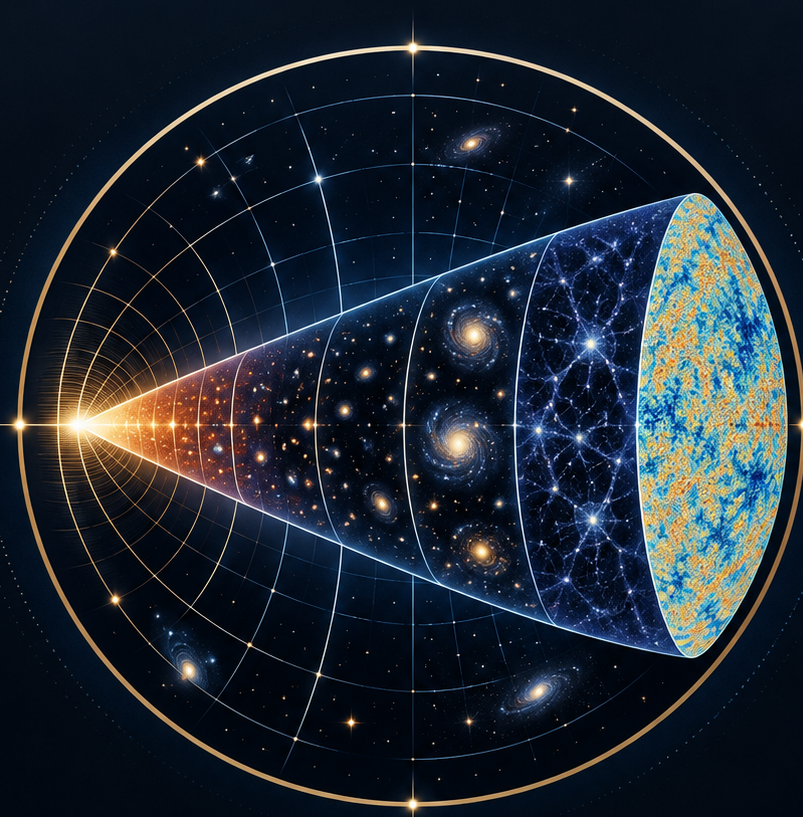
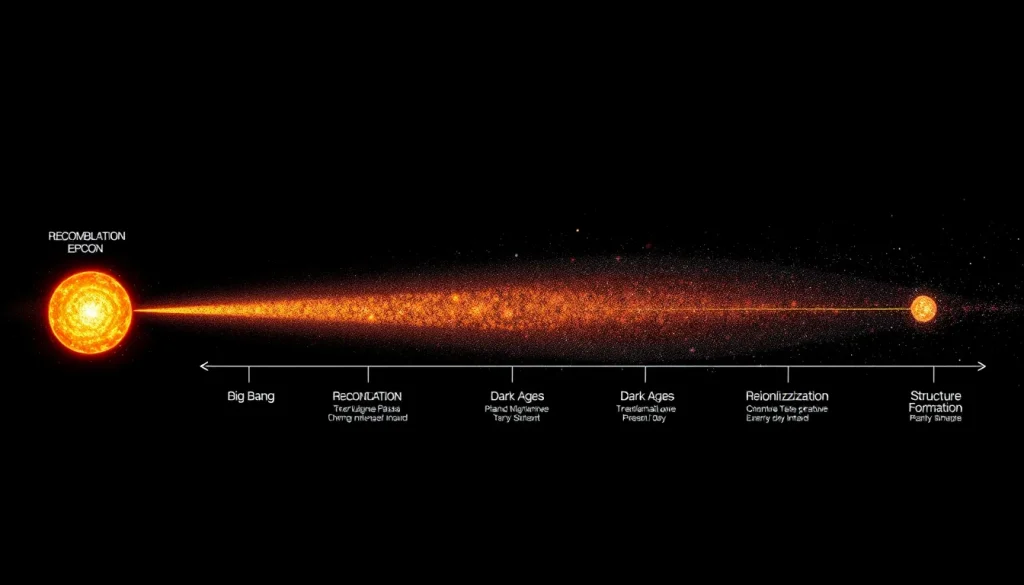
The standard cosmological model (ΛCDM) describes a universe that began in an incredibly hot, dense state and has been expanding and cooling ever since. In the first few hundred thousand years, the universe was a seething plasma of protons, electrons, and photons, all tightly coupled through electromagnetic interactions. Photons continuously scattered off free electrons via Thomson scattering, making the plasma effectively opaque — like trying to see through a thick fog.
This opacity is the fundamental reason we cannot observe earlier times with light. Any photon that existed before recombination would have been scattered countless times, its information hopelessly scrambled. The universe only became transparent when the temperature dropped enough (about 3000 K) for electrons and protons to bind into neutral hydrogen atoms. Once free electrons disappeared, photons could travel unimpeded. These photons, redshifted by cosmic expansion, form the cosmic microwave background we observe today.
The CMB is often called the “surface of last scattering” because it represents the last moment when light interacted with matter. Looking at the CMB is like looking at a wall of fog that has cleared — we see the glow of the fog itself, but nothing behind it. To see earlier, we would need probes that do not interact with matter as strongly as photons, such as neutrinos or gravitational waves, both of which are extremely difficult to detect.
Question Article
Short Answer
Light before recombination was trapped in a dense plasma. Only after recombination did photons decouple, and that decoupled light is the CMB. No telescope that sees light can look beyond this “wall.”
What We Know
We know the universe underwent a phase transition from opaque to transparent about 380,000 years after the Big Bang. This is confirmed by the CMB’s near-perfect blackbody spectrum and its tiny temperature anisotropies, which match predictions from ΛCDM and inflation. The CMB provides a snapshot of the universe at that moment, revealing the seeds of cosmic structure.
What We Don’t Know
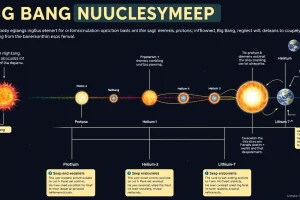
We do not yet have direct observations of the universe before recombination. The physics of the very early universe (Planck epoch, inflation, grand unification) remains largely untested. Even the epoch between inflation and recombination is only indirectly constrained by CMB measurements and primordial nucleosynthesis.
Evidence
The CMB itself is the primary evidence. Its temperature (2.725 K), spectrum, and anisotropies have been measured with increasing precision by COBE, WMAP, and Planck. The existence of acoustic peaks in the CMB power spectrum matches predictions of baryon-photon oscillations before decoupling. Additionally, the observed abundances of light elements from Big Bang nucleosynthesis agree with baryon density derived from CMB data.
Competing Explanations
There are no serious alternatives to recombination in the standard model. Some speculative ideas, such as “tired light” or plasma cosmology, have been proposed, but they fail to explain the CMB spectrum and structure. The ΛCDM model remains the consensus framework.
Current Research
Current and future missions aim to probe the epoch of reionization (when the first stars formed) using JWST and other observatories. The CMB polarization (B-modes) is being studied to detect gravitational waves from inflation, which could give indirect evidence of the very early universe. Neutrino detectors might one day capture the cosmic neutrino background, which decoupled even earlier than the CMB.
Why It Matters
Understanding why we cannot see before recombination with light is central to cosmology. It defines the observable limit of electromagnetic astronomy, which is why missions like COBE, WMAP, and Planck are so important — they map the CMB, the oldest light we can see. This light encodes the initial conditions that led to galaxies, stars, and ultimately life. It also motivates searches for other messengers, such as neutrinos and gravitational waves, that could peer behind the CMB wall.
Evidence / Sources
The following sources provide authoritative background on the early universe and the cosmic microwave background:
- NASA Science – Early Universe: https://science.nasa.gov/mission/webb/early-universe/
- Physics StackExchange – Why are we blind for the era before recombination?: https://physics.stackexchange.com/questions/109103/why-are-we-blind-for-the-era-before-the-recombination
- Forbes – When Did The Universe Become Transparent To Light?: https://www.forbes.com/sites/startswithabang/2019/05/10/when-did-the-universe-become-transparent-to-light/
- Live Science – Did light exist at the beginning of the universe?: https://www.livescience.com/space/cosmology/did-light-exist-at-the-beginning-of-the-universe
Related Registry Entries
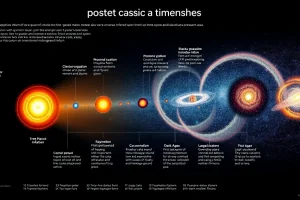
Explore related entries on the cosmic timeline:
- Cosmic Microwave Background
- Recombination
- Inflation
- Photon Epoch
- Dark Ages
- Reionization
FAQ
What exactly is recombination?
Recombination is the epoch when electrons and protons combined to form neutral hydrogen atoms, occurring about 380,000 years after the Big Bang. This removed free electrons, allowing photons to travel freely.
Why is the CMB considered the “oldest light”?
The CMB is composed of photons that decoupled from matter at recombination. Since then, they have been traveling unimpeded, redshifted by cosmic expansion. It is the earliest electromagnetic radiation we can observe.
Can we ever see before recombination?
With light, no. But neutrinos and gravitational waves from earlier epochs are theoretically detectable, though extremely challenging. Future experiments like PTOLEMY or the Cosmic Neutrino Background mapping could open new windows.
Leave a Reply