
Short Answer
Main Explanation
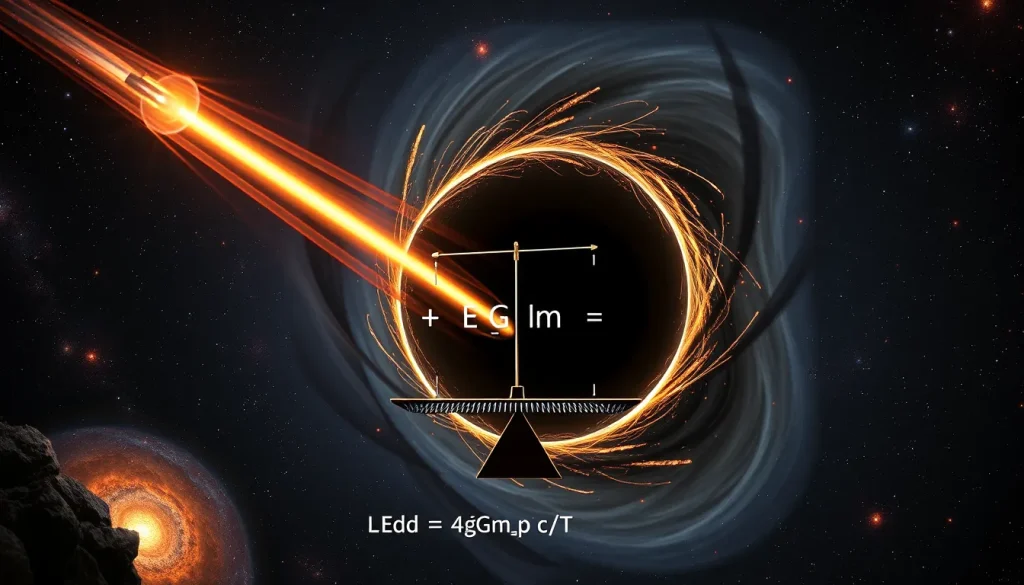
When matter falls toward a black hole, it heats up and radiates. That radiation exerts an outward pressure on the infalling gas. If the pressure becomes too strong, it can blow away the surrounding material, halting accretion. The Eddington limit is the threshold at which the outward radiation force exactly balances the inward gravitational force. For a spherically symmetric, fully ionized hydrogen gas, this balance yields the Eddington luminosity:
L_Edd = 4πGMm_p c / σ_T
where G is the gravitational constant, M is the black hole mass, m_p is the proton mass, c is the speed of light, and σ_T is the Thomson cross-section. The corresponding Eddington accretion rate is M˙_Edd = L_Edd / (ηc²), with η the radiative efficiency (typically ~0.1).
For decades, astronomers assumed black holes could not exceed this limit for long. But the discovery of quasars less than a billion years after the Big Bang—some with masses exceeding a billion solar masses—posed a serious problem. Starting from a stellar-mass seed (~100 M☉), Eddington-limited growth would take longer than the age of the universe at that time. This tension has driven interest in super-Eddington accretion, where the Eddington fraction f_Edd exceeds 1.
Recent work (Johnson & Upton Sanderbeck 2022) showed that sustained super-Eddington accretion is possible if f_Edd ≳ 2/η. In this regime, the radiation carries too little momentum to halt the flow, allowing the black hole to grow rapidly. This condition is met for typical efficiencies (η ≈ 0.1) when f_Edd ≳ 20, but even more modest super-Eddington episodes can help.
Concept
Definition
The Eddington limit is a theoretical cap on luminosity, not a hard physical boundary. It arises from the balance between gravity and radiation pressure in a spherically symmetric flow. In practice, accretion disks are not spherically symmetric, and magnetic fields, outflows, and geometry can allow matter to fall in faster.
How It Works
Photons produced by accretion interact with free electrons via Thomson scattering. Each scattering transfers momentum, creating an outward force. When the outward force per unit area equals the gravitational pull per unit area, accretion stalls. For black holes, the Eddington limit sets a characteristic timescale: the Salpeter time, ~4.5×10^7 years, for e-folding growth at Eddington rate.
Equation
As above, L_Edd = 4πGMm_p c / σ_T. Numerically, L_Edd ≈ 1.26×10^31 (M/M☉) W. For a 10^8 M☉ black hole, that’s ~1.26×10^39 W, comparable to the luminosity of a small galaxy.
Example
Consider the supermassive black hole in the quasar J0313-1806, observed at redshift 7.6 (when the universe was ~670 million years old). Its mass is ~1.6×10^9 M☉. To grow from a 100 M☉ seed at Eddington rate would require ~8×10^8 years—longer than the age of the universe at that redshift. Super-Eddington accretion, even episodic, can compress the growth time sufficiently (Trinca et al. 2025).
Observable Consequences
If black holes undergo super-Eddington accretion, they should produce strong outflows, high X-ray luminosities, and possibly excess UV emission. JWST has discovered several overmassive black holes at high redshift that appear to require super-Eddington episodes (Caleno et al. 2026). Additionally, the Klein–Nishina effect—where Compton scattering cross-section drops at high photon energies—can relax the Eddington limit, as proposed by Frangos et al. (2025).
Common Misconceptions
- “Black holes cannot grow faster than the Eddington rate.” In reality, super-Eddington accretion is possible, especially with non-spherical inflow.
- “The Eddington limit applies to all objects.” It assumes ionized hydrogen and spherical symmetry; it doesn’t apply to cold gas or non-spherical geometries.
- “Exceeding the Eddington limit means the black hole stops accreting.” Instead, it may expel material in jets, while still accreting matter near the equator.
Cosmic Epoch Timeline and Black Hole Growth
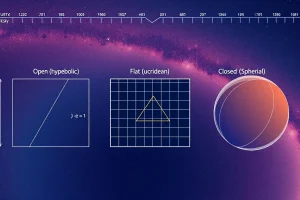
The early universe went through distinct epochs, each affecting black hole seed formation and growth. The table below summarizes the major eras and their relevance to Eddington-limited growth.
| Epoch | Time after Big Bang | Key Physics | Relevance to Black Holes |
|---|---|---|---|
| Planck Epoch | 0 – 10⁻⁴³ s | Quantum gravity | No black holes yet |
| Grand Unification Epoch | 10⁻⁴³ – 10⁻³⁶ s | Unified forces | — |
| Inflationary Epoch | 10⁻³⁶ – 10⁻³² s | Exponential expansion | Sets initial density fluctuations |
| Electroweak Epoch | 10⁻³² – 10⁻¹² s | Electroweak symmetry breaking | — |
| Quark Epoch | 10⁻¹² – 10⁻⁶ s | Quark–gluon plasma | — |
| Hadron Epoch | 10⁻⁶ – 1 s | Protons and neutrons form | — |
| Lepton Epoch | 1 – 10 s | Leptons dominate | — |
| Photon Epoch | 10 s – 380,000 yr | Photons coupled to matter | — |
| Recombination | 380,000 yr | Atoms form, CMB released | — |
| Dark Ages | 380,000 yr – 150 million yr | No stars yet | Primordial black holes? (speculative) |
| Reionization | 150 million – 1 billion yr | First stars and galaxies | First stellar-mass black holes form |
| Structure Formation | 1 billion yr – present | Galaxy clusters, SMBH growth | Eddington-limited and super-Eddington accretion |
Why It Matters
The Eddington limit is central to understanding how supermassive black holes (SMBHs) grew so quickly in the early universe. JWST has revealed numerous galaxies with overmassive black holes at redshifts >6, challenging standard Eddington-limited growth models. Super-Eddington accretion offers a plausible solution, allowing black holes to exceed the nominal limit by factors of tens or more, especially in dense, clumpy environments or with modified physics (e.g., Klein–Nishina corrections). This has profound implications for galaxy evolution, quasar feedback, and the seeds of SMBHs.
Evidence / Sources
Multiple studies support the importance of super-Eddington accretion. Johnson & Upton Sanderbeck (2022) derived a simple condition for sustained super-Eddington growth. Caleno et al. (2026) argue that major mergers can trigger such accretion episodes. Trinca et al. (2025) show that episodic super-Eddington accretion explains overmassive black holes. Frangos et al. (2025) demonstrate that Klein–Nishina effects relax the Eddington limit.
Related Registry Entries
FAQ
What happens if a black hole exceeds the Eddington limit?
It can still accrete matter, but radiation pressure may drive strong outflows. The accretion becomes super-Eddington, and the efficiency of converting mass to energy may change.
Why is the Eddington limit important for early black holes?
It sets a maximum growth rate; if black holes could never exceed it, they couldn't grow massive enough in the time available. Super-Eddington accretion provides a way around this.
Are there other ways to grow black holes fast?
Yes, direct collapse of massive gas clouds could form seeds of 10⁴–10⁵ M☉, and mergers can add mass. But super-Eddington accretion is often invoked to explain the most extreme cases.
Leave a Reply