
Short Answer
Main Explanation
The Friedmann–Lemaître–Robertson–Walker (FLRW) metric is the cornerstone of modern cosmology. It is an exact solution to Einstein’s field equations of general relativity that assumes the universe is spatially homogeneous and isotropic on large scales — a principle known as the cosmological principle. This metric, developed independently by Alexander Friedmann, Georges Lemaître, Howard Robertson, and Arthur Walker in the 1920s and 1930s, provides the mathematical description of an expanding universe and forms the foundation of the ΛCDM ‘concordance’ model [1][2].
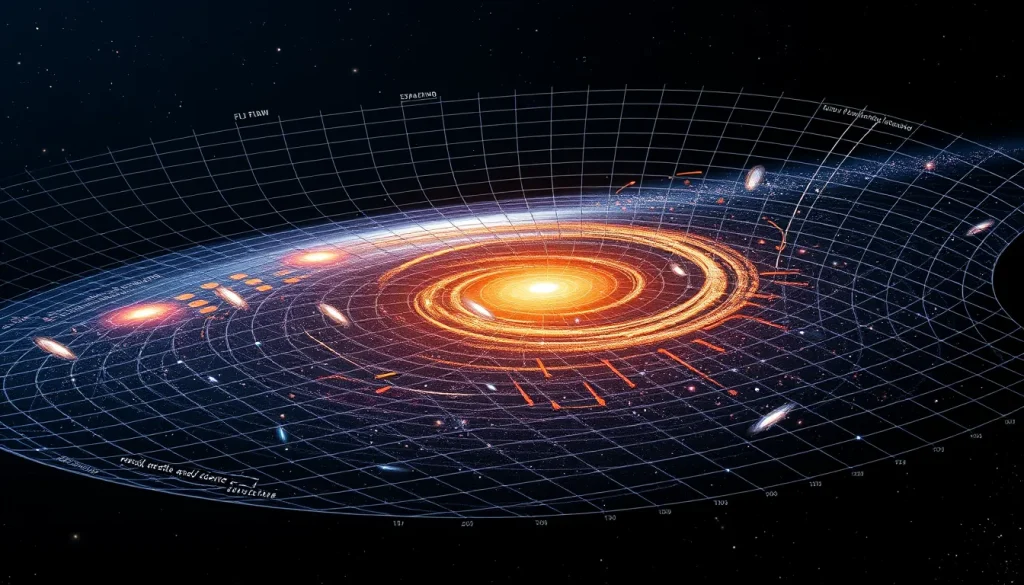
The FLRW metric describes a spacetime with a single dynamic scale factor a(t) that governs the expansion or contraction of space, and a spatial curvature parameter that can be flat, spherical, or hyperbolic. It is the template for all standard cosmological models, from the hot Big Bang to the present epoch of accelerated expansion driven by dark energy.
Concept
Definition
The FLRW metric is a four-dimensional line element that encodes the geometry of a homogeneous and isotropic universe. In its most common form, it is written as:
[ dtau^2 = dt^2 – a^2(t) left( dr^2 + S^2(r) left( dtheta^2 + sin^2theta , dphi^2 right) right) ]
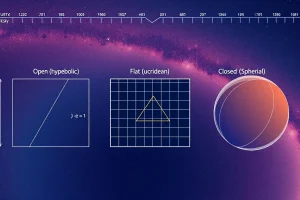
where t is cosmic time, r, θ, φ are spatial comoving coordinates, a(t) is the scale factor, and S(r) depends on the spatial curvature: R sin(r/R) for a sphere, r for flat space, and R sinh(r/R) for a saddle-like (hyperbolic) geometry [2].
How It Works
The metric solves Einstein’s field equations under the assumptions of homogeneity and isotropy. The scale factor a(t) evolves according to the Friedmann equations, which relate the expansion rate (Hubble parameter) to the energy density and pressure of the universe’s contents. The metric also predicts that light from distant objects is redshifted as space expands, and that the geometry of the universe can be inferred from measurements of cosmic distances and the cosmic microwave background (CMB).
Equation
The Friedmann equations, derived from the FLRW metric, are:
[ left(frac{dot{a}}{a}right)^2 = frac{8pi G}{3}rho – frac{k}{a^2} + frac{Lambda}{3} ]
[ frac{ddot{a}}{a} = -frac{4pi G}{3}(rho + 3p) + frac{Lambda}{3} ]
where ρ is energy density, p is pressure, k is curvature constant (0 for flat, +1 for spherical, −1 for hyperbolic), and Λ is the cosmological constant [3][4].
Example
For a flat universe (k=0) filled with non-relativistic matter (pressure ≈ 0), the scale factor grows as a(t) ∝ t2/3. This simple solution describes the matter-dominated era after recombination. The metric also allows us to define the Hubble law: v = H0 d, where H0 is the present-day Hubble constant, directly connecting redshift to distance [3].
Observable Consequences
The FLRW metric predicts the expansion of the universe (Hubble–Lemaître law), the existence and properties of the cosmic microwave background (CMB) as a relic of the hot Big Bang, the primordial abundances of light elements via Big Bang nucleosynthesis, and the growth of large-scale structure from quantum fluctuations amplified by inflation. These predictions have been confirmed with remarkable precision by missions like COBE, WMAP, Planck, and JWST [1][4].
Common Misconceptions
One common misconception is that the FLRW metric describes a universe expanding into an external space. In fact, the metric describes the expansion of space itself; galaxies are not moving through space but are carried along by the expansion of the spatial grid. Another is that the metric is only valid for a perfectly uniform universe — while true on large scales, the metric is still used as a background for studying perturbations that lead to galaxies and clusters.
Cosmic Epochs in the FLRW Framework
The FLRW metric, combined with particle physics, allows us to reconstruct the thermal history of the universe. The following table summarizes the major epochs from the Planck epoch to the present day:
| Epoch | Time after Big Bang | Temperature | Key Events |
|---|---|---|---|
| Planck Epoch | < 10−43 s | > 1032 K | Quantum gravity effects dominate; no known physics. |
| Grand Unification Epoch | 10−43 – 10−36 s | 1027 – 1032 K | Strong and electroweak forces unify; inflation may begin. |
| Inflationary Epoch | 10−36 – 10−32 s | Dropping rapidly | Exponential expansion; quantum fluctuations seeded structure. |
| Electroweak Epoch | 10−32 – 10−12 s | 1015 – 1027 K | Electromagnetic and weak forces separate; particles acquire mass. |
| Quark Epoch | 10−12 – 10−6 s | 1012 – 1015 K | Quarks and gluons form a quark-gluon plasma. |
| Hadron Epoch | 10−6 – 1 s | 1012 – 1010 K | Quarks combine into hadrons (protons, neutrons); matter-antimatter asymmetry emerges. |
| Lepton Epoch | 1 – 10 s | 1010 – 109 K | Leptons dominate; neutrinos decouple. |
| Photon Epoch | 10 s – 380,000 years | 109 – 3000 K | Photons dominate; Big Bang nucleosynthesis creates light elements. |
| Recombination | ~380,000 years | ~3000 K | Electrons combine with protons to form neutral hydrogen; CMB released. |
| Dark Ages | 380,000 – 150 million years | ~3000 – 50 K | No stars yet; universe filled with neutral hydrogen and the CMB cools. |
| Reionization | 150 million – 1 billion years | ~50 – 10 K | First stars and galaxies form; ultraviolet light reionizes hydrogen. |
| Structure Formation | 1 billion years – present | ~10 K – 2.7 K | Galaxies cluster, superclusters form; dark energy accelerates expansion. |
Why It Matters
The FLRW metric is not just a mathematical curiosity; it is the framework on which all modern cosmology rests. It allows us to interpret observations of galaxy redshifts, the CMB temperature anisotropies, and the distribution of large-scale structure in terms of fundamental parameters like the Hubble constant, matter density, and dark energy. The ΛCDM model, based on the FLRW metric, successfully explains the universe’s evolution from the first fractions of a second to the present, and its predictions have been confirmed by missions such as COBE, WMAP, and Planck, which measured the CMB to exquisite precision [1][4]. JWST is now extending these tests into the epoch of reionization and first galaxy formation.
Evidence / Sources
The FLRW metric is supported by a wealth of observational evidence: the linear redshift–distance relation (Hubble’s law), the near-perfect blackbody spectrum of the CMB, the acoustic peaks in the CMB power spectrum, the primordial abundances of helium and deuterium, and the accelerated expansion revealed by Type Ia supernovae. These observations are consistent with a flat universe dominated by dark energy and cold dark matter, as encoded in the ΛCDM model [1][3][4].
Related Registry Entries
Explore other entries in this cosmic registry: Cosmic Microwave Background, Inflation, Recombination, Big Bang, Dark Ages.
FAQ
What does the FLRW metric actually describe?
It describes the geometry of a homogeneous, isotropic expanding universe. It determines how distances between galaxies change over time and how light propagates through the expanding cosmos.
Why is the FLRW metric so important?
It is the foundation of the ΛCDM model, allowing cosmologists to interpret observations of the cosmic microwave background, galaxy surveys, and supernovae in terms of fundamental parameters like the Hubble constant and dark energy density.
What are the main assumptions of the FLRW metric?
The universe is spatially homogeneous (same at every point) and isotropic (same in every direction) on large scales. These assumptions are supported by observations of the CMB and galaxy distributions.
How does the FLRW metric relate to cosmic epochs?
By solving the Friedmann equations derived from the metric, we can model the evolution of the universe through different epochs — from inflation to nucleosynthesis to structure formation — each characterized by the dominant energy content and physical processes.
Leave a Reply