
Short Answer
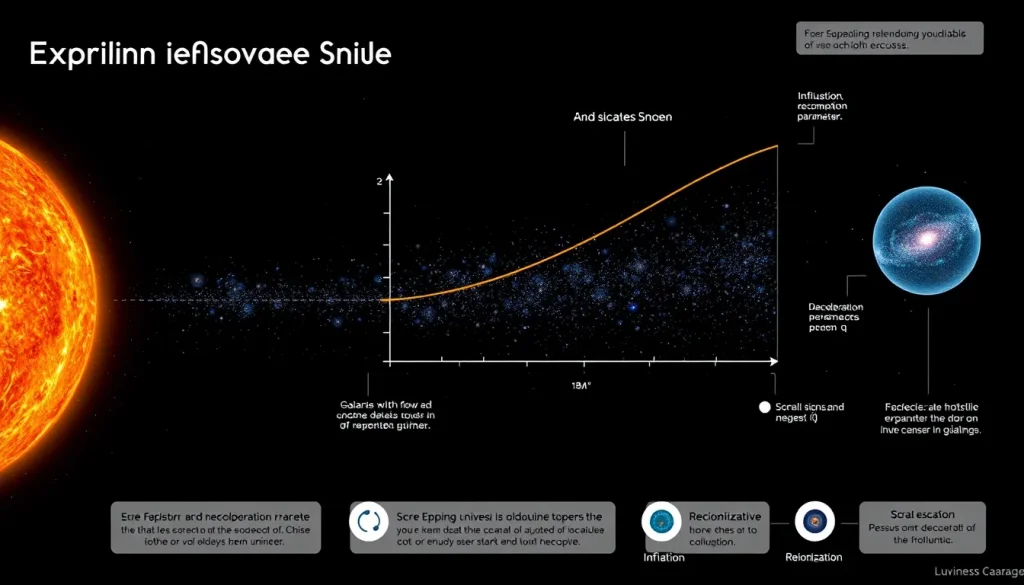
Short Answer: The deceleration parameter q is a dimensionless number that quantifies whether the expansion of the universe is speeding up or slowing down. A negative value of q corresponds to accelerating expansion, as observed today.
| Parameter | Value |
|---|---|
| Symbol | q |
| Definition | q = − (ä a) / (ȧ²) |
| Current value (q₀) | ≈ −0.55 (from Planck + ΛCDM) |
| Units | dimensionless |
| Introduced | Historical, from Friedmann equations |
Main Explanation
The deceleration parameter is a fundamental quantity in physical cosmology. It was introduced when astronomers expected gravity to slow the expansion of the universe, hence the name. In a Friedmann–Lemaître–Robertson–Walker universe, the parameter is defined as
q = − (ä a) / (ȧ²),
where a is the cosmic scale factor, and dots denote derivatives with respect to cosmic time. If the expansion is decelerating (ä < 0), then q is positive; if it is accelerating (ä > 0), q is negative. Observations of distant Type Ia supernovae since 1998 have shown that the expansion is accelerating, so the present-day value q₀ is negative.
The acceleration equation of Friedmann cosmology relates q to the density parameters of the universe:
q = (1/2) Ωm − ΩΛ + Ωr,
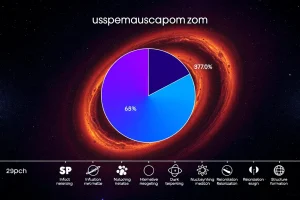
ignoring curvature. Using the latest Planck values (Ωm,0 = 0.30495, ΩΛ,0 = 0.695, Ωr,0 = 0.00005), we obtain q₀ ≈ −0.54, confirming acceleration. In the past, when matter and radiation dominated, q was positive; the transition to negative q occurred when dark energy began to dominate, roughly 5 billion years ago.
Cosmic Epochs and the Deceleration Parameter
The deceleration parameter is not constant throughout cosmic history. Its evolution tracks the changing balance of radiation, matter, and dark energy. The table below outlines the major epochs of the universe, from the Planck epoch to the present, with approximate times, temperatures, and key events.
| Epoch | Time after Big Bang | Temperature | Key Events |
|---|---|---|---|
| Planck epoch | 0 – 10⁻⁴³ s | > 10³² K | Quantum gravity regime; all forces unified |
| Grand Unification epoch | 10⁻⁴³ – 10⁻³⁶ s | 10²⁸ – 10³² K | Strong force separates; inflation begins |
| Inflationary epoch | 10⁻³⁶ – 10⁻³² s | ~10²⁸ K | Exponential expansion; seeds of structure form |
| Electroweak epoch | 10⁻³² – 10⁻¹² s | 10¹⁵ – 10²⁸ K | Electromagnetic and weak forces separate |
| Quark epoch | 10⁻¹² – 10⁻⁶ s | 10¹² – 10¹⁵ K | Quarks and gluons exist in quark–gluon plasma |
| Hadron epoch | 10⁻⁶ – 1 s | 10¹⁰ – 10¹² K | Protons and neutrons form; annihilation of baryons and antibaryons |
| Lepton epoch | 1 – 10 s | 10⁹ – 10¹⁰ K | Leptons and antileptons dominate; neutrinos decouple |
| Photon epoch | 10 s – 380,000 yr | 10⁴ – 10⁹ K | Photons dominate; nucleosynthesis occurs |
| Recombination | ~380,000 yr | ~3000 K | Electrons combine with nuclei; CMB released |
| Dark Ages | 380,000 – 150 million yr | ~3000 – 50 K | No stars; universe filled with neutral hydrogen |
| Reionization | 150 million – 1 billion yr | ~50 – 20 K | First stars and galaxies ionize hydrogen |
| Structure Formation | 1 billion yr – present | < 20 K | Galaxies, clusters, and large-scale structure form |
The cosmic microwave background (CMB) is a relic of recombination. Missions such as COBE, WMAP, and Planck have mapped its anisotropies, providing precise constraints on cosmological parameters and confirming the ΛCDM model. The James Webb Space Telescope (JWST) is now probing the era of reionization and the first galaxies.
Concept
Definition
The deceleration parameter q is defined as the negative of the ratio of the scale factor’s second derivative times the scale factor to the square of its first derivative. It is a dimensionless measure of the curvature of the expansion history.
How It Works
In an expanding universe, the scale factor a(t) describes how distances grow. If q > 0, the expansion is slowing; if q < 0, it is speeding up. The parameter is derived from the Friedmann acceleration equation, which links the acceleration of the scale factor to the energy content of the universe.
Equation
q = − (ä a) / (ȧ²) = − (1/H²) (ä/a),
where H = ȧ/a is the Hubble parameter.
Example
In a matter-dominated universe (Ωm = 1, ΩΛ = 0), the deceleration parameter is exactly 0.5. In a dark-energy-dominated universe (ΩΛ = 1), it is −1. Our universe is a mix, giving q₀ ≈ −0.55.
Observable Consequences
A negative q means distant supernovae appear fainter than expected in a decelerating universe. It also affects the growth of large-scale structure and the age of the universe. Measurements of the CMB and baryon acoustic oscillations independently support the accelerating expansion.
Common Misconceptions
One misconception is that the deceleration parameter is a constant. It varies with cosmic time, being positive in the early universe and negative today. Another is that a negative q implies the universe is expanding faster than light; it does not—it describes the rate of change of the expansion rate, not the expansion speed itself.
Why It Matters
The deceleration parameter is a direct probe of the universe’s energy composition. Its measured negative value was the first clear evidence for dark energy, a mysterious component that drives acceleration. Understanding q helps cosmologists refine the ΛCDM model, test alternative theories, and determine the ultimate fate of the cosmos.
Evidence / Sources
Key evidence includes:
- Type Ia supernova surveys (1998–1999) showing dimming at high redshift.
- Planck satellite measurements of the CMB power spectrum.
- Baryon acoustic oscillation surveys (e.g., SDSS, DESI).
- Theoretical framework of the Friedmann equations and ΛCDM model.
Related Registry Entries
Explore these related concepts:
- Hubble Parameter
- Scale Factor
- Friedmann Equations
- Dark Energy
- Cosmic Microwave Background
FAQ
What is the deceleration parameter in simple terms?
It tells us whether the expansion of the universe is slowing down (positive q) or speeding up (negative q).
How was the deceleration parameter measured?
By observing distant Type Ia supernovae and mapping the cosmic microwave background, cosmologists determined q₀ ≈ −0.55.
Does a negative q mean the universe is expanding faster than light?
No. q describes the change in expansion rate, not the expansion speed itself. Galaxies can recede faster than light due to the expansion of space, but that is a separate phenomenon.
What is the value of q during the radiation-dominated era?
In a radiation-dominated universe, q = 1. In a matter-dominated universe, q = 0.5. The universe transitioned from positive to negative q about 5 billion years ago.
Leave a Reply