
Short Answer
Short Answer
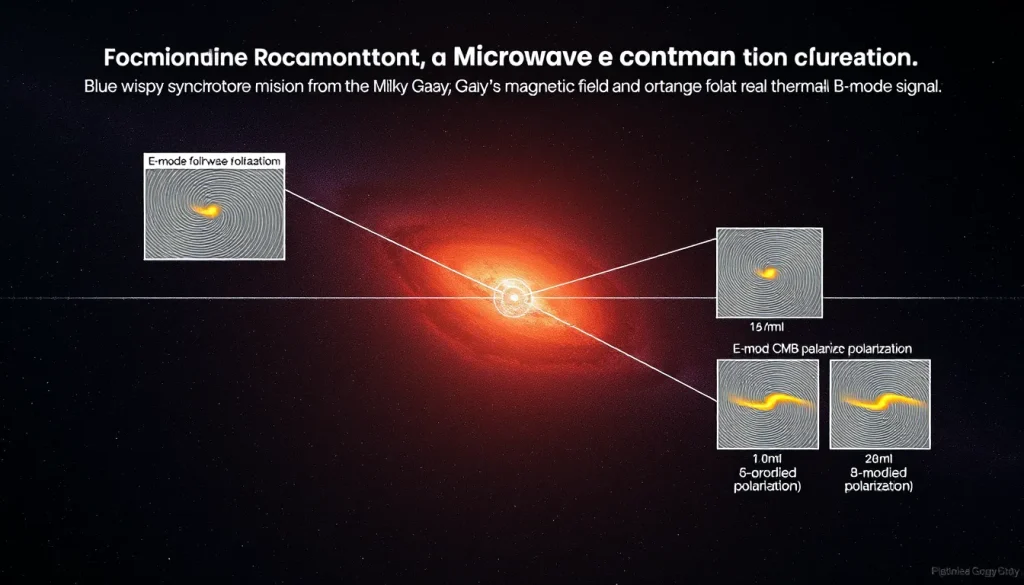
CMB foregrounds are all astrophysical emissions—from the Milky Way and extragalactic sources—that contaminate measurements of the cosmic microwave background. They are especially damaging to polarization studies because diffuse Galactic synchrotron radiation and thermal dust emission can be polarized at levels of 10–40%, completely overwhelming the faint polarization signal of the CMB, including the primordial B-mode signal that would confirm the inflationary paradigm.
At a Glance: CMB Foregrounds
| Topic | CMB Foregrounds |
| Primary Types | Synchrotron, thermal dust, free-free, extragalactic sources |
| Polarization Level | ≥10% (synchrotron: 20–40% at high latitudes) |
| Key Challenge | B-mode detection for cosmic inflation |
| Mitigation | Component separation via multi-frequency observations |
| Key Missions | COBE, WMAP, Planck, S-PASS, future CMB-S4, LiteBIRD |
Main Explanation
The Cosmic Microwave Background (CMB) is the oldest light in the universe, emitted approximately 380,000 years after the Big Bang during the epoch of recombination. In the first instants of cosmic history, the universe was an opaque plasma of photons, electrons, and atomic nuclei. As space expanded and cooled, protons and electrons combined to form neutral hydrogen—an event called recombination—and photons were finally able to stream freely across the cosmos. Those same photons, stretched to microwave wavelengths by nearly 13.8 billion years of cosmic expansion, constitute the CMB we observe today.
The CMB is not a perfectly uniform glow. It carries tiny temperature fluctuations of roughly one part in 100,000, which are the seeds from which all galaxies and large-scale structures grew. It also carries a faint polarization signal encoding critical information about the physics of the early universe. But between the surface of last scattering and our detectors lies a universe full of matter and radiation that contaminates this signal. These contaminants are the CMB foregrounds.
A Brief History of the Cosmos
The standard model of cosmology—the Lambda-CDM model—describes a universe that began in an extremely hot, dense state and has been expanding and cooling ever since. The major epochs of cosmic history are summarized below.
| Epoch | Time After Big Bang | Temperature | Key Events |
|---|---|---|---|
| Planck Epoch | 0 to ~10⁻⁴³ s | >10³² K | Quantum gravity era; all four forces unified |
| Grand Unification Epoch | ~10⁻⁴³ to ~10⁻³⁶ s | ~10²⁸ K | Gravity separates from the other forces |
| Inflationary Epoch | ~10⁻³⁶ to ~10⁻³² s | ~10²⁷ K | Exponential expansion; quantum fluctuations become seeds of structure |
| Electroweak Epoch | ~10⁻³² to ~10⁻¹² s | ~10¹⁵ K | Electromagnetic and weak forces separate |
| Quark Epoch | ~10⁻¹² to ~10⁻⁶ s | ~10¹² K | Quarks and gluons form a quark-gluon plasma |
| Hadron Epoch | ~10⁻⁶ to ~1 s | ~10¹² to 10¹⁰ K | Protons and neutrons form; matter-antimatter asymmetry emerges |
| Lepton Epoch | ~1 to ~10 s | ~10¹⁰ K | Leptons and antileptons dominate; neutrinos decouple |
| Photon Epoch | ~10 s to ~380,000 yr | ~10¹⁰ to 3,000 K | Photons dominate; Big Bang nucleosynthesis forms light elements |
| Recombination | ~380,000 yr | ~3,000 K | Atoms form; CMB photons released |
| Dark Ages | ~380,000 to ~150 million yr | ~3,000 to ~50 K | No luminous sources; neutral hydrogen pervades |
| Reionization | ~150 million to ~1 billion yr | ~50 to ~20 K | First stars and galaxies ionize neutral hydrogen |
| Structure Formation | ~1 billion yr to present | ~20 K to 2.7 K | Galaxies, clusters, and large-scale structure form |
What Are CMB Foregrounds?
As Dickinson (2016) defines them, CMB foregrounds consist of all radiation between the surface of last scattering and the detectors that can interfere with the cosmological interpretation of CMB data. There are several major classes of foregrounds, each with distinct spectral and polarization properties.
Synchrotron radiation dominates at low frequencies (below roughly 70 GHz). It is produced by relativistic electrons spiraling in the Milky Way’s magnetic field, and it is strongly polarized—with fractional polarization of 20–40% at high Galactic latitudes (Dickinson, 2010). This makes synchrotron emission the most serious contaminant for low-frequency CMB polarization measurements.
Thermal dust emission dominates at high frequencies (above roughly 300 GHz). Interstellar dust grains heated by starlight emit in the far-infrared and submillimeter regime. Dust grains aligned with the Galactic magnetic field produce polarized emission at levels of 10% or more (Dickinson, 2016).
Free-free (bremsstrahlung) radiation arises from free electrons interacting with ions in ionized gas. It is largely unpolarized but still contaminates temperature measurements, particularly at intermediate frequencies.
Extragalactic sources—radio galaxies, quasars, and dusty star-forming galaxies—also contribute significantly, even on large angular scales of about one degree (Dickinson, 2010).
Why Polarization Matters
The CMB’s polarization pattern can be decomposed into two geometric components: E-modes (curl-free) and B-modes (divergence-free). E-modes were first detected in 2002 by the DASI instrument and arise primarily from scalar density perturbations. B-modes, however, are special: at large angular scales, primordial B-modes can only be generated by gravitational waves produced during cosmic inflation. As Dickinson (2016) emphasizes, B-modes are a “smoking-gun signature of inflation.”
The problem is that the B-mode signal is extraordinarily faint—far fainter than the polarized foregrounds. Galactic synchrotron and thermal dust emissions, polarized at 10–40%, can easily mimic or mask the cosmological B-mode signal. Component separation is therefore critical for future CMB polarization missions, requiring many channels covering a wide range of frequencies to ensure that foreground modeling errors are minimized (Dickinson, 2016).
Mitigation: Component Separation
The standard approach to dealing with foregrounds is multi-frequency observation. Different foregrounds have distinct spectral signatures: synchrotron follows a power law in frequency, dust follows a modified blackbody spectrum, and the CMB follows a blackbody spectrum. By observing at many frequencies, astronomers can separate the components statistically. However, this approach is imperfect. As Dickinson (2010) notes, simulations suggest that a detection at the level of r = 0.001 (the tensor-to-scalar ratio) might be achievable “if the foregrounds are not too complex.”
Concept
Definition
CMB foregrounds are all astrophysical emissions between the surface of last scattering and the observer that contaminate CMB measurements. They include Galactic synchrotron radiation, thermal dust emission, free-free radiation, and extragalactic point sources (Dickinson, 2016).
How It Works
Foregrounds contaminate CMB observations by adding extra signal at the observed frequencies. In temperature, they are relatively easy to mitigate because their spectral shapes differ from the CMB’s blackbody spectrum. In polarization, however, they are far more problematic because Galactic synchrotron and dust are naturally polarized at high levels, and their polarization angles can mimic the faint B-mode pattern expected from inflation.
Example
The S-Band Polarization All Sky Survey (S-PASS) was a dedicated survey of the southern sky designed to investigate Galactic CMB foregrounds at low frequencies, where synchrotron emission dominates (Carretti, 2010). Such surveys provide the data needed to model and subtract foregrounds in CMB polarization analyses.
Observable Consequences
Foregrounds can create false B-mode signals that mimic inflation, or they can mask the true cosmological signal entirely. If not properly accounted for, they can lead to incorrect conclusions about the tensor-to-scalar ratio r and the energy scale of inflation.
Common Misconceptions
A common misconception is that foregrounds can be completely removed from CMB data. In practice, they can only be mitigated through careful component separation, and residual uncertainties always remain. Another misconception is that foregrounds only affect temperature measurements—in fact, they are far more damaging to polarization measurements because of their high fractional polarization.
Why It Matters
The detection of primordial B-modes would confirm the inflationary paradigm and provide a direct window into physics at energy scales far beyond what particle accelerators can achieve. It would also constrain the energy scale of inflation and the physics of gravitational waves in the early universe. But this detection hinges entirely on our ability to separate the CMB signal from foregrounds. Future missions such as LiteBIRD, the Simons Observatory, and CMB-S4 are designed with multi-frequency capabilities specifically to address this challenge. The stakes are high: as Dickinson (2010) concludes, a detection at r = 0.001 might be achievable, but only if foregrounds are not too complex and if our modeling is sufficiently accurate.
Evidence / Sources
The scientific understanding of CMB foregrounds is built on decades of observations and modeling. Key sources include Dickinson (2010), which reviews the severity of polarized foregrounds for B-mode detection; Dickinson (2016), which provides a comprehensive overview of CMB foregrounds and their mitigation; Fraisse et al. (2008), which details the CMBPol mission concept and foreground science; and Carretti (2010), which describes the S-PASS survey of Galactic synchrotron foregrounds. Together, these works establish the current consensus that foregrounds are the primary obstacle to detecting inflationary B-modes.
Related Registry Entries
FAQ
Can CMB foregrounds be completely removed?
No. Foregrounds can only be mitigated through component separation techniques that exploit the different spectral signatures of each emission component. Residual uncertainties always remain, which is why future missions require many frequency channels to minimize modeling errors (Dickinson, 2016).
Why are B-modes so important for cosmology?
Primordial B-modes can only be generated by gravitational waves produced during cosmic inflation. Their detection would be a smoking-gun confirmation of the inflationary paradigm and would provide constraints on the energy scale of inflation (Dickinson, 2016).
What is the most problematic foreground for polarization?
At low frequencies, Galactic synchrotron emission is the dominant contaminant, with fractional polarization of 20–40% at high latitudes. At high frequencies, thermal dust emission dominates, with polarization levels of 10% or more. Both are serious challenges for B-mode detection (Dickinson, 2010).
How do astronomers separate CMB from foregrounds?
Astronomers observe the sky at multiple frequencies and exploit the distinct spectral signatures of each component. The CMB follows a blackbody spectrum, synchrotron follows a power law, and dust follows a modified blackbody spectrum. Algorithms such as ILC (Internal Linear Combination), SEVEM, and SMICA are used to extract the CMB component.
Leave a Reply