
Short Answer
Main Explanation
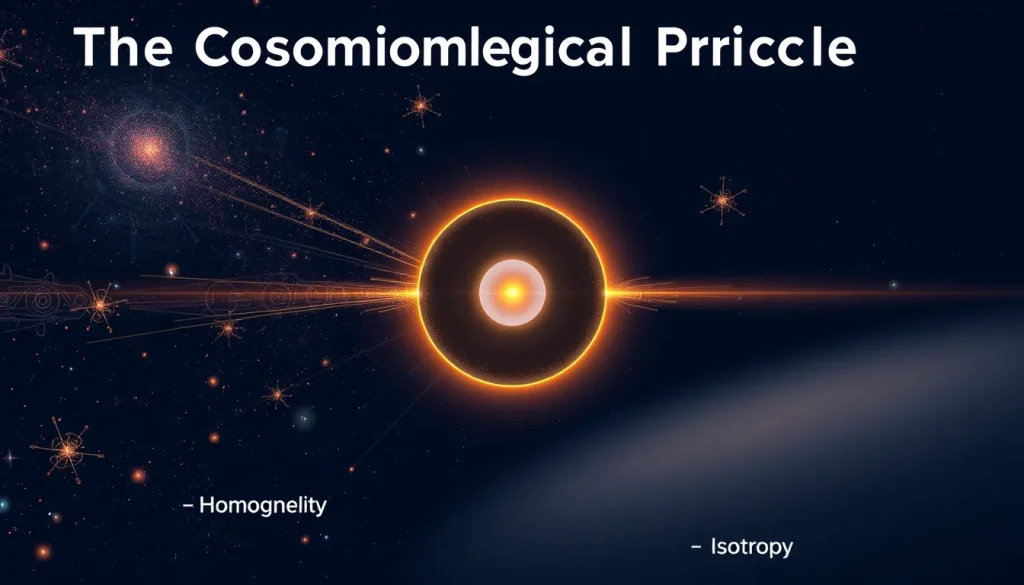
The cosmological principle is the foundational assumption that the universe, when viewed on sufficiently large scales, is both homogeneous (the same in every location) and isotropic (the same in every direction). This principle is what allows cosmologists to apply the Friedmann–Lemaître–Robertson–Walker (FLRW) metric and build the standard ΛCDM model of the universe. Without it, we could not meaningfully speak of a single cosmic expansion history or a universal age of the cosmos.
Testing the cosmological principle is therefore not merely an academic exercise—it is a crucial check on the very framework of modern cosmology. Observations of the cosmic microwave background (CMB), the large-scale distribution of galaxies, and the subtle imprints of baryon acoustic oscillations (BAO) all provide ways to probe homogeneity and isotropy. In recent years, some analyses have claimed possible violations, such as the “hemisphere asymmetry” in galaxy distributions or anomalies in the CMB. However, careful re-examinations often show these to be statistical flukes or artifacts of selection effects.
The Cosmic Epochs: A Context for Testing
To understand the cosmological principle, it helps to see the universe as a sequence of distinct epochs, each governed by different physics. From the Planck epoch to the present, the universe has expanded, cooled, and structured itself in ways that are consistent with an isotropic and homogeneous backdrop.
| Epoch | Time After Big Bang | Temperature | Key Events |
|---|---|---|---|
| Planck Epoch | 0 to 10⁻⁴³ s | >10³² K | Quantum gravity effects dominate; no current theory |
| Grand Unification Epoch | 10⁻⁴³ to 10⁻³⁶ s | 10²⁸–10³² K | Strong and electroweak forces unified; inflation begins |
| Inflationary Epoch | 10⁻³⁶ to 10⁻³² s | ~10²⁷ K | Exponential expansion; quantum fluctuations seeded structure |
| Electroweak Epoch | 10⁻³² to 10⁻¹² s | 10¹⁵–10²⁸ K | Electromagnetic and weak forces separate; particle production |
| Quark Epoch | 10⁻¹² to 10⁻⁶ s | 10¹²–10¹⁵ K | Quarks and gluons exist in a quark–gluon plasma |
| Hadron Epoch | 10⁻⁶ to 1 s | 10¹⁰–10¹² K | Protons and neutrons form; matter–antimatter annihilation |
| Lepton Epoch | 1 to 10 s | 10⁹–10¹⁰ K | Electrons, muons, neutrinos; neutrinos decouple |
| Photon Epoch | 10 s to 380,000 yr | 3,000–10⁹ K | Photons dominate; nucleosynthesis (BBN) occurs |
| Recombination | ~380,000 yr | ~3,000 K | Electrons combine with nuclei; CMB released |
| Dark Ages | 380,000 yr to ~150 million yr | ~60–3,000 K | Dark, no stars; matter clumps gravitationally |
| Reionization | ~150 million to ~1 billion yr | ~20–60 K | First stars and galaxies ionize hydrogen |
| Structure Formation | ~1 billion yr to present | 2.7 K (now) | Galaxies, clusters, and superclusters form |
The CMB is a direct relic of the recombination epoch. Its near-perfect uniformity—temperature fluctuations of only 1 part in 100,000—is one of the strongest pieces of evidence for the cosmological principle. The tiny anisotropies that do exist are thought to be quantum fluctuations stretched by inflation, and they later seeded the large-scale structure we observe today.
When we test the cosmological principle, we are essentially asking whether these fluctuations and the subsequent structure formation are consistent with a statistically homogeneous and isotropic universe. Galaxy surveys like the Dark Energy Spectroscopic Instrument (DESI) map the distribution of millions of galaxies, allowing us to search for coherent anisotropies. Baryon acoustic oscillations provide a standard ruler that can be used to measure the expansion history in different directions, testing isotropy.
Evidence
Observation
The most direct observations come from the CMB, measured by COBE, WMAP, and Planck. The Planck satellite mapped the temperature and polarization of the CMB with exquisite precision, confirming that the universe is isotropic to about 1 part in 10⁵. Galaxy surveys, such as DESI, SDSS, and 2dFGRS, have mapped the three-dimensional distribution of galaxies, revealing a web of filaments and voids that is statistically consistent with homogeneity on scales above about 100 Mpc.
Prediction
The ΛCDM model, built on the cosmological principle, predicts that the CMB should be nearly isotropic with a specific angular power spectrum, that galaxy clustering should be statistically homogeneous, and that the expansion rate should be the same in all directions. Any significant deviation would require new physics or a breakdown of the FLRW metric.
Measurement
Measurements of the CMB temperature anisotropy by Planck (2018) give a dipole anisotropy of about 0.1% due to our peculiar motion, but after subtracting that, the residual isotropy is extremely high. Galaxy surveys measure the correlation function and power spectrum of galaxy clustering, which match the predictions of ΛCDM. BAO measurements, such as those from DESI, provide distance measurements that are consistent with isotropy.
Why It Supports the Model
The consistency of these measurements with the FLRW metric is a powerful confirmation. The observed galaxy distribution, the CMB, and the primordial abundances of light elements all align with the standard model. The cosmological principle is not just an assumption; it is a falsifiable hypothesis that has passed many tests.
Limitations
Tests are limited by cosmic variance—we can only observe one universe—and by the finite volume of our observable horizon. Additionally, some anomalies, such as the “axis of evil” in the CMB or the “hemisphere asymmetry” reported in some galaxy samples, have been debated. A 2026 analysis by Wang and Huang (JCAP) parameterized hemisphere asymmetries and found no significant deviation, while Sawala (2026) showed that the local galaxy distribution from DESI DR1 is consistent with ΛCDM simulations.
Alternative Explanations
Some alternative models, such as inhomogeneous cosmologies (e.g., Lemaître–Tolman–Bondi void models), attempt to explain observations without the cosmological principle. However, these are strongly constrained by CMB and BAO data. The consensus remains that the standard model is the most parsimonious explanation.
Current Scientific Consensus
The cosmological principle is accepted as a working assumption, but it is continuously tested. The 2023 review by Aluri et al. in Classical and Quantum Gravity concluded that while there are hints of anomalies, none rise to the level of a robust violation. As surveys reach larger volumes and higher precision, the principle will be tested even more stringently.
Why It Matters
The cosmological principle is not merely a philosophical stance. It is the mathematical foundation for the Friedmann equations, which describe the expansion of the universe. If the principle were violated, our entire interpretation of cosmic expansion, dark energy, and dark matter would need revision. Moreover, the principle underlies the interpretation of every cosmological observable—from the CMB to supernovae distances. Testing it rigorously is essential for ensuring that our cosmic story is built on solid ground.
Evidence / Sources
The key sources for this article include:
- Wang & Huang (2026), “Testing the cosmological principle on gigaparsec scales,” JCAP 02(2026)031.
- Bengaly (2022), “A null test of the Cosmological Principle with BAO measurements,” Physics of the Dark Universe.
- Aluri et al. (2023), “Is the observable Universe consistent with the cosmological principle?” Classical and Quantum Gravity 40, 094001.
- Sawala (2026), “The Local Galaxy Distribution Does Not Violate the Cosmological Principle,” ApJL 1007, L22.
Related Registry Entries
Explore related concepts in the cosmic registry:
- Cosmic Microwave Background – the relic radiation from recombination.
- Baryon Acoustic Oscillations – frozen sound waves that serve as standard rulers.
- Large-Scale Structure – the cosmic web of galaxies and voids.
- Inflation – the rapid expansion that seeded density fluctuations.
FAQ
What exactly is the cosmological principle?
It is the assumption that the universe is homogeneous (the same at every location) and isotropic (the same in every direction) on sufficiently large scales. This allows the use of the FLRW metric and forms the basis of the standard ΛCDM model.
How do we test the cosmological principle?
We test it by comparing observations of the CMB, galaxy distributions, and BAO to the predictions of an isotropic and homogeneous universe. If significant deviations were found, the principle would be questioned.
Has the cosmological principle been violated?
No robust violation has been confirmed. Some anomalies, like hemispheric asymmetries in galaxy surveys, have been reported, but subsequent analyses (e.g., Sawala 2026) show they are consistent with ΛCDM within cosmic variance.
Why is testing the cosmological principle important?
If the principle were false, our entire interpretation of cosmic expansion, dark energy, and dark matter would be invalid. It is a foundational test of the standard model of cosmology.

Leave a Reply