
Short Answer
Main Explanation
Redshift is the phenomenon whereby light from distant galaxies is stretched to longer, redder wavelengths as it travels through an expanding universe. This stretching is a direct consequence of the expansion of space itself: as space expands, the wavelength of light traveling through it also expands. The cosmological redshift is distinct from the Doppler shift caused by relative motion; it arises from the cumulative expansion of the universe between the emitter and the observer.
To measure a galaxy’s redshift, astronomers obtain its spectrum and identify characteristic spectral lines—either emission lines from hot gas or absorption lines from cooler material. These lines have known rest wavelengths (e.g., the Balmer series of hydrogen). By comparing the observed wavelengths with the rest wavelengths, the redshift z is calculated using the formula:
z = (λobs – λrest) / λrest
where λobs is the observed wavelength and λrest is the emitted (rest) wavelength. For example, if a hydrogen Balmer line at 656.3 nm is observed at 700 nm, then z = (700 – 656.3) / 656.3 ≈ 0.066. A higher z means a greater expansion of space since the light was emitted, hence a more distant galaxy (in the context of the standard cosmological model).
Edwin Hubble first demonstrated the relationship between galaxy distance and recession velocity in the 1920s, using spectroscopy to measure redshifts and Cepheid variables to estimate distances. This relation, now known as the Hubble–Lemaître law, states that the recession velocity of a galaxy is proportional to its distance, with the proportionality constant being the Hubble constant (H0). Modern surveys, such as the Sloan Digital Sky Survey (SDSS), measure redshifts for millions of galaxies, providing a three-dimensional map of the large-scale structure of the universe.
It is important to note that the redshift of a galaxy is composed of both cosmological expansion and peculiar velocities (Doppler shifts due to gravitational interactions). For distant galaxies, the cosmological component dominates, but for nearby galaxies, the two can be comparable. Astronomers often decompose the total redshift into these components when studying local dynamics.
Cosmic Epochs: A Timeline
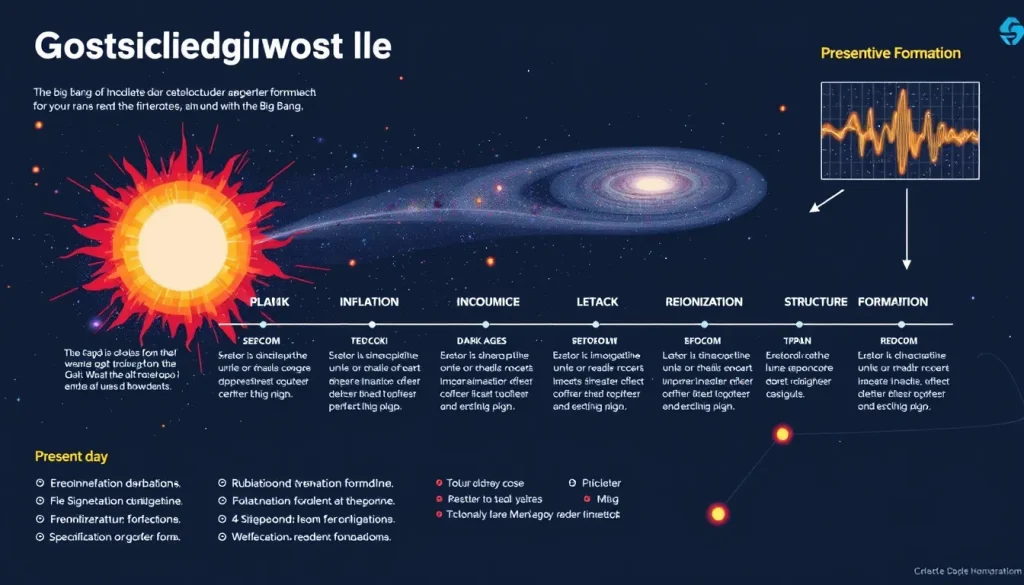
The universe began about 13.8 billion years ago with the Big Bang. Since then, it has undergone a series of distinct epochs, each characterized by different physical conditions and dominant particles. The table below summarizes the major epochs, their approximate times, temperatures, redshifts, and key events.
| Epoch | Time (after Big Bang) | Temperature | Approx. Redshift | Key Events |
|---|---|---|---|---|
| Planck Epoch | 0 – 10−43 s | > 1032 K | > 1032 | Quantum gravity era; all four fundamental forces unified. |
| Grand Unification Epoch | 10−43 – 10−36 s | 1027 – 1032 K | 1027 – 1032 | Strong and electroweak forces separate. |
| Inflationary Epoch | 10−36 – 10−32 s | ~1027 K | ~1027 | Exponential expansion; seeds of large-scale structure formed. |
| Electroweak Epoch | 10−32 – 10−12 s | 1015 – 1027 K | 1015 – 1027 | Electromagnetic and weak forces separate; particles acquire mass. |
| Quark Epoch | 10−12 – 10−6 s | 1012 – 1015 K | 1012 – 1015 | Quarks and gluons exist in a quark-gluon plasma. |
| Hadron Epoch | 10−6 – 1 s | 1010 – 1012 K | 1010 – 1012 | Protons and neutrons form; matter and antimatter annihilate. |
| Lepton Epoch | 1 – 10 s | 109 – 1010 K | 109 – 1010 | Leptons dominate; neutrinos decouple. |
| Photon Epoch | 10 s – 380,000 yr | 104 – 109 K | 104 – 109 | Photons dominate; nucleosynthesis occurs (first elements form). |
| Recombination | ~380,000 yr | ~3,000 K | ~1,100 | Electrons combine with nuclei to form neutral atoms; universe becomes transparent; CMB released. |
| Dark Ages | 380,000 yr – ~150 million yr | ~3,000 K – ~50 K | 1,100 – ~20 | No stars yet; universe filled with neutral hydrogen and dark matter. |
| Reionization | ~150 million – ~1 billion yr | ~50 K – ~10 K | 20 – ~6 | First stars and galaxies form; ultraviolet light reionizes neutral hydrogen. |
| Structure Formation | ~1 billion yr – present | < 10 K | < 6 | Galaxies cluster; dark energy accelerates expansion; universe evolves to present state. |
Each epoch is defined by the dominant physical processes and particle content. The cosmic microwave background (CMB) is the relic radiation from recombination, observed today as a nearly uniform glow at a temperature of 2.725 K. Its detailed anisotropies, first measured by COBE and later mapped with high precision by WMAP and Planck, provide a wealth of information about the early universe, including its geometry, composition, and the seeds of structure.
After recombination, the universe entered the Dark Ages, a period with no luminous sources. The first stars and galaxies formed during the epoch of reionization, when their ultraviolet radiation ionized the neutral hydrogen. This process is being directly probed by the James Webb Space Telescope (JWST), which can observe galaxies at redshifts as high as ~13.
Inflation, a brief period of exponential expansion in the first fraction of a second, explains the observed flatness and homogeneity of the universe on large scales, as well as the origin of density fluctuations that later grew into galaxies and clusters.
Why It Matters
Measuring galaxy redshift is not just a technical exercise; it is the fundamental probe of cosmic expansion and evolution. Redshift surveys allow astronomers to map the large-scale structure of the universe, measure the Hubble constant, and constrain the properties of dark energy and dark matter. The cosmic timeline described above is built on redshift measurements combined with theoretical models. Understanding how redshift is measured and interpreted is essential for grasping the evidence for the Big Bang and the current ΛCDM model, which is the standard consensus cosmology.
Evidence / Sources
The following sources provide authoritative information on redshift measurement and cosmic history:
- NASA Science: Hubble Cosmological Redshift
- SDSS SkyServer: Redshifts
- NED/IPAC: Extragalactic Redshifts
Related Registry Entries
Explore related topics in our encyclopedia:
FAQ
What is the difference between cosmological redshift and Doppler redshift?
Cosmological redshift is caused by the expansion of space itself, stretching light as it travels. Doppler redshift is due to the relative motion of the source and observer. For distant galaxies, the cosmological component dominates, while for nearby objects, Doppler shifts can be significant.
How do astronomers measure the redshift of a galaxy?
Astronomers obtain a spectrum of the galaxy and identify known spectral lines (e.g., hydrogen Balmer lines). By comparing the observed wavelengths to the rest wavelengths, they compute z using the formula z = (λ_obs - λ_rest) / λ_rest.
What is the highest redshift galaxy observed?
As of 2026, the James Webb Space Telescope has identified galaxies at redshifts as high as z ≈ 13, corresponding to about 300 million years after the Big Bang. These observations are probing the epoch of reionization.
Why is the cosmic microwave background important for cosmology?
The CMB is a snapshot of the universe at recombination (z ≈ 1100). Its temperature anisotropies encode information about the universe's composition, geometry, and the seeds of large-scale structure, providing strong evidence for the ΛCDM model.

Leave a Reply