
Short Answer
Main Explanation
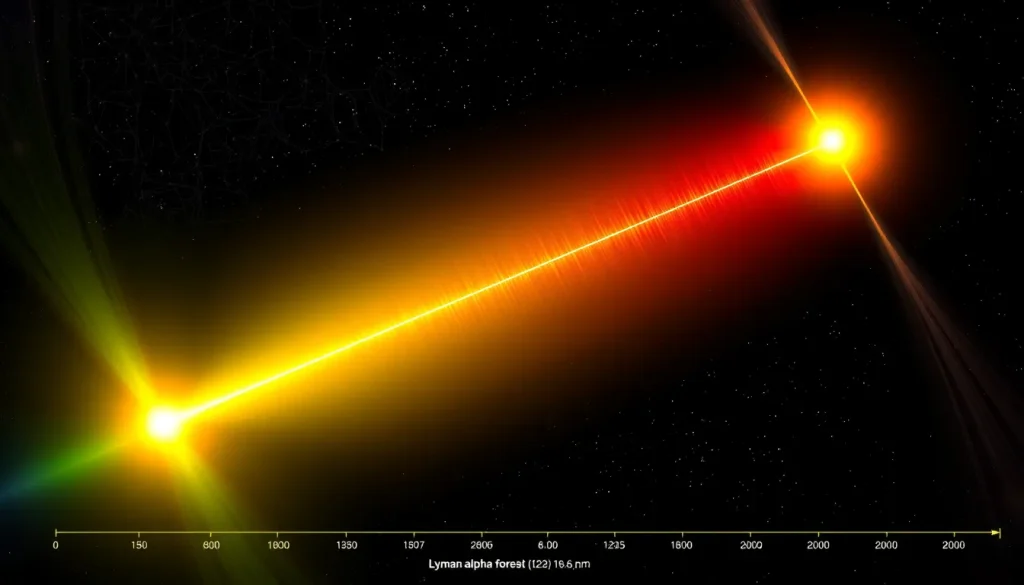
The Lyman-alpha forest is one of the most powerful tools in observational cosmology. It refers to the dense thicket of absorption lines seen in the ultraviolet spectra of distant quasars, caused by neutral hydrogen gas in the intergalactic medium (IGM) absorbing photons at the Lyman-alpha transition (121.6 nm). As light from a quasar travels across billions of light-years, it passes through countless clouds of hydrogen gas, each at a different redshift. Each cloud imprints its own absorption line, creating a “forest” of lines that encodes the distribution of matter along the line of sight.
This phenomenon provides a direct, three-dimensional map of the IGM, allowing astronomers to trace the evolution of cosmic structure from the epoch of reionization (z ~ 6) to the present day. The Lyman-alpha forest is thus a key probe of the universe’s expansion, the growth of density fluctuations, and the thermal history of the intergalactic gas.
Definition
The Lyman-alpha forest is a series of absorption lines in the spectra of distant quasars and galaxies, arising from the Lyman-alpha electron transition of neutral hydrogen (n=2 to n=1) at a rest wavelength of 121.6 nm. As light travels through multiple gas clouds at different redshifts, each cloud absorbs at a different observed wavelength, producing a dense “forest” of lines (Rauch, 1998; Wikipedia, 2026).
How It Works
Quasars are extraordinarily luminous active galactic nuclei powered by supermassive black holes. Their spectra exhibit a strong emission line at 121.6 nm (the Lyman-alpha line) produced by hydrogen in the quasar’s vicinity. As this light travels toward Earth, the expansion of the universe stretches its wavelength (cosmological redshift). When the light encounters a cloud of neutral hydrogen along the way, the hydrogen absorbs photons at the Lyman-alpha frequency in the cloud’s rest frame. Since the cloud is at a lower redshift than the quasar, the absorption occurs at a wavelength slightly shorter than the quasar’s emission line. Multiple clouds at different distances produce multiple absorption lines at different wavelengths, creating the forest.
The strength of each absorption line depends on the column density of neutral hydrogen in the cloud, while the wavelength position gives the cloud’s redshift. By analyzing the forest, astronomers can reconstruct the density, temperature, and ionization state of the IGM along the line of sight (MIT OCW, 2023).
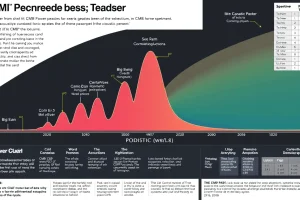
To place the Lyman-alpha forest in context, it is useful to review the major epochs of cosmic evolution, from the Planck epoch to the present day. The table below summarizes these epochs, their approximate redshifts, temperatures, and key events.
| Epoch | Redshift | Temperature | Key Events |
|---|---|---|---|
| Planck Epoch | >10^32 | ~10^32 K | Quantum gravity effects dominate |
| Grand Unification Epoch | ~10^27 | ~10^27 K | Unification of strong and electroweak forces |
| Inflationary Epoch | ~10^27 – 10^22 | ~10^27 K | Exponential expansion; seeds of structure |
| Electroweak Epoch | ~10^15 | ~10^15 K | Electromagnetic and weak forces separate |
| Quark Epoch | ~10^12 | ~10^12 K | Quarks and gluons form quark-gluon plasma |
| Hadron Epoch | ~10^12 – 10^10 | ~10^12 – 10^10 K | Protons and neutrons form |
| Lepton Epoch | ~10^10 – 10^9 | ~10^10 – 10^9 K | Leptons dominate; neutrinos decouple |
| Photon Epoch | ~10^9 – 1100 | ~10^9 – 3000 K | Photons dominate; nucleosynthesis occurs |
| Recombination | ~1100 | ~3000 K | Electrons and protons combine to form neutral hydrogen; CMB released |
| Dark Ages | ~1100 – 20 | ~3000 – 60 K | No luminous sources; neutral hydrogen fills the universe |
| Reionization | ~20 – 6 | ~60 – 10 K | First stars and galaxies reionize the IGM |
| Structure Formation | ~6 – 0 | <10 K | Galaxies, clusters, and large-scale structure form |
The Lyman-alpha forest is primarily observed at redshifts between 2 and 5, corresponding to the epoch when the IGM was highly ionized but still contained residual neutral hydrogen clouds. At higher redshifts (z > 6), the forest gives way to the Gunn-Peterson trough, indicating the end of reionization.
Equation
The observed wavelength of a Lyman-alpha absorption line from a cloud at redshift z is given by:
λ_obs = λ_α (1 + z)
where λ_α = 121.6 nm is the rest-frame Lyman-alpha wavelength.
Example
Consider a quasar at redshift z = 3.0. A neutral hydrogen cloud at redshift z = 2.5 will absorb light at λ_obs = 121.6 nm × (1 + 2.5) = 425.6 nm, which falls in the visible range. Multiple clouds at different redshifts produce a series of lines at different observed wavelengths.
Observable Consequences
The Lyman-alpha forest has several observable consequences: it provides a measurement of the baryon density, constrains the temperature history of the IGM, and reveals the power spectrum of density fluctuations on small scales. It also serves as a probe of dark matter, as the gas distribution traces the underlying dark matter potential wells.
Common Misconceptions
A common misconception is that the Lyman-alpha forest is caused by gas within our own galaxy. In fact, the absorption lines arise from intergalactic gas at various distances, each at a different redshift. Another misconception is that the forest is a single continuous absorption; in reality, it is a series of discrete lines. Finally, some think the forest is unrelated to cosmic evolution, but it is a direct tracer of structure growth.
Why It Matters
The Lyman-alpha forest is indispensable for modern cosmology. It allows astronomers to:
- Map the distribution of baryonic matter in the universe on scales of megaparsecs.
- Measure the expansion rate of the universe at intermediate redshifts, complementing supernova and CMB data.
- Constrain the nature of dark matter and dark energy through the growth of structure.
- Study the epoch of reionization and the formation of the first stars and galaxies.
- Test models of galaxy formation and feedback processes.
Moreover, the forest provides a unique view of the intergalactic medium, which contains most of the baryonic matter at low redshifts, and serves as a laboratory for studying gas physics under extreme conditions.
Evidence / Sources
The Lyman-alpha forest was first discovered by Roger Lynds in 1970 in the spectrum of quasar 4C 05.34 (Wikipedia, 2026). Subsequent observations by Bahcall and Goldsmith confirmed the phenomenon. The theoretical framework linking the forest to the IGM was developed in the 1990s, with hydrodynamic simulations reproducing the observed absorption patterns. Key observational programs include the Keck Observatory’s HIRES spectrograph, the Very Large Telescope’s UVES, and the Sloan Digital Sky Survey’s quasar spectra. Space-based observatories such as the Hubble Space Telescope have extended the forest to lower redshifts (z < 1.5).
For authoritative reviews, see Rauch (1998) in the Annual Review of Astronomy and Astrophysics, and the MIT OpenCourseWare lecture notes (2023). The Carnegie Observatories lecture notes also provide a comprehensive overview.
Related Registry Entries
Explore related topics in this interactive reference:
- The Cosmic Microwave Background
- The Epoch of Reionization
- Quasars and Active Galactic Nuclei
- Large-Scale Structure of the Universe
Last reviewed: September 5, 2026
FAQ
What causes the Lyman-alpha forest?
The Lyman-alpha forest is caused by neutral hydrogen clouds in the intergalactic medium absorbing light from background quasars at the Lyman-alpha transition (121.6 nm). Each cloud at a different redshift produces an absorption line at a different observed wavelength, creating a series of lines.
How does the Lyman-alpha forest help measure the expansion of the universe?
By measuring the redshifts of absorption lines, astronomers can determine the distances to the absorbing clouds. The distribution of these clouds as a function of redshift provides constraints on the expansion history and the growth of structure, complementing other probes like supernovae and the CMB.
What is the Gunn-Peterson trough?
The Gunn-Peterson trough is a complete absorption of quasar flux at wavelengths just blueward of the Lyman-alpha emission line, occurring when the IGM is fully neutral. Its absence at redshifts z < 6 indicates that the universe was reionized by then.
How does the Lyman-alpha forest relate to reionization?
During reionization, the IGM transitions from neutral to ionized. The Lyman-alpha forest disappears at z > 6 because the neutral IGM absorbs all Lyman-alpha photons, producing the Gunn-Peterson trough. Observations of the forest at z ~ 5–6 constrain the end of reionization.
Leave a Reply