
Short Answer
Short Answer / Definition
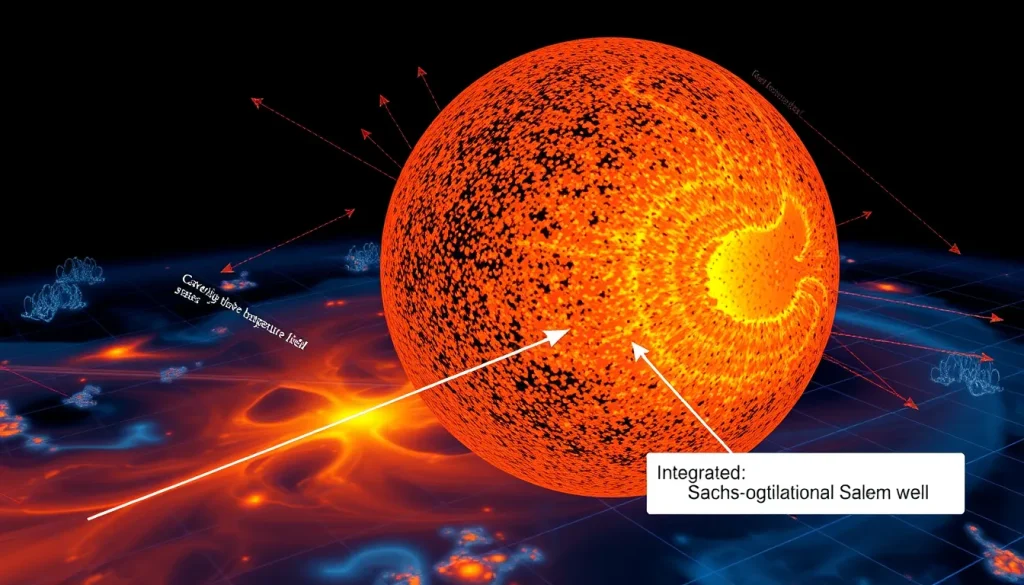
The integrated Sachs–Wolfe (ISW) effect is a secondary anisotropy in the cosmic microwave background (CMB) caused by the time variation of gravitational potentials along the line of sight. When a CMB photon passes through a region where the gravitational potential is changing—because the universe’s expansion is accelerating or because structure is evolving—the photon gains or loses energy, leaving a characteristic imprint on the CMB temperature map. This effect is a direct probe of the dark energy density and the growth of cosmic structure.
Main Explanation
The cosmic microwave background (CMB) is the oldest light in the universe, released about 380,000 years after the Big Bang when the universe cooled enough for protons and electrons to form neutral hydrogen. This relic radiation has traveled through the expanding universe, and its temperature fluctuations encode information about conditions at the surface of last scattering as well as everything the photons encountered along the way.
The Sachs–Wolfe effect, named after Rainer K. Sachs and Arthur M. Wolfe, describes how gravitational fields alter CMB photon energies. The non-integrated Sachs–Wolfe effect occurs at the surface of last scattering: photons climbing out of gravitational potential wells lose energy (gravitational redshift), while those from overdensities gain energy. This effect is constant for a given potential and is a primary source of CMB anisotropy on large angular scales.
The integrated Sachs–Wolfe effect, by contrast, accumulates along the entire path from the last scattering surface to us. It arises when the gravitational potential wells and hills change with time. In a universe dominated by matter, gravitational potentials are constant (they neither grow nor decay), so the net effect cancels. But if the expansion accelerates—as it does today under dark energy—or if radiation dominates (as in the early universe), the potentials decay, and photons passing through them experience a net energy shift. This secondary anisotropy is the integrated Sachs–Wolfe effect.
The ISW effect is a powerful tool for studying dark energy because its amplitude depends directly on the rate at which gravitational potentials evolve, which in turn depends on the expansion history. By cross-correlating CMB temperature maps with large-scale structure (galaxy surveys), astronomers can isolate the ISW signal from the dominant primary anisotropies.
Cosmic Timeline: From Planck Epoch to Structure Formation
The ISW effect is part of the broader story of cosmic evolution. The universe has passed through several distinct epochs, each governed by different physical processes. The table below summarizes the major eras, their approximate times, temperatures, and key events.
| Epoch | Time after Big Bang | Temperature | Key events |
|---|---|---|---|
| Planck epoch | 0 – 10⁻⁴³ s | >10³² K | Quantum gravity effects; all forces unified |
| Grand Unification epoch | 10⁻⁴³ – 10⁻³⁶ s | 10²⁸ – 10³² K | Strong force separates from electroweak |
| Inflationary epoch | 10⁻³⁶ – 10⁻³² s | ~10²⁷ K | Exponential expansion; seeds for structure |
| Electroweak epoch | 10⁻³² – 10⁻¹² s | 10¹⁵ – 10²⁸ K | Electromagnetic and weak forces separate |
| Quark epoch | 10⁻¹² – 10⁻⁶ s | 10¹² – 10¹⁵ K | Quarks and gluons form quark–gluon plasma |
| Hadron epoch | 10⁻⁶ – 1 s | 10¹⁰ – 10¹² K | Protons and neutrons form; matter–antimatter annihilation |
| Lepton epoch | 1 s – 10 s | 10⁹ – 10¹⁰ K | Leptons dominate; neutrinos decouple |
| Photon epoch | 10 s – 380,000 yr | 3,000 – 10⁹ K | Photons coupled to matter; Big Bang nucleosynthesis |
| Recombination | ~380,000 yr | ~3,000 K | Electrons and protons combine; CMB released |
| Dark Ages | 380,000 – ~150 million yr | ~3,000 K to ~60 K | No stars; neutral hydrogen fills the universe |
| Reionization | ~150 million – 1 billion yr | ~60 K to ~20 K | First stars and galaxies ionize hydrogen |
| Structure Formation | >1 billion yr | <20 K | Galaxies, clusters, and large-scale structure grow |
The CMB we observe today is a snapshot of the universe at recombination. The ISW effect modifies that snapshot by adding a secondary signal from the later evolution of potentials, especially during the dark-energy–dominated era (roughly the last 5 billion years).
Concept
Definition
The integrated Sachs–Wolfe effect is the cumulative gravitational redshift or blueshift of CMB photons caused by the time evolution of gravitational potentials along the line of sight.
How It Works
Photons travel through a universe filled with overdensities (clusters) and underdensities (voids). If the gravitational potentials are constant in time, a photon gains energy falling into a well and loses the same amount climbing out—net zero. But if the potential decays (because cosmic acceleration stretches the well), the photon emerges with a net gain or loss. The effect is “integrated” because it sums contributions from every potential well along the path.
Equation
The temperature fluctuation from the ISW effect is given by:
ΔT/T = -2 ∫ (∂Φ/∂t) dt / c
where Φ is the gravitational potential, t is cosmic time, and the integral is along the photon’s path. The factor of 2 arises from the relativistic time dilation.
Example
Consider a CMB photon passing through a supercluster. If the cluster’s gravitational potential is slowly decaying due to cosmic acceleration, the photon gains a small amount of energy (blueshift) on the way in and loses less on the way out, resulting in a net blueshift—a hot spot in the CMB correlated with the cluster’s location.
Observable Consequences
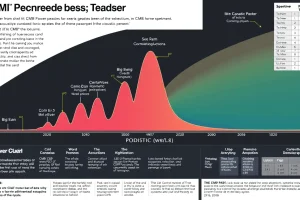
The ISW effect produces a positive correlation between CMB temperature and galaxy density on angular scales of several degrees. This correlation is strongest for low-redshift structures (z < 2) where dark energy dominates. It also contributes to the CMB power spectrum at low multipoles (ℓ < 10).
Common Misconceptions
One misconception is that the ISW effect is the same as the ordinary Sachs–Wolfe effect. The ordinary effect is a primary anisotropy from the last scattering surface, while the ISW is a secondary effect that accumulates afterward. Another misconception is that the ISW effect can be observed directly in the CMB maps alone; in practice, it is extracted via cross-correlation with galaxy surveys because its amplitude is small compared to primary fluctuations.
Why It Matters
The integrated Sachs–Wolfe effect is one of the few direct probes of the accelerating expansion of the universe. Its amplitude depends on the growth rate of structure and the equation of state of dark energy. By measuring the ISW signal, cosmologists can test the standard ΛCDM model and constrain alternative theories of gravity. It also provides a way to map the distribution of dark energy and to check for deviations from general relativity on cosmological scales.
Evidence / Sources
The ISW effect was first detected in the early 2000s through cross-correlation of CMB data from the Wilkinson Microwave Anisotropy Probe (WMAP) with galaxy catalogs. Subsequent analyses using Planck data have confirmed the signal at high significance. The Planck 2013 results paper (arXiv:1303.5079) reported a detection with about 4σ significance. More recent studies combine data from dark energy surveys to improve constraints.
Related Registry Entries
Related phenomena and concepts include the ordinary Sachs–Wolfe effect, the Rees–Sciama effect (a nonlinear ISW contribution), gravitational lensing of the CMB, and the integrated Sachs–Wolfe effect’s role in the late-time integrated Sachs–Wolfe effect.
FAQ
What is the difference between the Sachs–Wolfe effect and the integrated Sachs–Wolfe effect?
The Sachs–Wolfe effect includes both the non-integrated (primary) effect at the last scattering surface and the integrated (secondary) effect along the line of sight. The non-integrated part is constant, while the integrated part depends on time-varying potentials.
How is the ISW effect detected?
It is detected by cross-correlating CMB temperature maps with large-scale structure (galaxy positions). The correlation appears as a small positive signal at angular scales of several degrees.
Why is the ISW effect important for dark energy?
The ISW effect is directly sensitive to the decay of gravitational potentials, which is caused by the accelerated expansion driven by dark energy. Its amplitude can be used to measure the dark energy density and equation of state.
Does the ISW effect affect the CMB power spectrum?
Yes, it contributes to the low-multipole (large-angle) part of the CMB power spectrum, but it is subdominant compared to the primary anisotropies.

Leave a Reply