
Short Answer
Main Explanation
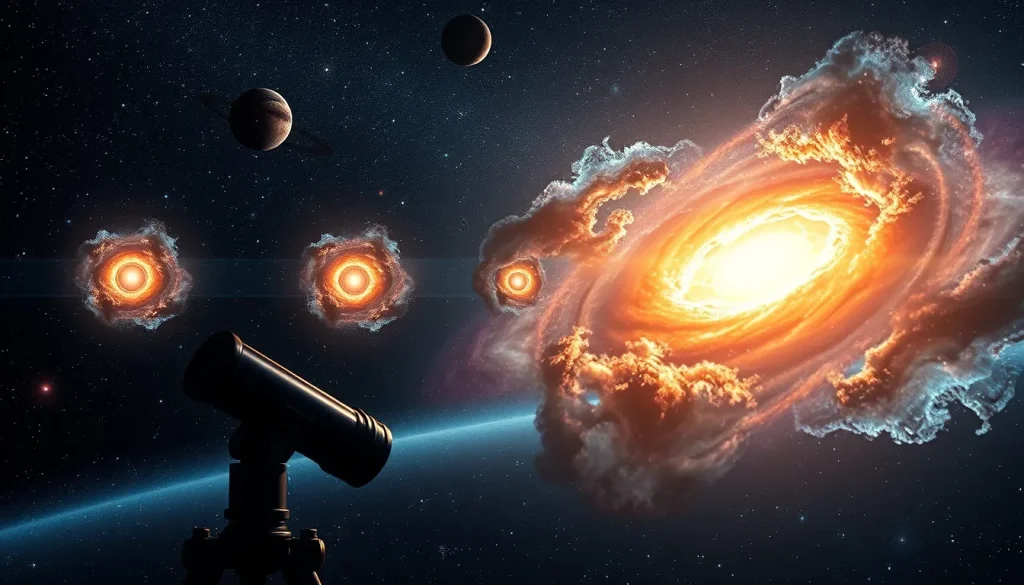
The first galaxies are the fundamental building blocks of the cosmic structure we see today. They formed at the end of the cosmic dark ages, a few hundred million years after the Big Bang, when gravity pulled together the first clumps of dark matter and primordial gas. Understanding their observational signatures is one of the most active frontiers in cosmology, and the James Webb Space Telescope (JWST) has revolutionized this field since its launch.
What Are the First Galaxies?
According to the standard Lambda-CDM model, the first galaxies assembled in dark matter halos with masses around 108–109 solar masses. These systems hosted the first generations of stars—Population III stars—which were massive, metal-free, and short-lived. The first galaxies are often defined as the first gravitationally bound structures that sustained star formation and produced ionizing radiation. Bromm and Yoshida (2011) review the theoretical framework for their formation, emphasizing that they emerged at redshifts z ≈ 10–30, roughly 100–500 million years after the Big Bang.
Observational Signatures
Detecting these distant galaxies requires observing light that has been redshifted into the near-infrared. The primary observational signatures include:
- Ultraviolet continuum: The combined light of young, hot stars produces a strong UV continuum. Due to cosmic expansion, this light is redshifted to infrared wavelengths for galaxies at z > 7.
- Lyman-alpha emission: The 121.6 nm Lyman-alpha line from hydrogen is a classic tracer of star-forming galaxies. However, at high redshift, the intergalactic medium can scatter this line, making it a complex but valuable probe.
- Nebular emission lines: Strong recombination lines such as H-alpha and [O III] can be used to measure star formation rates and metallicity. Jeon and Bromm (2018) showed that H-alpha emission might be the most promising detection channel for the very first galaxies with JWST.
- Continuum break: The Lyman break feature—a sharp drop in flux blueward of Lyman-alpha—is used to identify high-redshift galaxy candidates via photometric selection.
Zackrisson et al. (2011) modeled the spectral evolution of Population III galaxies and provided JWST detection limits and color criteria, predicting that JWST could detect such objects in deep fields if they are sufficiently luminous.
The Cosmic Timeline: From the Planck Epoch to Structure Formation
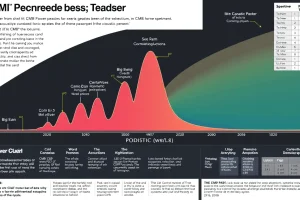
To place the first galaxies in context, it is useful to review the major epochs of cosmic history. The following table summarizes the key phases:
| Epoch | Time after Big Bang | Approximate Redshift | Key Events |
|---|---|---|---|
| Planck Epoch | 0 – 10-43 s | > 1032 | Quantum gravity era; all forces unified |
| Grand Unification Epoch | 10-43 – 10-36 s | 1032 – 1028 | Strong and electroweak forces separate |
| Inflationary Epoch | 10-36 – 10-32 s | 1028 – 1024 | Exponential expansion; seeds of structure |
| Electroweak Epoch | 10-32 – 10-12 s | 1024 – 1016 | Electromagnetic and weak forces separate |
| Quark Epoch | 10-12 – 10-6 s | 1016 – 1012 | Quarks and gluons form quark-gluon plasma |
| Hadron Epoch | 10-6 – 1 s | 1012 – 1010 | Protons and neutrons form; baryogenesis |
| Lepton Epoch | 1 – 10 s | 1010 – 109 | Leptons dominate; neutrinos decouple |
| Photon Epoch | 10 s – 380,000 yr | 109 – 1100 | Photons dominate; Big Bang nucleosynthesis |
| Recombination | 380,000 yr | 1100 | Electrons combine with nuclei; CMB released |
| Dark Ages | 380,000 yr – ~100 Myr | 1100 – 30 | No luminous sources; hydrogen neutral |
| Reionization | ~100 Myr – 1 Gyr | 30 – 6 | First stars and galaxies ionize the IGM |
| Structure Formation | > 1 Gyr | < 6 | Galaxies cluster; large-scale structure grows |
Key Missions and Instruments
Our understanding of the early universe has been shaped by a series of space missions. COBE (1989) measured the cosmic microwave background (CMB) spectrum and anisotropy, confirming the hot Big Bang. WMAP (2001) provided high-precision maps of CMB temperature fluctuations, pinning down cosmological parameters. Planck (2009) improved these measurements further, constraining the Hubble constant and the tilt of the primordial power spectrum. JWST (2021) is now observing the first galaxies directly, with deep field surveys such as JADES and CEERS revealing galaxies at redshifts beyond z=13.
How We Detect Them
Astronomers use two main techniques to identify first-galaxy candidates: deep imaging with photometric redshift selection (using the Lyman break) and spectroscopy to measure Lyman-alpha or other emission lines. JWST’s near-infrared camera (NIRCam) and near-infrared spectrograph (NIRSpec) are optimized for these observations. The detection of a galaxy at z ≈ 13 implies we are seeing it as it was just 300 million years after the Big Bang—a direct view into the cosmic dawn.
What We Know, What We Don’t Know, and Current Research
What we know: The first galaxies were small, numerous, and highly efficient at producing ionizing photons. They likely had low metallicity and high specific star formation rates. JWST has confirmed that galaxies existed at z > 13, and their UV luminosity functions suggest a steep rise in star formation density at early times.
What we don’t know: The exact properties of Population III stars remain elusive. Whether the first galaxies were dominated by Population III or already enriched by Population II stars is unclear. The escape fraction of ionizing radiation and the role of feedback (supernovae, radiation) are also poorly constrained.
Evidence: The primary evidence comes from deep JWST photometry and spectroscopy. For example, Stark et al. (2025) review current knowledge of galaxies in the first billion years, highlighting the surprising abundance of luminous galaxies and the presence of strong emission lines. The detection of H-alpha in a simulated first galaxy by Jeon and Bromm (2018) supports the idea that nebular lines are key signatures.
Competing explanations: Some observations show more bright galaxies at high redshift than predicted by simple models, which might indicate enhanced star formation efficiency, a top-heavy IMF, or contributions from active galactic nuclei. Alternative explanations involving modified dark matter or varying initial mass functions are being explored, but the standard Lambda-CDM framework remains the consensus.
Current research: Ongoing JWST programs are targeting the most distant candidates for spectroscopic confirmation, measuring their metallicities and ionization states. Future observatories like the Nancy Grace Roman Space Telescope and the Vera C. Rubin Observatory will complement these efforts.
Why It Matters
The first galaxies are the bridge between the smooth early universe and the complex cosmos we inhabit. They reionized the intergalactic medium, enriched it with heavy elements, and seeded the growth of larger structures. Studying their observational signatures tells us how the universe transitioned from darkness to light, and it tests our models of galaxy formation, star formation, and cosmology at the earliest times. Furthermore, the techniques developed to find these galaxies—photometric redshifts, emission-line diagnostics, and deep field surveys—are now standard tools for all of astrophysics.
Evidence / Sources
The following sources provide the foundational information for this article:
- Bromm, V. & Yoshida, N. (2011). The First Galaxies. Annual Review of Astronomy and Astrophysics, 49, 373–407. doi:10.1146/annurev-astro-081710-102608
- Stark, D. P., Topping, M. W., Endsley, R., & Tang, M. (2025). Observations of the First Galaxies in the Era of JWST. arXiv:2501.17078. doi:10.48550/arxiv.2501.17078
- Jeon, M. & Bromm, V. (2018). Signature of the first galaxies in JWST deep field observations. arXiv:1812.06116. arXiv:1812.06116
- Zackrisson, E. et al. (2011). The spectral evolution of the first galaxies. I. JWST detection limits and colour criteria for population III galaxies. arXiv:1105.0921. arXiv:1105.0921
Related Registry Entries
Explore related topics in the Cosmic Registry:
- Cosmic Dawn
- Reionization
- Population III Stars
- JWST Deep Field Surveys
- Lyman-alpha Emitters
FAQ
What are the main observational signatures of the first galaxies?
The main signatures are the ultraviolet continuum from young stars, Lyman-alpha emission from hydrogen, nebular lines like H-alpha and [O III], and the Lyman break in the spectral energy distribution. These are redshifted into the infrared for galaxies at z > 7.
How does JWST detect the first galaxies?
JWST uses its near-infrared camera (NIRCam) for deep imaging to identify candidates via photometric redshifts (Lyman break technique) and its near-infrared spectrograph (NIRSpec) to confirm redshifts and measure emission lines. Its infrared sensitivity is crucial because the light from the first galaxies is redshifted out of the optical.
What is the cosmic dawn and how does it relate to the first galaxies?
The cosmic dawn refers to the period when the first stars and galaxies formed, roughly 100–500 million years after the Big Bang. It marks the end of the Dark Ages and the beginning of reionization, when ultraviolet radiation from these objects ionized the neutral hydrogen in the universe.

Leave a Reply