
Short Answer
Main Explanation
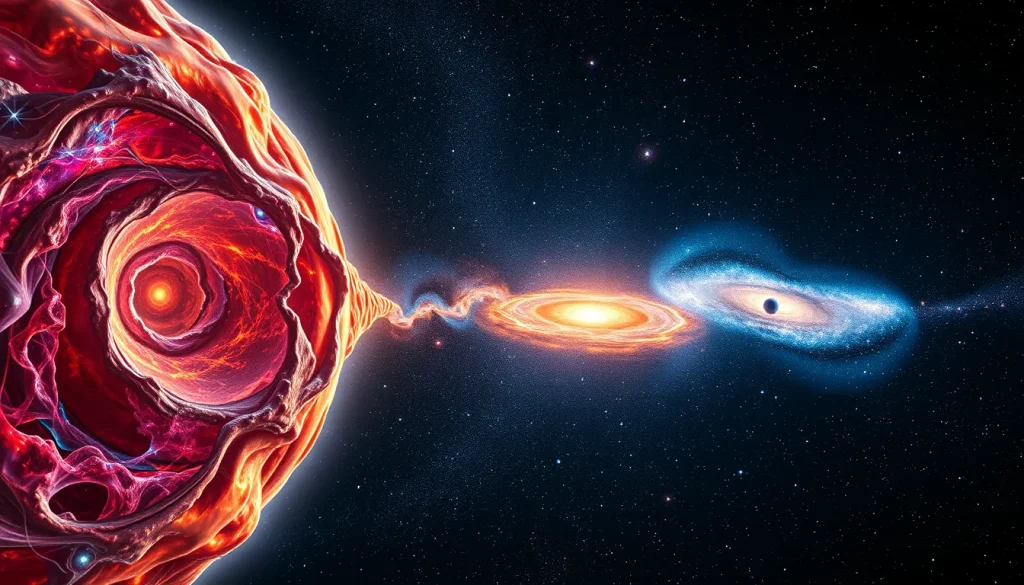
Quantum gravity is the unfinished revolution in modern physics — the theoretical framework that seeks to reconcile Albert Einstein’s general theory of relativity, which describes gravity as the curvature of spacetime, with quantum mechanics, the physics governing the subatomic realm. At the Planck scale — approximately 10⁻³⁵ meters in length and 10⁻⁴³ seconds in time — the gravitational field itself becomes subject to quantum fluctuations, and neither theory can stand alone. This is precisely the regime of the Planck epoch, the earliest measurable phase of cosmic history, making quantum gravity the missing link in our account of how the universe began.
The Planck epoch spans from t = 0 to roughly 10⁻⁴³ seconds after the Big Bang. During this interval, the entire observable universe was compressed into a volume smaller than a single proton, with temperatures exceeding 10³² kelvin. All four fundamental forces — gravity, electromagnetism, the strong nuclear force, and the weak nuclear force — are believed to have been unified into a single interaction. General relativity, so successful on cosmic scales, produces singularities — points of infinite density — under these extreme conditions, signaling its breakdown. A quantum theory of gravity is required to describe what actually occurred. As the Stanford Encyclopedia of Philosophy notes, quantum gravity is a theory “still ‘under construction’ after over 100 years,” yet it is essential for a satisfactory description of spacetime microstructure at the Planck scale.
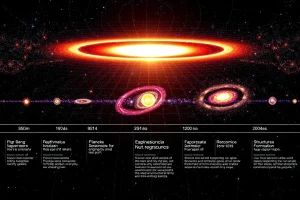
The Cosmic Timeline at a Glance
| Epoch | Time After Big Bang | Temperature | Key Events |
|---|---|---|---|
| Planck Epoch | 0 – 10⁻⁴³ s | >10³² K | Quantum gravity dominates; all forces unified |
| Grand Unification Epoch | 10⁻⁴³ – 10⁻³⁶ s | 10²⁹ – 10³² K | Gravity separates from unified forces |
| Inflationary Epoch | 10⁻³⁶ – 10⁻³² s | ~10²⁸ K | Exponential expansion; quantum fluctuations seeded |
| Electroweak Epoch | 10⁻³² – 10⁻¹² s | 10¹⁵ – 10²⁸ K | Strong force separates; electroweak unified |
| Quark Epoch | 10⁻¹² – 10⁻⁶ s | 10¹² – 10¹⁵ K | Quark–gluon plasma fills the universe |
| Hadron Epoch | 10⁻⁶ – 1 s | 10¹⁰ – 10¹² K | Protons and neutrons form |
| Lepton Epoch | 1 – 10 s | 10⁹ – 10¹⁰ K | Leptons dominate; neutrinos decouple |
| Photon Epoch | 10 s – 380,000 yr | 3,000 – 10⁹ K | Big Bang nucleosynthesis; photon-dominated |
| Recombination | ~380,000 yr | ~3,000 K | First atoms form; CMB released |
| Dark Ages | 380,000 – ~150 million yr | ~60 – 3,000 K | Darkness; neutral hydrogen pervades |
| Reionization | ~150 million – 1 billion yr | ~20 – 60 K | First stars and galaxies reionize hydrogen |
| Structure Formation | 1 billion yr – present | 2.7 K (today) | Galaxies, clusters, large-scale structure |
Planck Epoch (0 – 10⁻⁴³ s)
When It Happened: From the Big Bang to approximately 10⁻⁴³ seconds — the Planck time, the smallest meaningful unit of time in physics.
Temperature: Above 10³² kelvin, the Planck temperature, at which thermal fluctuations have energies comparable to the Planck energy.
Approximate Redshift: Beyond z ~ 10³², far exceeding any observable redshift today.
Dominant Particles/Physics: Quantum gravity governs all interactions; the four fundamental forces are unified into a single force.
What Happened: At the initial singularity, spacetime itself was subject to quantum fluctuations. The equations of general relativity break down, producing infinities, and a quantum description of gravity becomes indispensable. This is the “missing link” in our understanding of cosmic origins — the realm where quantum gravity theories such as loop quantum gravity, string theory, and causal dynamical triangulations compete to provide a consistent description.
What Came Before: The concept of “before” the Big Bang is not well-defined in standard cosmology, as spacetime itself emerged from the initial event. Some quantum gravity models suggest a pre-Big Bang phase, but these remain speculative.
What Came Next: The Grand Unification Epoch, when gravity separated from the other three forces as the universe cooled.
Evidence: Direct observation at Planck-scale energies is impossible with current technology — the energies involved are roughly 10¹⁶ times greater than those achievable at the Large Hadron Collider. However, quantum gravity theories make predictions that may be testable through cosmological observations, including primordial gravitational waves and polarization patterns in the cosmic microwave background.
Grand Unification Epoch (10⁻⁴³ – 10⁻³⁶ s)
When It Happened: From 10⁻⁴³ to 10⁻³⁶ seconds after the Big Bang.
Temperature: Between 10²⁹ and 10³² kelvin.
Approximate Redshift: z ~ 10²⁸ to 10³².
Dominant Particles/Physics: Grand Unified Theory (GUT) physics — the strong nuclear force and the electroweak force are unified, while gravity has already separated.
What Happened: As the universe expanded and cooled, gravity became distinct from the other forces. The strong and electroweak forces remained unified under the GUT symmetry. This epoch is also when baryogenesis — the process that generated the matter–antimatter asymmetry — is thought to have occurred, although the precise mechanism remains an open question.
What Came Before: The Planck epoch.
What Came Next: The Inflationary Epoch.
Evidence: No direct evidence exists, but GUT theories predict proton decay and the existence of magnetic monopoles, neither of which has been observed — a puzzle that inflation helps resolve.
Inflationary Epoch (10⁻³⁶ – 10⁻³² s)
When It Happened: From approximately 10⁻³⁶ to 10⁻³² seconds after the Big Bang.
Temperature: Approximately 10²⁸ kelvin, cooling rapidly as expansion proceeded.
Approximate Redshift: z ~ 10²⁸.
Dominant Particles/Physics: A hypothetical scalar field called the inflaton drove exponential expansion.
What Happened: The universe underwent a period of exponential expansion, growing by a factor of at least 10²⁶ in size in a fraction of a second. This rapid expansion smoothed out any initial irregularities, explaining the remarkable uniformity of the cosmic microwave background. Quantum fluctuations during inflation were stretched to cosmic scales, seeding the density perturbations that later grew into galaxies and large-scale structure.
What Came Before: The Grand Unification Epoch.
What Came Next: The Electroweak Epoch.
Evidence: Inflation is strongly supported by observations of the CMB’s near-uniformity, its flat geometry, and the pattern of acoustic peaks in the CMB power spectrum measured by COBE, WMAP, and the Planck satellite.
Electroweak Epoch (10⁻³² – 10⁻¹² s)
When It Happened: From 10⁻³² to 10⁻¹² seconds.
Temperature: Between 10¹⁵ and 10²⁸ kelvin.
Approximate Redshift: z ~ 10¹⁵ to 10²⁸.
Dominant Particles/Physics: Electroweak interaction — electromagnetism and the weak nuclear force are unified.
What Happened: The strong nuclear force separated from the electroweak force. As the universe continued to cool, the electroweak symmetry was broken, and the electromagnetic and weak forces became distinct. This symmetry breaking is mediated by the Higgs mechanism, which gives particles their mass.
What Came Before: The Inflationary Epoch.
What Came Next: The Quark Epoch.
Evidence: The electroweak unification has been confirmed experimentally at particle accelerators, and the Higgs boson was discovered at the Large Hadron Collider in 2012, validating the mechanism.
Quark Epoch (10⁻¹² – 10⁻⁶ s)
When It Happened: From 10⁻¹² to 10⁻⁶ seconds.
Temperature: Between 10¹² and 10¹⁵ kelvin.
Approximate Redshift: z ~ 10¹² to 10¹⁵.
Dominant Particles/Physics: Quarks, gluons, and leptons exist in a hot, dense quark–gluon plasma.
What Happened: The universe was filled with a primordial soup of quarks and gluons — the fundamental constituents of matter — along with leptons and photons. Quarks and antiquarks constantly annihilated and were recreated, with a slight excess of matter over antimatter surviving from baryogenesis.
What Came Before: The Electroweak Epoch.
What Came Next: The Hadron Epoch.
Evidence: Quark–gluon plasma has been recreated in heavy-ion collisions at the Large Hadron Collider and the Relativistic Heavy Ion Collider, providing experimental insights into this epoch.
Hadron Epoch (10⁻⁶ – 1 s)
When It Happened: From 10⁻⁶ to 1 second.
Temperature: Between 10¹⁰ and 10¹² kelvin.
Approximate Redshift: z ~ 10¹⁰ to 10¹².
Dominant Particles/Physics: Quarks combine into hadrons — protons, neutrons, and mesons.
What Happened: As the universe cooled below the confinement temperature, quarks became bound together by the strong force to form protons and neutrons. The slight matter–antimatter asymmetry meant that a small excess of protons and neutrons survived annihilation, providing the raw material for all later atomic nuclei.
What Came Before: The Quark Epoch.
What Came Next: The Lepton Epoch.
Evidence: The properties of hadrons are well understood from particle physics experiments, and the observed abundance of light elements in the universe is consistent with the conditions of this epoch.
Lepton Epoch (1 – 10 s)
When It Happened: From 1 to 10 seconds.
Temperature: Between 10⁹ and 10¹⁰ kelvin.
Approximate Redshift: z ~ 10⁹ to 10¹⁰.
Dominant Particles/Physics: Leptons — electrons, muons, and neutrinos — dominate the energy density.
What Happened: After protons and neutrons formed, leptons dominated the universe’s energy content. Electron–positron pairs annihilated, producing photons. Neutrinos decoupled from the thermal bath at approximately 1 second, creating the cosmic neutrino background — a relic that has not yet been directly detected but is predicted by the standard model.
What Came Before: The Hadron Epoch.
What Came Next: The Photon Epoch.
Evidence: The cosmic neutrino background is a prediction of Big Bang nucleosynthesis, and its existence is inferred from the successful predictions of light element abundances.
Photon Epoch (10 s – 380,000 yr)
When It Happened: From 10 seconds to approximately 380,000 years.
Temperature: From 10⁹ kelvin down to ~3,000 kelvin.
Approximate Redshift: z ~ 1,100 to 10⁹.
Dominant Particles/Physics: Photons dominate the energy density; Big Bang nucleosynthesis occurs.
What Happened: During the first few minutes of this epoch, Big Bang nucleosynthesis (BBN) produced the light elements: approximately 75% hydrogen, 25% helium-4, and trace amounts of deuterium, helium-3, and lithium-7. After BBN, the universe continued to cool, and photons dominated the energy density. The universe remained opaque because free electrons scattered photons continuously.
What Came Before: The Lepton Epoch.
What Came Next: Recombination.
Evidence: The predicted abundances of light elements from BBN match observations of primordial gas clouds with remarkable precision, providing some of the strongest evidence for the Big Bang model.
Recombination (~380,000 yr)
When It Happened: Approximately 380,000 years after the Big Bang.
Temperature: Approximately 3,000 kelvin.
Approximate Redshift: z ~ 1,100.
Dominant Particles/Physics: Electrons combine with protons to form neutral hydrogen atoms.
What Happened: As the universe cooled to about 3,000 kelvin, electrons and protons combined to form neutral hydrogen atoms. This dramatically reduced the number of free electrons, allowing photons to travel freely through space. The universe became transparent, and the photons released at this moment form the cosmic microwave background (CMB) we observe today. The CMB is the oldest light in the universe — a fossil relic of the early cosmos.
What Came Before: The Photon Epoch.
What Came Next: The Dark Ages.
Evidence: The CMB was first detected by Arno Penzias and Robert Wilson in 1965. Subsequent missions — COBE (1989), WMAP (2001), and the Planck satellite (2009) — mapped its temperature fluctuations with extraordinary precision, revealing the seeds of cosmic structure and confirming the predictions of the Lambda-CDM model.
Dark Ages (380,000 – ~150 million yr)
When It Happened: From 380,000 to approximately 150 million years.
Temperature: Cooling from 3,000 to about 60 kelvin.
Approximate Redshift: z ~ 20 to 1,100.
Dominant Particles/Physics: Neutral hydrogen and helium gas; no luminous sources.
What Happened: The universe entered a period of darkness. Neutral hydrogen and helium filled space, and no stars or galaxies had yet formed. Gravity slowly amplified the tiny density fluctuations seeded during inflation, causing matter to clump into denser regions. These overdensities would eventually collapse to form the first stars.
What Came Before: Recombination.
What Came Next: Reionization and Cosmic Dawn.
Evidence: Observations of the CMB provide indirect evidence for the Dark Ages, and the 21-centimeter hydrogen line offers a potential probe, though it has not yet been definitively detected.
Reionization (~150 million – 1 billion yr)
When It Happened: From approximately 150 million to 1 billion years.
Temperature: Around 20 – 60 kelvin.
Approximate Redshift: z ~ 6 to 20.
Dominant Particles/Physics: First stars (Population III) and early galaxies; ultraviolet radiation reionizes neutral hydrogen.
What Happened: The first stars ignited, ending the Dark Ages. These massive, hot Population III stars emitted intense ultraviolet radiation that ionized the surrounding neutral hydrogen, reionizing the universe. Over time, galaxies assembled and merged, and the intergalactic medium became fully ionized by about 1 billion years after the Big Bang.
What Came Before: The Dark Ages.
What Came Next: Structure Formation.
Evidence: The James Webb Space Telescope (JWST) has detected galaxies at redshifts beyond z = 10, revealing the era of reionization in unprecedented detail. Observations of the Lyman-alpha forest and the CMB’s polarization also constrain the reionization history.
Structure Formation (1 billion yr – present)
When It Happened: From 1 billion years after the Big Bang to the present day.
Temperature: Cooling from ~20 kelvin to the present 2.7 kelvin.
Approximate Redshift: z = 0 to 6.
Dominant Particles/Physics: Dark matter halos; baryonic matter; ΛCDM cosmology.
What Happened: Dark matter halos provided the gravitational scaffolding for galaxy formation. Over billions of years, galaxies merged and clustered, forming the large-scale structure of the universe — filaments, walls, and voids. Dark energy began dominating the universe’s expansion around 5 billion years ago, accelerating the expansion. The universe today is a vast cosmic web of galaxies, with the Lambda-CDM model providing the consensus framework for understanding its evolution.
What Came Before: Reionization.
What Came Next: The universe continues to expand and evolve; the ultimate fate depends on the nature of dark energy.
Evidence: Galaxy surveys such as the Sloan Digital Sky Survey and the Dark Energy Survey, along with measurements of the CMB, baryon acoustic oscillations, and supernovae, provide comprehensive evidence for the Lambda-CDM model.
Why It Matters
Quantum gravity is not merely a theoretical curiosity — it is the key to understanding the universe’s origin. The Planck epoch represents the boundary of our current knowledge: before this moment, our physical theories fail. Without a quantum theory of gravity, we cannot answer fundamental questions: What happened at the instant of the Big Bang? What is the nature of spacetime at the smallest scales? What happened before the Planck epoch, if anything?
The search for quantum gravity also has profound implications beyond cosmology. It may reveal the quantum nature of black holes, explain the information paradox, and provide insights into the unification of all fundamental forces. As recent observational breakthroughs in gravitational wave astronomy and CMB cosmology bring us closer to testing quantum gravity predictions, the urgency of developing a complete theory has never been greater.
The cosmic timeline from the Planck epoch to the present is a story of cooling, expansion, and structure formation — a narrative that connects the quantum fluctuations of the earliest instant to the galaxies, stars, and planets we observe today. Each epoch represents a chapter in this story, and quantum gravity is the first and most mysterious chapter of all.
Evidence / Sources
The standard Lambda-CDM model of cosmology is supported by a wealth of observational evidence:
- Cosmic Microwave Background: The COBE, WMAP, and Planck missions have mapped the CMB’s temperature and polarization with extraordinary precision, confirming the predictions of inflation and the flat geometry of the universe.
- Big Bang Nucleosynthesis: The observed abundances of hydrogen, helium, and lithium match the predictions of BBN within the standard model.
- Large-Scale Structure: Galaxy surveys reveal a cosmic web of structure consistent with the growth of density fluctuations seeded during inflation.
- Accelerating Expansion: Type Ia supernova observations and baryon acoustic oscillation measurements confirm dark energy’s role in accelerating cosmic expansion.
- JWST Observations: The James Webb Space Telescope has pushed the observable frontier to redshifts beyond z = 10, revealing galaxies in the reionization era.
Quantum gravity itself remains unconfirmed, but it is a necessary theoretical framework for describing the Planck epoch. As Loll et al. (2022) note, “Quantum gravity is the missing piece in our understanding of the fundamental interactions today.” The Stanford Encyclopedia of Philosophy emphasizes that quantum gravity is expected to provide “a satisfactory description of the microstructure of spacetime at the so-called Planck scale.”
Related Registry Entries
- Cosmic Microwave Background — The relic radiation from recombination, mapping the universe at 380,000 years.
- Cosmic Inflation — The exponential expansion that seeded structure in the early universe.
- Big Bang Nucleosynthesis — The formation of the first light elements in the first minutes.
- Reionization — The era when the first stars and galaxies ionized the intergalactic medium.
- Lambda-CDM Model — The consensus cosmological model describing the universe’s evolution.
- Planck Epoch — The earliest era of the universe, requiring quantum gravity for its description.
FAQ
What is quantum gravity?
Quantum gravity is a theoretical framework that seeks to unify general relativity (Einstein's theory of gravity) with quantum mechanics. It is needed to describe physical conditions where both gravitational and quantum effects are significant, such as the Planck epoch, black hole interiors, and the earliest moments of the Big Bang. After over 100 years of effort, it remains under construction, with approaches including string theory, loop quantum gravity, and causal dynamical triangulations.
Why is the Planck epoch important?
The Planck epoch (0 to ~10⁻⁴³ seconds after the Big Bang) is the earliest phase of the universe, when the entire observable universe was compressed to a subatomic scale and temperatures exceeded 10³² kelvin. At these conditions, general relativity breaks down and quantum gravity is required. Understanding this epoch is essential for answering fundamental questions about the origin of the universe, the nature of spacetime, and the unification of all fundamental forces.
What is the cosmic microwave background and why does it matter?
The cosmic microwave background (CMB) is the oldest light in the universe, released approximately 380,000 years after the Big Bang when electrons and protons combined to form neutral hydrogen atoms, allowing photons to travel freely. It provides a snapshot of the universe at that early moment, revealing tiny temperature fluctuations that seeded the formation of galaxies and large-scale structure. Missions like COBE, WMAP, and Planck have mapped the CMB with extraordinary precision, strongly confirming the Lambda-CDM model.
How do we know what happened in the early universe if we can't observe it directly?
We use multiple indirect lines of evidence: the cosmic microwave background provides a snapshot at 380,000 years; Big Bang nucleosynthesis predicts light element abundances that match observations; the large-scale structure of galaxies reflects the growth of early density fluctuations; and particle physics experiments (like the LHC) recreate conditions similar to the early universe. Together, these independent lines of evidence converge on the Lambda-CDM model as the consensus description of cosmic evolution.
Leave a Reply