Short Answer
Main Explanation
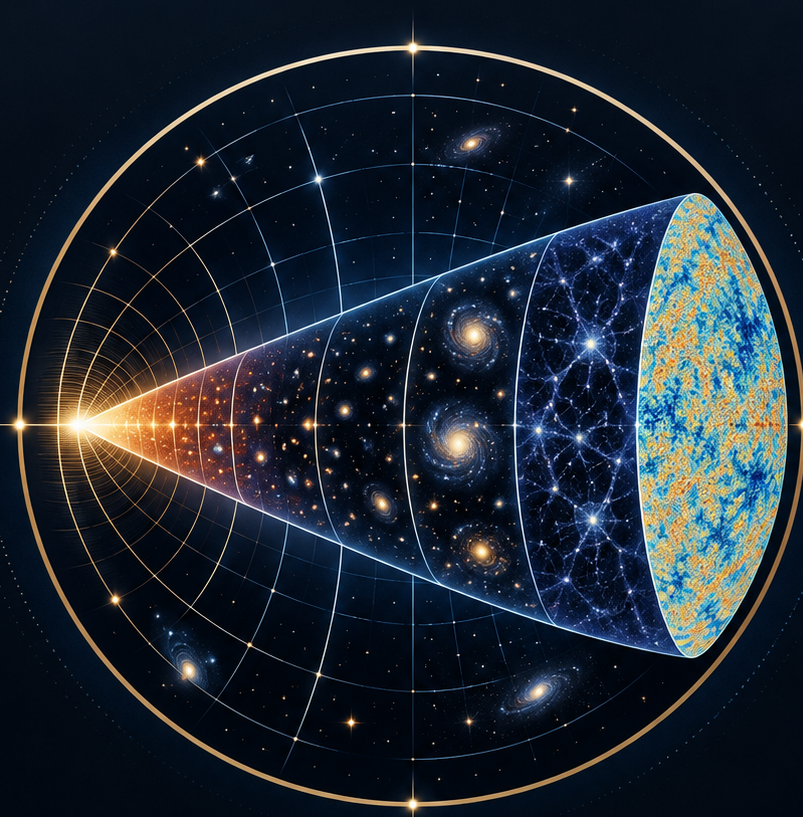
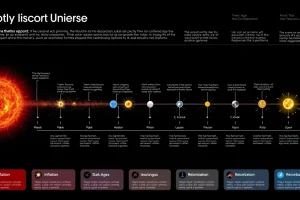
Cosmic Dawn is the era when the first stars and galaxies formed, ending the cosmic Dark Ages and beginning the reionization of the universe. It is a central chapter in the standard Lambda-CDM cosmological model, which describes a universe that began in a hot, dense state about 13.8 billion years ago and has been expanding and cooling ever since. The interactive timeline below summarizes the major epochs from the Planck epoch to the present day.
| Epoch | Time after Big Bang | Approx. Redshift | Key events |
|---|---|---|---|
| Planck epoch | <10-43 s | — | Quantum gravity dominates; all forces possibly unified |
| Grand Unification epoch | 10-43–10-36 s | — | Strong force separates; possible baryogenesis |
| Inflationary epoch | 10-36–10-32 s | — | Exponential expansion stretches quantum fluctuations to cosmic scales |
| Electroweak epoch | 10-32–10-12 s | — | Electromagnetic and weak forces separate; W and Z bosons acquire mass |
| Quark epoch | 10-12–10-6 s | — | Quark-gluon plasma fills the universe |
| Hadron epoch | 10-6–1 s | — | Quarks combine into protons and neutrons |
| Lepton epoch | 1–10 s | — | Leptons and antileptons dominate; neutrinos decouple |
| Photon epoch | 10 s–380,000 yr | ~109–1100 | Big Bang nucleosynthesis produces hydrogen, helium, trace lithium; photons dominate |
| Recombination | ~380,000 yr | ~1100 | Electrons and protons combine into neutral hydrogen; CMB released |
| Dark Ages | 380,000 yr–~150–200 million yr | ~1100–20 | No stars; universe filled with neutral hydrogen and fading CMB |
| Cosmic Dawn / Reionization | ~150 million–1 billion yr | ~20–6 | First stars and galaxies form; ultraviolet light reionizes intergalactic gas |
| Structure Formation | ~200 million yr–present | <20 | Galaxies, clusters, and cosmic web grow under gravity |
From Planck to Photon Epoch
The universe began in the Planck epoch, before 10-43 seconds, when all four fundamental forces may have been unified and quantum gravity dominated. The Grand Unification epoch saw the strong force separate, and the Inflationary epoch is hypothesized to have stretched quantum fluctuations to cosmic scales, seeding the large-scale structure we observe today. During the Electroweak and Quark epochs, the universe was a hot soup of elementary particles; the Hadron and Lepton epochs saw protons, neutrons, and leptons dominate. Big Bang nucleosynthesis in the first few minutes produced hydrogen, helium, and trace lithium. The Photon epoch ended with recombination, when electrons and protons combined to form neutral hydrogen at about 380,000 years, releasing the cosmic microwave background (CMB).
Recombination and the CMB
Before recombination, the universe was an opaque plasma of free electrons and photons. Once neutral atoms formed, photons could travel freely. That ancient light, stretched by the expansion of space, is the CMB we observe today at a temperature of 2.725 K. Its tiny temperature anisotropies—mapped by COBE, WMAP, and Planck—encode the density fluctuations that later grew into galaxies and clusters. The CMB is therefore a direct relic of the early universe and a cornerstone of modern cosmology.
Dark Ages and Cosmic Dawn
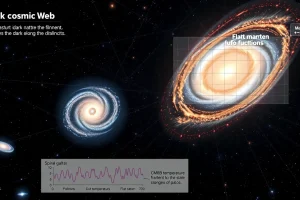
After recombination, the universe entered the Dark Ages, with no stars. Gradually, slight density enhancements in dark matter pulled in gas, and the first stars—known as Population III stars—ignited. Their ultraviolet light began reionizing the intergalactic medium, a process called reionization. Galaxies assembled, and structure formation continued to produce the cosmic web of clusters and voids we see today. An analogy for expansion: as space expands, light traveling through it is stretched to longer, redder wavelengths—a phenomenon called redshift. The CMB, now at 2.725 K, is a relic of the hot, dense early universe, and its tiny temperature anisotropies, mapped by COBE, WMAP, and Planck, encode the seeds of cosmic structure.
Cosmic Epoch: Cosmic Dawn
When It Happened
Cosmic Dawn is not a single instant but a transition. It began when the first stars formed, perhaps around 150–200 million years after the Big Bang, and extended through the first billion years. A 2026 JWST survey found a steep drop in galaxy formation at only 150 to 200 million years after the Big Bang, suggesting the earliest galaxies are within observational reach. Ground-based CLASS observations have detected a signal from around 800 million years after the Big Bang, when the first stars were dispelling cosmic darkness.
Temperature
At the start of Cosmic Dawn, the cosmic microwave background had cooled to roughly 50–60 K (at redshift ~20), and the intergalactic gas was mostly neutral hydrogen at a few tens of kelvin. As stars and galaxies formed, their radiation heated and ionized the gas, raising temperatures in ionized regions to about 10,000 K.
Approximate Redshift
Cosmic Dawn corresponds roughly to redshifts z ~ 20 to 6, spanning the first few hundred million years to about 1 billion years after the Big Bang. Reionization, a key part of Cosmic Dawn, is often placed at z ~ 15 to 6.
Dominant Particles/Physics
The dominant components were cold dark matter, neutral hydrogen, and helium, with ordinary matter falling into dark matter halos. The key physics included gravitational collapse, gas cooling, star formation, and radiative feedback from the first stars and black holes.
What Happened
The first stars—Population III—formed from pristine hydrogen and helium, likely very massive and short-lived. They produced the first heavy elements and ultraviolet photons. Their light, along with radiation from early galaxies and accreting black holes, reionized the intergalactic medium, ending the Dark Ages and making the universe transparent to ultraviolet light.
What Came Before
Before Cosmic Dawn was the Dark Ages, a period after recombination when the universe was filled with neutral hydrogen and the CMB, but no luminous sources. The only light was the fading glow of the CMB.
What Came Next
After reionization, the universe became increasingly transparent, and galaxy formation accelerated. Large-scale structure continued to grow, producing the cosmic web of galaxy clusters, filaments, and voids observed today.
Evidence
Evidence for Cosmic Dawn includes deep galaxy surveys by JWST, which have detected galaxies at redshifts beyond 10; measurements of the CMB optical depth by Planck, which indicate when reionization occurred; and 21-cm radio experiments such as CLASS that probe neutral hydrogen before and during reionization. The steep drop in galaxy formation at 150–200 million years after the Big Bang is a key recent finding.
Why It Matters
Cosmic Dawn connects the simple early universe to the complex cosmos we inhabit. The first stars forged the first heavy elements, set the stage for planets and life, and reionized the universe. Understanding this era tests the Lambda-CDM model, dark matter, and galaxy formation physics, and it is a primary science goal of JWST and future 21-cm observatories.
Evidence / Sources
The standard timeline is supported by multiple independent lines of evidence: the CMB temperature and polarization measured by COBE, WMAP, and Planck; the primordial abundances of light elements from Big Bang nucleosynthesis; the large-scale distribution of galaxies; and direct observations of high-redshift galaxies by JWST. The NASA Cosmic Dawn documentary describes JWST’s mission to unveil the early universe. A 2026 JWST survey of thousands of objects found a steep drop in galaxy formation at 150–200 million years after the Big Bang. CLASS ground-based telescopes in Chile have detected a Cosmic Dawn signal from about 800 million years after the Big Bang.
Related Registry Entries
- Cosmic Microwave Background — the relic radiation from recombination.
- Dark Ages — the starless period before Cosmic Dawn.
- Reionization — the process by which the first light ionized the universe.
- First Stars & Galaxies — the objects that ended the Dark Ages.
- Lambda-CDM Model — the standard cosmological framework.
Last reviewed / updated: September 8, 2026.
FAQ
What is Cosmic Dawn?
Cosmic Dawn is the era when the first stars and galaxies formed, ending the Dark Ages and beginning the reionization of the universe. It spans roughly the first billion years after the Big Bang.
What came before Cosmic Dawn?
Before Cosmic Dawn was the Dark Ages, a period after recombination when the universe was filled with neutral hydrogen and the cosmic microwave background, but no stars or galaxies.
How do astronomers observe Cosmic Dawn?
Astronomers use deep surveys with JWST to detect high-redshift galaxies, CMB measurements by Planck to infer reionization, and 21-cm radio experiments like CLASS to probe neutral hydrogen.
What is the cosmic microwave background?
The CMB is the relic radiation released about 380,000 years after the Big Bang when electrons and protons combined into neutral atoms. It now has a temperature of 2.725 K and provides a snapshot of the early universe.
Leave a Reply