
Short Answer
Main Explanation
The Epoch of Reionization is a pivotal chapter in cosmic history, occurring roughly 100 million to 1 billion years after the Big Bang. During this era, the first generation of stars and galaxies emitted intense ultraviolet light that stripped electrons from neutral hydrogen atoms, transforming the intergalactic medium from opaque to transparent. This process, known as reionization, marked the end of the cosmic Dark Ages and set the stage for the large-scale structure we observe today.
From the Big Bang to the First Light
The universe began in a hot, dense state and expanded rapidly. In the first fractions of a second, fundamental forces separated, and elementary particles formed. As the cosmos cooled, protons and neutrons emerged, and within the first few minutes, nucleosynthesis forged light elements like hydrogen and helium. For the next 380,000 years, the universe was a plasma of nuclei and electrons, opaque to radiation. When it cooled enough, electrons combined with protons to form neutral hydrogen—a process called recombination. This released the cosmic microwave background (CMB), the oldest light we can detect.
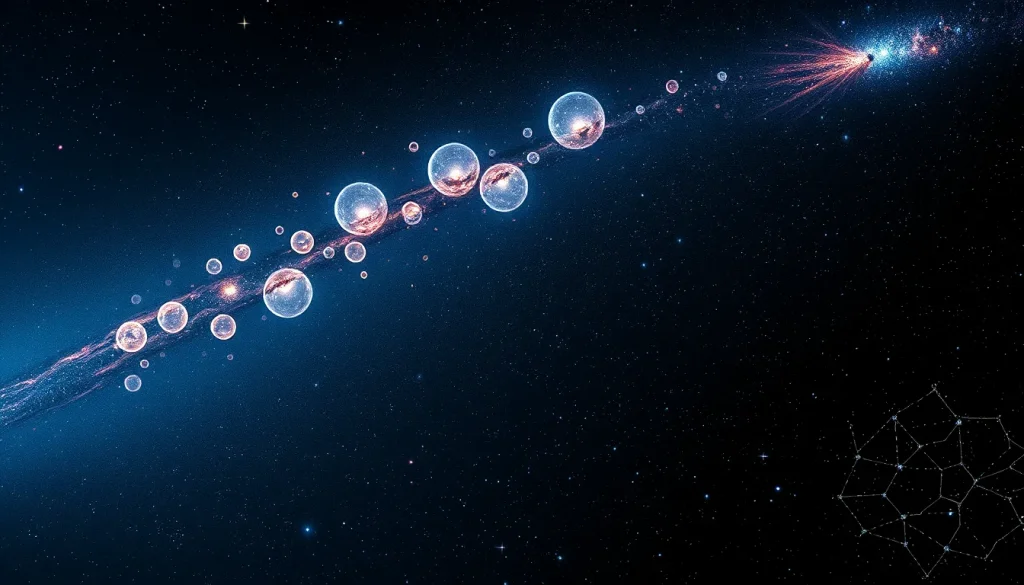
After recombination, the universe entered the Dark Ages: a period with no stars or galaxies, filled with neutral hydrogen gas. Gravity slowly amplified tiny density fluctuations left from inflation, pulling matter together. Over hundreds of millions of years, these overdensities collapsed to form the first stars and galaxies. Their light—especially from massive, short-lived stars—began to ionize the surrounding hydrogen, creating bubbles of ionized gas that grew and merged until the entire universe became ionized.
The Cosmic Timeline
The standard Lambda-CDM model describes a sequence of epochs from the Planck era to today. The table below summarizes key phases:
| Epoch | Time After Big Bang | Redshift | Key Events |
|---|---|---|---|
| Planck Epoch | <10⁻⁴³ s | >10³² | Quantum gravity era; all forces unified |
| Grand Unification Epoch | 10⁻⁴³ – 10⁻³⁶ s | ~10³² – 10²⁸ | Strong force separates; inflation begins |
| Inflationary Epoch | 10⁻³⁶ – 10⁻³² s | ~10²⁸ – 10²⁴ | Exponential expansion; seeds of structure |
| Electroweak Epoch | 10⁻³² – 10⁻¹² s | ~10²⁴ – 10¹⁵ | Electromagnetic and weak forces separate |
| Quark Epoch | 10⁻¹² – 10⁻⁶ s | ~10¹⁵ – 10¹⁰ | Quarks and gluons form quark-gluon plasma |
| Hadron Epoch | 10⁻⁶ – 1 s | ~10¹⁰ – 10¹⁰ | Protons and neutrons form; matter-antimatter asymmetry |
| Lepton Epoch | 1 – 10 s | ~10¹⁰ – 10⁹ | Leptons dominate; neutrinos decouple |
| Photon Epoch | 10 s – 380,000 yr | ~10⁹ – 1100 | Photons coupled to matter; nucleosynthesis; CMB released |
| Recombination | ~380,000 yr | ~1100 | Neutral atoms form; universe becomes transparent |
| Dark Ages | 380,000 yr – ~100 Myr | ~1100 – 20 | No stars; neutral hydrogen fills space |
| Reionization | ~100 Myr – 1 Gyr | ~20 – 6 | First stars ionize hydrogen; universe becomes transparent |
| Structure Formation | 1 Gyr – present | <6 | Galaxies cluster; dark energy accelerates expansion |
The Epoch of Reionization: A Cosmic Epoch
Focusing on reionization, we can detail its characteristics.
When It Happened
Reionization began around 100 million years after the Big Bang and was largely complete by 1 billion years after, corresponding to redshifts from about 20 down to 6. The exact duration is still under investigation, with JWST providing new constraints.
Temperature
During reionization, the intergalactic medium was heated by photoionization to temperatures of roughly 10,000 to 30,000 K in ionized regions, though the cosmic background temperature continued to cool with expansion.
Approximate Redshift
The epoch spans redshifts from about z ≈ 20 (early onset) to z ≈ 6 (completion). The CMB was released at z ≈ 1100, so reionization occurred much later.
Dominant Particles/Physics
The dominant physics involved the interaction of ultraviolet photons from massive stars and quasars with neutral hydrogen. Key processes include photoionization, recombination, and the growth of ionized bubbles. Dark matter played a role in seeding the gravitational wells that formed galaxies.
What Happened
First stars (Population III) formed in dark matter halos, emitting intense UV radiation. This radiation ionized hydrogen in their vicinity, creating HII regions. As galaxies grew and merged, these ionized bubbles expanded and overlapped, eventually ionizing the entire intergalactic medium. The universe transitioned from neutral to ionized, allowing light to travel freely.
What Came Before
Before reionization was the Dark Ages, a period with no luminous sources and a neutral hydrogen fog. The CMB had already decoupled, and the universe was expanding and cooling in darkness.
What Came Next
After reionization, the universe became transparent to ultraviolet light, enabling the formation of the large-scale structure we see today. Galaxies evolved, stars continued to form, and eventually planets and life emerged. The ionized intergalactic medium persists to the present.
Evidence
Evidence for reionization comes from several sources: the Gunn-Peterson trough in quasar spectra (absorption by neutral hydrogen at high redshifts), the polarization of the CMB (WMAP and Planck measured a signal consistent with reionization at z≈8-10), and the abundance of ionized gas in the early universe observed by JWST. The James Webb Space Telescope has detected galaxies at z>10 that appear to be driving reionization.
Why It Matters
Reionization is the last major phase transition of the universe. It marks the end of the Dark Ages and the emergence of the first sources of light. Understanding reionization tells us about the properties of the first stars and galaxies, the role of dark matter, and the physics of the intergalactic medium. It also affects our interpretation of the CMB and the cosmic distance scale. Moreover, reionization is a key test of the Lambda-CDM model, as the timing and duration depend on the details of galaxy formation.
Evidence / Sources
Key observational evidence includes: (1) The CMB polarization measured by WMAP and Planck, which shows a reionization optical depth of τ≈0.054, indicating reionization occurred at z≈8. (2) Quasar absorption spectra showing the Gunn-Peterson trough at z>6, indicating neutral hydrogen in the intergalactic medium. (3) JWST’s deep-field observations revealing galaxies at z>10 with strong UV emission, likely responsible for reionization. (4) The absence of a strong 21-cm signal from neutral hydrogen at high redshift, as probed by radio telescopes like LOFAR and HERA.
For more details, refer to the sources listed in the References section.
Related Registry Entries
Explore more cosmic milestones in our registry: Cosmic Microwave Background, The First Stars, The Dark Ages, Large-Scale Structure.
FAQ
What caused the Epoch of Reionization?
The first stars and galaxies produced intense ultraviolet radiation that ionized the neutral hydrogen gas filling the universe. Massive, short-lived Population III stars were likely the primary drivers, along with quasars and later galaxies.
How do we observe reionization if it happened so long ago?
We observe reionization through several probes: the polarization of the cosmic microwave background (from WMAP and Planck), the absorption of quasar light (Gunn-Peterson effect), and deep-field observations by JWST that catch galaxies in the act of ionizing their surroundings.
Did reionization happen all at once?
No, it was a gradual process. Ionized bubbles formed around the first galaxies and grew over hundreds of millions of years, eventually overlapping and merging until the entire intergalactic medium became ionized. The process was patchy and likely lasted from z≈20 to z≈6.
Leave a Reply