
Short Answer
Main Explanation
The Cosmic Dawn marks the pivotal era in cosmic history when the first stars and galaxies ignited, ending the cosmic Dark Ages and transforming the universe from a dark, featureless expanse into the structured cosmos we observe today. According to the standard Lambda-CDM model of cosmology, this transition occurred roughly 100 million to 1 billion years after the Big Bang, when dense regions of primordial hydrogen and helium collapsed under their own gravitational pull to ignite the first stars (NASA, n.d.).
The Cosmic Epochs: A Timeline
Cosmologists divide the history of the universe into distinct epochs, each characterized by different physical processes and dominant particle populations. The table below summarizes the major epochs from the Planck epoch to the present day.
| Epoch | Time After Big Bang | Temperature | Key Events |
|---|---|---|---|
| Planck Epoch | 0 to ~10⁻⁴³ s | >10³² K | Quantum gravity dominates; all forces unified |
| Grand Unification Epoch | ~10⁻⁴³ to ~10⁻³⁶ s | ~10²⁷–10³² K | Strong force separates from electroweak force |
| Inflationary Epoch | ~10⁻³⁶ to ~10⁻³² s | ~10²⁷ K | Exponential expansion; quantum fluctuations seed structure |
| Electroweak Epoch | ~10⁻³² to ~10⁻¹² s | ~10¹⁵–10²⁷ K | Electromagnetic and weak forces separate |
| Quark Epoch | ~10⁻¹² to ~10⁻⁶ s | ~10¹²–10¹⁵ K | Quark-gluon plasma fills the universe |
| Hadron Epoch | ~10⁻⁶ to ~1 s | ~10¹⁰–10¹² K | Protons and neutrons form; matter-antimatter annihilation |
| Lepton Epoch | ~1 to ~10 s | ~10⁹–10¹⁰ K | Leptons dominate; neutrinos decouple |
| Photon Epoch | ~10 s to ~380,000 yr | ~3,000–10⁹ K | Big Bang nucleosynthesis; photons dominate |
| Recombination | ~380,000 yr | ~3,000 K | Electrons combine with protons; CMB released |
| Dark Ages | ~380,000 to ~100 million yr | ~30–3,000 K | No luminous sources; neutral hydrogen fills space |
| Cosmic Dawn / Reionization | ~100 million to ~1 billion yr | ~10–30 K | First stars and galaxies form; reionization of intergalactic gas |
| Structure Formation | ~1 billion yr to present | 2.7 K (today) | Galaxies cluster; star formation peaks at Cosmic Noon |
From the Planck Epoch to the Photon Epoch
The universe emerged from a state of extremely high temperature and density about 13.7 billion years ago (ESA, 2024). During the Planck epoch, quantum gravity dominated and all four fundamental forces were unified. As the universe expanded and cooled, the forces separated sequentially. Around 10⁻³⁶ seconds, the Inflationary epoch began — a period of exponential expansion that stretched quantum fluctuations to cosmic scales, seeding the density variations that would later grow into galaxies and galaxy clusters. One helpful analogy is to imagine drawing a tiny squiggle on a deflated balloon and then inflating it: the squiggle becomes stretched into a vast, nearly smooth pattern — just as inflation stretched microscopic quantum jitters into the seeds of cosmic structure. This expansion also explains the phenomenon of redshift — the stretching of light to longer wavelengths as space itself expands, which astronomers use to measure cosmic distances.
By the Quark epoch, the universe was filled with a quark-gluon plasma. During the Hadron epoch, quarks combined to form protons and neutrons, and matter-antimatter annihilation left a small excess of matter that would ultimately build all the structures we see today. The Lepton epoch saw neutrinos decouple from the cosmic plasma, and the Photon epoch witnessed Big Bang nucleosynthesis — the formation of the lightest elements, primarily hydrogen, helium, and trace amounts of lithium (NASA, n.d.). These primordial abundances — roughly 75% hydrogen and 25% helium by mass — are among the key observational predictions of the Big Bang model, confirmed by spectroscopic measurements of the oldest, most distant gas clouds.
Recombination: The Universe Becomes Transparent
At approximately 380,000 years after the Big Bang, the universe had cooled to about 3,000 K. During the Recombination epoch, charged electrons and protons combined to form neutral atoms, and light could finally travel freely through space (ESA, 2024). This released the cosmic microwave background (CMB) — a relic radiation field that still permeates the universe and provides our most direct observational window into the early universe. Missions such as COBE, WMAP, and Planck have mapped the CMB with extraordinary precision, revealing temperature fluctuations of about one part in 100,000 that correspond to the density seeds for cosmic structure. These measurements have pinned down the universe’s composition — roughly 5% ordinary matter, 27% dark matter, and 68% dark energy — and confirmed the geometry of space as nearly flat.
The Dark Ages
Following Recombination, the universe entered the Dark Ages — a period when no luminous sources existed. The universe was filled with neutral hydrogen gas, slowly collapsing under gravity into denser regions. This era lasted until the first stars formed, roughly 100 million years after the Big Bang (NASA, n.d.). During the Dark Ages, the universe was truly dark — not because light was absent, but because no sources of light had yet ignited. Gravity was quietly at work, amplifying the tiny density fluctuations imprinted by inflation into the massive structures that would soon host the first stars.
The Cosmic Dawn: First Stars Ignite
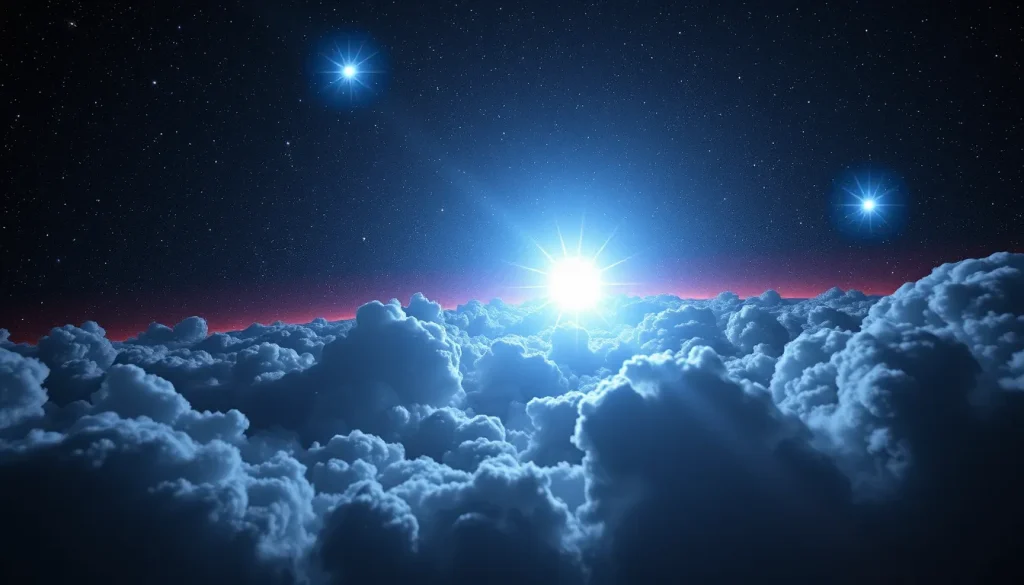
The Cosmic Dawn began when dense regions of hydrogen and helium collapsed under their own gravitational pull. Once the pressure and temperature in the center of these clouds was high enough, hydrogen atoms began to fuse together, releasing energy in the form of light (NASA, n.d.).
The first stars — known as Population III stars — were fundamentally different from stars today. They were composed almost entirely of hydrogen and helium, with only trace amounts of lithium (NASA, n.d.). Models suggest they were probably much more massive, hotter, and brighter than the Sun — possibly hundreds of times the Sun’s mass. These colossal stars produced intense ultraviolet radiation that began to ionize the surrounding neutral hydrogen gas, transforming the universe from opaque to transparent. They also forged the first heavy elements through nuclear fusion, seeding the cosmos with carbon, oxygen, iron, and other elements that would be incorporated into subsequent generations of stars and planets.
Reionization and Structure Formation
The energetic light emitted by the first stars and galaxies changed the state of intergalactic gas from neutral to charged again — a process known as Reionisation (ESA, 2024). This era, spanning roughly 100 million to 1 billion years after the Big Bang, was the universe’s transition from darkness to the brilliant starscape we see today. Over subsequent billions of years, gravity continued to assemble galaxies into larger structures. Star formation peaked during an era known as Cosmic Noon, approximately 3 billion years after the Big Bang (ESA, 2024).
Why It Matters
Understanding the Cosmic Dawn addresses some of the most fundamental questions in modern astrophysics: When did the first stars form? How did they differ from stars today? How did galaxies like the Milky Way come to be (UCLA, n.d.)?
The era also represents a critical test for the Lambda-CDM model. Observations of the CMB by COBE, WMAP, and Planck have provided precise measurements of the universe’s composition and geometry. The James Webb Space Telescope (JWST) is now probing the Cosmic Dawn directly, revealing galaxies that existed when the universe was less than a billion years old. NASA’s upcoming Nancy Grace Roman Space Telescope will further illuminate this era, probing the universe’s transition from opaque to transparent (NASA, 2024).
Evidence / Sources
The primary evidence for the Cosmic Dawn comes from multiple complementary observations. The cosmic microwave background, measured with extraordinary precision by COBE, WMAP, and Planck, provides the initial conditions for structure formation. Deep-field observations by JWST have identified candidate galaxies at redshifts corresponding to the Cosmic Dawn era. The Roman Space Telescope will conduct wide-field surveys designed to probe this epoch (NASA, 2024). Together, these observations form a coherent picture consistent with the Lambda-CDM model.
Related Registry Entries
- Cosmic Microwave Background — The relic radiation from Recombination, providing a snapshot of the early universe.
- Reionization — The process by which the first stars and galaxies re-ionized the intergalactic medium.
- Dark Ages — The period between Recombination and the first star formation.
- First Stars & Galaxies — The Population III stars and the first galaxies that formed during the Cosmic Dawn.
- Inflation — The exponential expansion that seeded the density fluctuations from which all structure grew.
Last Reviewed: September 5, 2026
FAQ
What exactly is the Cosmic Dawn?
The Cosmic Dawn is the era, roughly 100 million to 1 billion years after the Big Bang, when the first stars and galaxies formed and began reionizing the neutral hydrogen gas that filled the universe. It marks the transition from the Dark Ages to the structured cosmos we observe today.
When did the first stars form?
The first stars are thought to have formed as early as 100 million years after the Big Bang, when dense regions of hydrogen and helium collapsed under their own gravitational pull (NASA, n.d.).
What were the first stars made of?
The first stars, known as Population III stars, were made almost entirely of hydrogen and helium, with only trace amounts of lithium. They likely were much more massive, hotter, and brighter than the Sun (NASA, n.d.).
How do astronomers observe the Cosmic Dawn?
Astronomers use telescopes like the James Webb Space Telescope to observe distant galaxies at high redshift, and missions like Planck, WMAP, and COBE to measure the cosmic microwave background. NASA's upcoming Roman Space Telescope will conduct wide-field surveys to probe the Cosmic Dawn (NASA, 2024).
Leave a Reply