
Short Answer
Main Explanation
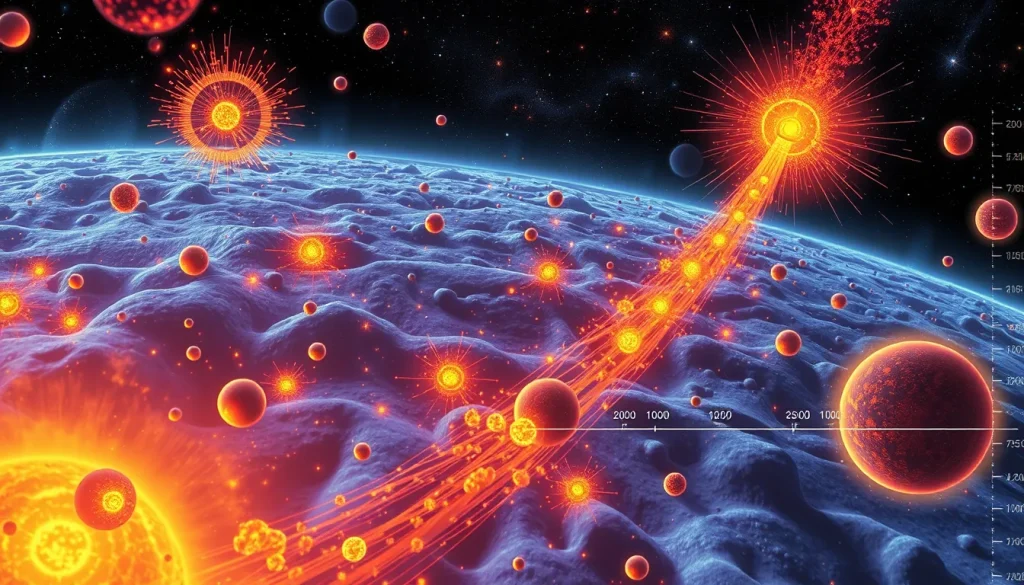
The first second of the universe’s existence is a story of extreme heat, rapid expansion, and the emergence of the fundamental building blocks of matter. After the Big Bang, the cosmos was a seething soup of energy and particles. As it expanded and cooled, a series of distinct epochs unfolded, each with its own physical processes. The hadron epoch stands out as the moment when quarks—the elementary particles that make up protons and neutrons—first combined into stable hadrons, setting the stage for the formation of atomic nuclei and, eventually, atoms.
Timeline of Cosmic Epochs
| Epoch | Time after Big Bang | Approximate Temperature | Key Events |
|---|---|---|---|
| Planck epoch | 0 – 10−43 s | >1032 K | Quantum gravity dominates; all forces unified |
| Grand Unification epoch | 10−43 – 10−36 s | 1028 – 1032 K | Strong and electroweak forces separate |
| Inflationary epoch | 10−36 – 10−32 s | ~1027 K | Exponential expansion; seeds of structure form |
| Electroweak epoch | 10−32 – 10−12 s | 1015 – 1028 K | Electromagnetic and weak forces separate |
| Quark epoch | 10−12 – 10−6 s | 1012 – 1015 K | Quarks and gluons exist freely in a quark–gluon plasma |
| Hadron epoch | 10−6 – 1 s | ~1010 K | Quarks bind into hadrons; matter–antimatter annihilation |
| Lepton epoch | 1 – 10 s | 109 – 1010 K | Leptons dominate; neutrinos decouple |
| Photon epoch | 10 s – 380,000 years | 103 – 109 K | Photons dominate; nucleosynthesis occurs |
| Recombination | ~380,000 years | ~3000 K | Electrons combine with nuclei to form neutral atoms; CMB released |
| Dark Ages | 380,000 – 150 million years | ~100 – 3000 K | No stars; universe dark and neutral |
| Reionization | 150 million – 1 billion years | ~10 – 100 K | First stars and galaxies ionize hydrogen |
| Structure Formation | 1 billion years – present | ~2.7 K | Galaxies, clusters, and large-scale structure form |
The hadron epoch occupies a narrow but crucial window in this timeline. According to the History of the Universe website, it began about 10−6 seconds after the creation and ended about 1 second later. However, the Wikipedia article on the hadron epoch states it started 20 microseconds after the Big Bang, reflecting slight variations in modeling. The temperature had fallen to around 10 thousand million degrees Celsius (1010 K), allowing quarks to bind together via the strong force.
The Hadron Epoch: A Detailed Look
When It Happened
The hadron epoch began when the universe was about 10–20 microseconds old, depending on the source, and lasted until approximately 1 second after the Big Bang. The History of the Universe website gives a range of 10−6 to 1 second, while Wikipedia cites 20 microseconds as the start. This discrepancy arises from different models of the quark–hadron transition, but both agree the epoch ended around the first second.
Temperature
During the hadron epoch, the universe had cooled to roughly 1010 K (10 thousand million degrees Celsius). This temperature was low enough for quarks and gluons to condense into hadrons, but still hot enough to allow the formation of hadron–antihadron pairs in thermal equilibrium.
Approximate Redshift
The redshift of the hadron epoch is not directly observable, but standard cosmology places it at an extremely high value, on the order of z ~ 1012. This is inferred from the known expansion history and the temperatures of later epochs.
Dominant Particles/Physics
The universe was filled with a quark–gluon plasma that gradually transitioned into a gas of hadrons—primarily protons and neutrons—along with their antiparticles. The strong nuclear force, mediated by gluons, governed the binding of quarks. As the temperature dropped, quarks could no longer exist freely and became permanently confined within hadrons.
What Happened
As the universe expanded and cooled, quarks and gluons combined to form hadrons. Initially, hadron–antihadron pairs were created and annihilated in equilibrium. However, a tiny asymmetry—about one part in a billion—favored matter over antimatter. After most annihilation, a small excess of matter remained, which eventually formed the protons and neutrons that would become the building blocks of atoms. Most of the hadrons and antihadrons were eliminated in this process, as noted in the Wikipedia article.
What Came Before
Before the hadron epoch, the universe was in the quark epoch, where quarks and gluons existed freely in a hot, dense quark–gluon plasma. The transition from the quark epoch to the hadron epoch occurred when the temperature dropped sufficiently for quarks to become bound.
What Came Next
Following the hadron epoch, the lepton epoch began at about 1 second. During this phase, leptons (such as electrons and neutrinos) dominated, and neutrinos decoupled from the radiation fluid. The end of the hadron epoch also saw the decoupling of neutrons, which later combined with protons during primordial nucleosynthesis.
Evidence
Direct evidence of the hadron epoch is not observable, but particle accelerator experiments, such as those at the Large Hadron Collider, recreate quark–gluon plasmas at temperatures similar to those of the early universe. These experiments confirm that quarks condense into hadrons as the temperature drops. Additionally, the observed abundance of light elements (like helium and deuterium) is consistent with the proton-to-neutron ratio set during the hadron epoch.
Why It Matters
The hadron epoch determined the fundamental composition of matter in the universe. The slight excess of matter over antimatter that emerged here is the reason we exist today. The protons and neutrons formed during this epoch later combined into atomic nuclei during Big Bang nucleosynthesis, and those nuclei eventually captured electrons to form atoms during recombination. Without the hadron epoch, there would be no stable matter as we know it.
Evidence / Sources
The information in this article is based on the following authoritative sources:
- Wikipedia: Hadron epoch
- Schwarz, D. J. (2003). “The first second of the Universe.” Annalen der Physik. doi:10.1002/andp.200310010
- European Space Agency: So, how did everything start?
- History of the Universe: Hadron Epoch 10-6 to 1 second
Related Registry Entries
- Quark Epoch
- Lepton Epoch
- Big Bang Nucleosynthesis
- Recombination
- Cosmic Microwave Background
Last Reviewed: September 5, 2026
FAQ
What exactly happened during the hadron epoch?
During the hadron epoch, the universe had cooled enough for quarks and gluons to bind together into hadrons such as protons and neutrons. Initially, hadron–antihadron pairs formed in equilibrium, but a slight excess of matter led to a residual population of protons and neutrons after annihilation.
How long did the hadron epoch last?
The hadron epoch began about 10–20 microseconds after the Big Bang and ended at approximately 1 second after the Big Bang, according to different sources. This is a very brief period in cosmic history but crucial for matter formation.
What is the evidence for the hadron epoch?
Direct observation is impossible, but particle accelerators like the LHC recreate quark–gluon plasmas at similar temperatures, confirming the condensation of quarks into hadrons. Additionally, the observed abundances of light elements are consistent with the proton-to-neutron ratio set during this epoch.
How did the hadron epoch lead to the matter–antimatter asymmetry?
A tiny asymmetry in the early universe favored matter over antimatter, resulting in about one extra proton or neutron for every billion antihadrons. After annihilation, this small excess remained, eventually forming all the matter we see today.
What came after the hadron epoch?
The lepton epoch followed, lasting from about 1 to 10 seconds after the Big Bang. During this time, leptons and antileptons dominated, and neutrinos decoupled from the cosmic plasma.


Leave a Reply