
Short Answer
Main Explanation
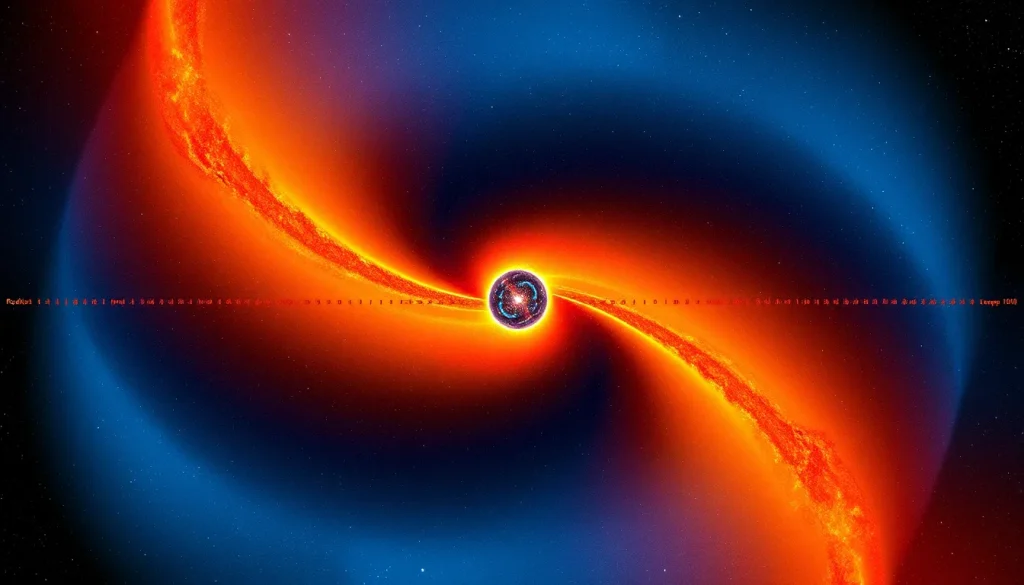
The cosmic microwave background is the oldest light in the universe, a faint glow that fills all space. Its redshift is not a Doppler shift from motion but a consequence of the expansion of the cosmos itself. As space stretches, the wavelength of photons is stretched proportionally, so the observed frequency decreases. The redshift z relates to the scale factor a of the universe by 1 + z = anow / athen. For the CMB, z ≈ 1100 means the universe was about 1100 times smaller when the radiation was released.
This radiation originated during the epoch of recombination, when the universe had cooled enough for electrons and protons to form neutral hydrogen. Before that, the universe was an opaque plasma; after recombination, photons could travel freely. Those photons are what we observe today as the CMB. Their temperature has dropped by the same factor of 1100, from roughly 3000 K to 2.7255 K.
The CMB is a pillar of the Big Bang model. Its near-perfect blackbody spectrum (with only tiny anisotropies) confirms that the early universe was hot, dense, and in thermal equilibrium. The redshift of the CMB is thus a direct measure of cosmic expansion and provides a key calibration for the history of the universe.
Question Article
Short Answer
The CMB redshift is about 1100, corresponding to an emission temperature of ~3000 K and a current temperature of 2.7255 K.
What We Know
We know the CMB redshift precisely from the measured temperature and the blackbody relation T = T0(1+z). The current temperature is 2.7255 K (PDG 2025). The CMB spectrum is the most perfect blackbody ever measured, with no detectable deviations (COBE/FIRAS). The anisotropies in temperature and polarization have been mapped by WMAP and Planck, revealing the seeds of large-scale structure.
What We Don’t Know
The exact physics of inflation that set the initial conditions for the CMB remains uncertain. The nature of dark matter and dark energy, which affect the evolution of the CMB and its anisotropies, is still unknown. The precise value of the Hubble constant derived from CMB measurements differs from local distance ladder measurements (the ‘Hubble tension’).
Evidence
Key evidence includes the discovery by Penzias and Wilson (1965), the COBE satellite’s measurement of the blackbody spectrum (1989-1990), and the high-resolution maps from WMAP (2003) and Planck (2013, 2018). These missions confirmed the CMB temperature, its anisotropies, and the acoustic peaks in the power spectrum, all consistent with the ΛCDM model.
Competing Explanations
Alternatives to the Big Bang, such as steady-state theory or tired-light hypotheses, fail to explain the CMB’s blackbody spectrum and its redshift evolution. The observed redshift and spectrum are uniquely explained by the expanding universe model.
Current Research
Ongoing and future experiments (e.g., Simons Observatory, CMB-S4, and the James Webb Space Telescope) aim to measure the CMB’s polarization (B-modes) to probe inflation, and to refine cosmological parameters. JWST is also observing high-redshift galaxies to understand reionization and structure formation.
Why It Matters
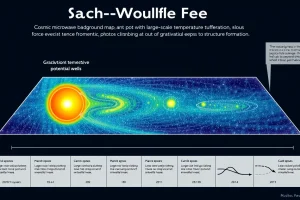
The redshift of the CMB is not just a number—it is a cosmic calendar. It tells us when the universe became transparent, when matter and radiation decoupled, and it provides the starting point for the formation of structure. The CMB’s temperature and anisotropies encode the geometry, composition, and history of the universe. Understanding its redshift allows us to trace cosmic evolution from the Planck epoch to the present day, across all major epochs:
- Planck epoch (t < 10⁻⁴³ s): quantum gravity era, unknown physics.
- Grand Unification epoch (10⁻⁴³ – 10⁻³⁶ s): fundamental forces unified.
- Inflationary epoch (10⁻³⁶ – 10⁻³² s): exponential expansion, seeds for structure.
- Electroweak epoch (10⁻³² – 10⁻¹² s): forces separate, particles acquire mass.
- Quark epoch (10⁻¹² – 10⁻⁶ s): quarks and gluons exist freely.
- Hadron epoch (10⁻⁶ – 1 s): protons and neutrons form.
- Lepton epoch (1 – 10 s): leptons dominate, neutrinos decouple.
- Photon epoch (10 s – 380,000 yr): photons dominate, nucleosynthesis occurs.
- Recombination (z ≈ 1100): atoms form, CMB released.
- Dark Ages (z ≈ 1100 – 20): no stars, only neutral hydrogen.
- Reionization (z ≈ 20 – 6): first stars and galaxies heat and ionize gas.
- Structure Formation (z < 6): galaxies, clusters, and large-scale structure evolve.
The CMB redshift anchors this timeline, and its study has earned Nobel Prizes (1978 for Penzias and Wilson, 2006 for COBE, 2019 for Peebles). It is the most direct evidence we have for the Big Bang and the expansion of the universe.
Evidence / Sources
The values and descriptions in this article are based on the Particle Data Group’s 2025 review of the Cosmic Microwave Background (D. Scott and G.F. Smoot), the 2021/2020 edition, and the Wikipedia article on the CMB. The physics of redshift is standard and corroborated by countless observations.
Related Registry Entries
For further exploration, see the entries on Recombination, Inflation, Cosmic Timeline, and CMB Missions in this encyclopedia.
FAQ
Why is the CMB redshift about 1100?
The redshift is determined by the ratio of the scale factor at recombination to today. The CMB temperature dropped from about 3000 K to 2.7255 K, giving 1+z = 3000/2.7255 ≈ 1100.
Does the CMB redshift change over time?
Yes, as the universe expands, the CMB photons continue to be redshifted, so the observed temperature will gradually decrease. The redshift of a given CMB photon increases with time.
How is the CMB redshift measured?
It is derived from the measured blackbody temperature of the CMB today (2.7255 K) and the predicted temperature at recombination (~3000 K), using the relation T = T0(1+z).
What does the CMB redshift tell us about the universe?
It confirms the expansion of space, gives the age of the universe at recombination, and supports the hot Big Bang model. It also provides the redshift reference for all cosmic epochs.
Leave a Reply