
Short Answer
Short Answer / Definition
Comoving distance is the distance between two objects that remains constant with cosmic expansion, effectively the distance measured along a path of constant cosmic time, divided by the scale factor. In an expanding universe, proper distance grows over time, but comoving distance stays fixed for objects moving with the Hubble flow. Redshift quantifies how much the universe has expanded since light was emitted; a higher redshift corresponds to a larger comoving distance and an earlier cosmic epoch.
Infobox: Key Facts
| Property | Value |
|---|---|
| Definition | Distance that does not change with cosmic expansion |
| Relation to proper distance | Proper distance = comoving distance × scale factor (a(t)) |
| Redshift (z) | 1 + z = 1 / a(t) |
| Current epoch | a(t₀) = 1, so comoving = proper at present |
| Used in | Hubble–Lemaître law, luminosity distance, angular diameter distance |
| Consensus model | ΛCDM (flat, dark energy + cold dark matter) |
Main Explanation
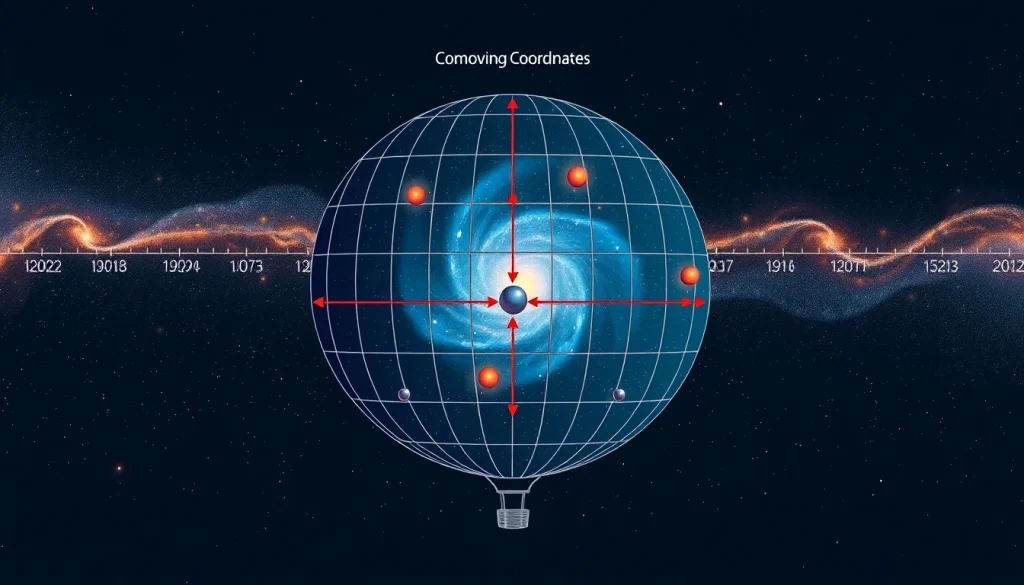
In cosmology, distances are not as straightforward as in everyday life because the fabric of space itself stretches. The standard framework uses comoving coordinates, where each galaxy’s position is fixed relative to the expanding grid. The scale factor a(t) describes how the grid expands over time; at the present moment a(t₀) = 1. Comoving distance is the distance along this grid, while proper distance is the distance you would measure with a ruler at a given cosmic time. They are equal today, but for a distant galaxy, the proper distance at emission was smaller than its comoving distance.
Redshift is the observational key. When light travels through expanding space, its wavelength stretches proportionally to the scale factor: 1 + z = 1/a(t). Thus, a galaxy with redshift z emitted its light when the universe was a factor (1+z) smaller. Because the expansion history is known (from the Friedmann equations), we can convert redshift into comoving distance by integrating the inverse of the Hubble parameter over redshift. This integral is the line-of-sight comoving distance, often denoted DC.
How Comoving Distance Relates to Redshift
The relationship is not linear for large redshifts because the expansion rate changes over time. For small redshifts (z < 0.1), comoving distance is approximately c z / H₀, where H₀ is the Hubble constant. For larger redshifts, the exact formula depends on the density parameters Ωm, ΩΛ, and Ωk. In the standard flat ΛCDM model, the integral is:
DC(z) = (c/H₀) ∫₀z dz′ / E(z′), with E(z) = √[Ωm(1+z)³ + ΩΛ].
This distance measure is the foundation for other observable distances, such as luminosity distance (DL = (1+z) DC) and angular diameter distance (DA = DC/(1+z)).
Cosmic Epochs and Redshift
The history of the universe is often divided into epochs, each characterized by a redshift range and dominant physics. The table below summarizes the major epochs from the Planck epoch to the present.
| Epoch | Approximate Redshift | Time After Big Bang | Key Events |
|---|---|---|---|
| Planck epoch | ∞ | < 10⁻⁴³ s | Quantum gravity effects; all forces unified |
| Grand unification epoch | ~10³² | 10⁻⁴³ – 10⁻³⁶ s | Strong force separates from electroweak |
| Inflationary epoch | ~10²⁸ → 10²² | 10⁻³⁶ – 10⁻³² s | Exponential expansion; seeds for structure |
| Electroweak epoch | ~10¹⁵ | 10⁻³² – 10⁻¹² s | Electromagnetic and weak forces separate |
| Quark epoch | ~10¹² | 10⁻¹² – 10⁻⁶ s | Quarks and gluons form quark–gluon plasma |
| Hadron epoch | ~10¹⁰ | 10⁻⁶ – 1 s | Protons and neutrons form |
| Lepton epoch | ~10⁹ | 1 – 10 s | Leptons dominate; neutrinos decouple |
| Photon epoch | ~10⁸ – 10³ | 10 s – 380,000 yr | Photons dominate; nucleosynthesis occurs |
| Recombination | ~1100 | 380,000 yr | Atoms form; CMB released |
| Dark Ages | ~1100 – 30 | 380,000 yr – 100 Myr | No stars; neutral hydrogen |
| Reionization | ~30 – 6 | 100 Myr – 1 Gyr | First stars and galaxies ionize hydrogen |
| Structure formation | ~6 – 0 | 1 Gyr – present | Galaxies, clusters, large-scale structure |
Why Redshift Matters for Distance
Redshift is directly observable via spectral lines. By measuring a galaxy’s redshift, we know its comoving distance if we adopt a cosmological model. This is how surveys like the Sloan Digital Sky Survey map the large-scale structure of the universe. The cosmic microwave background (CMB) at z ≈ 1100 is the most distant source we can observe, providing a snapshot of the universe at recombination.
Concept: Comoving Distance in Detail
Definition
Comoving distance is the distance between two points along a spatial slice at constant cosmic time, scaled to the present-day scale factor. It is the distance that would remain constant if the universe continued expanding uniformly.
How It Works
Imagine a grid drawn on a balloon. As the balloon inflates, the grid expands with it. A galaxy’s comoving coordinate is fixed on that grid. The physical (proper) distance between two galaxies grows as the balloon expands, but the comoving distance—the number of grid squares—stays the same. To convert from comoving to proper distance at time t, multiply by the scale factor a(t).
Equation
The line-of-sight comoving distance DC is given by the integral:
DC(z) = (c/H₀) ∫₀z [dz′ / E(z′)]
where E(z) = √[Ωm(1+z)³ + ΩΛ + Ωk(1+z)²]. For a flat universe, Ωk = 0.
Example
For a galaxy at redshift z = 1, using H₀ = 70 km/s/Mpc, Ωm = 0.3, ΩΛ = 0.7, the comoving distance is about 3.4 billion parsecs (11.1 billion light-years). The proper distance at the time of emission was half that because a(t) = 0.5.
Observable Consequences
Comoving distance is used to compute luminosity distance (for standard candles) and angular diameter distance (for standard rulers). The angular size of the CMB acoustic peaks depends on the angular diameter distance to z ≈ 1100, which tests the geometry of the universe.
Common Misconceptions
One misconception is that comoving distance is the “actual” distance at any time. It is not—it is a coordinate distance. Another is that redshift is due to Doppler motion; in cosmology, it is primarily due to the expansion of space. Also, the comoving distance to the cosmic horizon is not the age of the universe times c; it is larger because of expansion.
Why It Matters
Comoving distance is the backbone of modern cosmology. It allows us to place objects on a single map that does not change with time, making it possible to study the evolution of galaxies and the large-scale structure. It also underpins the Hubble–Lemaître law, which relates recession velocity (derived from redshift) to distance, and is essential for interpreting dark energy from supernovae and baryon acoustic oscillations. Without a clear understanding of comoving distance, we could not measure the expansion history of the universe or confirm the existence of dark energy.
Evidence / Sources
Key evidence for the standard cosmological model includes the cosmic microwave background (CMB) measured by COBE, WMAP, and Planck; the distribution of galaxies from surveys like SDSS; and the distance–redshift relation from Type Ia supernovae. The ΛCDM model, with a flat geometry, dark matter, and dark energy, is consistent with all these observations to high precision. The comoving distance framework is derived directly from the Friedmann–Lemaître–Robertson–Walker metric, which is supported by the isotropy and homogeneity of the universe on large scales.
Related Registry Entries
Last Reviewed / Updated: September 5, 2026
FAQ
What is the difference between comoving distance and proper distance?
Proper distance is the physical distance measured at a specific cosmic time, which grows as the universe expands. Comoving distance is the distance on a coordinate grid that expands with the universe, so it remains constant for objects moving with the Hubble flow. They are equal today because the scale factor is 1.
How does redshift relate to comoving distance?
Redshift z measures how much the universe has expanded since light was emitted: 1+z = 1/a(t). Comoving distance is computed by integrating the inverse of the expansion rate over redshift, so higher redshift corresponds to larger comoving distance and earlier cosmic time.
Why is comoving distance important for studying the early universe?
Comoving distance allows us to place objects at different epochs on a single map that accounts for expansion. It is essential for interpreting the cosmic microwave background, measuring the Hubble constant, and testing models of dark energy and dark matter.
Leave a Reply