
Short Answer
Main Explanation
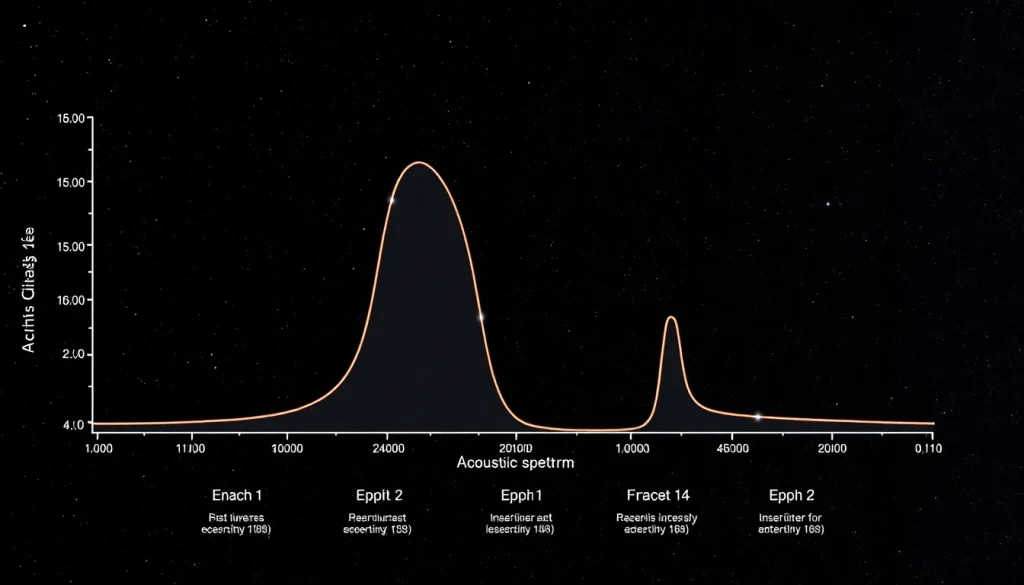
The cosmic microwave background (CMB) is the oldest light in the universe, released when the universe cooled enough for electrons and protons to combine into neutral hydrogen about 380,000 years after the Big Bang. This relic radiation is not perfectly smooth; it contains tiny temperature fluctuations—at the level of one part in 100,000—that are the seeds of all cosmic structure. Among the most informative features of these fluctuations are the acoustic peaks: a series of distinct bumps in the CMB power spectrum that arise from sound waves that traveled through the dense plasma of the early universe.
These acoustic peaks are a direct consequence of the interplay between gravity and pressure in the primordial plasma. In the first million years after the Big Bang, density perturbations behaved partly as sound waves, compressing and rarefying the baryon-photon fluid. When the universe cooled enough for neutral atoms to form, the photons were released, carrying with them a snapshot of these oscillations. The peaks in the CMB power spectrum correspond to the harmonic modes of these oscillations that were caught at the moment of recombination.
Acoustic peaks are not just a theoretical curiosity—they have been measured with increasing precision by experiments such as BOOMERANG, MAXIMA, WMAP, and the Planck satellite. Their locations and heights encode fundamental cosmological parameters, including the spatial curvature, the density of baryons and dark matter, and the Hubble constant. They also provide a geometric probe of cosmic expansion, linking the early universe to the present-day clustering of galaxies through baryon acoustic oscillations (BAO).
Definition
Acoustic peaks are the prominent maxima in the angular power spectrum of the CMB temperature anisotropies. They correspond to the compression phases of sound waves in the baryon-photon fluid at the epoch of recombination. The first peak (at multipole ℓ ≈ 200) indicates the scale of the sound horizon at recombination, while the relative heights of the odd and even peaks are sensitive to the baryon density.
How It Works
In the early universe, the plasma was a tightly coupled fluid of photons, electrons, and baryons. Gravity pulled overdense regions together, while radiation pressure pushed them apart, creating oscillating sound waves. These waves had a characteristic speed and traveled a maximum distance—the sound horizon—before recombination. When the universe became transparent, the photons last scattered, and the temperature pattern froze in. On the sky, these oscillations appear as a series of peaks and troughs in the power spectrum: the peaks are the modes that had reached maximum compression, and the troughs are the rarefaction phases.
The angular scale of these peaks depends on the geometry of the universe. If the universe is flat, the first peak appears at ℓ ≈ 200; if positively curved, it shifts to larger scales (smaller ℓ); if negatively curved, to smaller scales. This is why measuring the peak positions is a powerful test of cosmic geometry.
Equation
A simple formula for the angular scale of the first acoustic peak, derived by Cornish (2000), is:
ℓ ≈ 193 [1 + (3/5)(1 – Ω₀) + (1/5)(1 – h) + (1/35)Ω_Λ]
where Ω₀ is the total density parameter, h is the dimensionless Hubble constant, and Ω_Λ is the vacuum energy density. This formula illustrates how the peak position depends on the curvature, Hubble constant, and cosmological constant.
Example
The first acoustic peak, measured by the Planck satellite, is located at ℓ ≈ 220. The second peak appears at ℓ ≈ 540, and the third at ℓ ≈ 810. The exact positions and amplitudes are fit by the ΛCDM model with high precision, confirming the standard cosmological model.
Observable Consequences
Acoustic peaks have two major observable consequences:
- CMB power spectrum: The peaks and dips in the temperature anisotropies directly constrain the baryon density, dark matter density, and the curvature of space.
- Baryon acoustic oscillations (BAO): The same sound waves left a subtle imprint in the distribution of galaxies today, visible as a preferred separation scale of about 150 Mpc. This has been detected in galaxy surveys like SDSS and 2dF, providing a standard ruler for measuring cosmic expansion.
Common Misconceptions
- Peaks are not individual sound waves: They are the harmonic overtones of the fundamental oscillation mode, similar to the harmonics of a vibrating string.
- They are not Doppler peaks: While sometimes called Doppler peaks, the dominant contribution is from adiabatic (density) perturbations, not velocity flows.
- They do not require exotic physics: They arise naturally from standard gravitational instability in a baryon-photon fluid.
Cosmic Timeline: From Planck Epoch to Present
The acoustic peaks are a product of the early universe, but they connect to the entire cosmic history. Below is a timeline of the major epochs, from the very beginning to the formation of large-scale structure.
| Epoch | Time After Big Bang | Temperature | Key Events |
|---|---|---|---|
| Planck Epoch | 0 – 10⁻⁴³ s | > 10³² K | Quantum gravity effects dominate; no current theory. |
| Grand Unification Epoch | 10⁻⁴³ – 10⁻³⁶ s | > 10²⁸ K | Strong and electroweak forces unify; inflation begins. |
| Inflationary Epoch | 10⁻³⁶ – 10⁻³² s | ~10²⁷ K | Exponential expansion; seeds for structure generated. |
| Electroweak Epoch | 10⁻³² – 10⁻¹² s | > 10¹⁵ K | Electromagnetic and weak forces separate; W, Z bosons form. |
| Quark Epoch | 10⁻¹² – 10⁻⁶ s | > 10¹² K | Quarks and gluons exist in a quark-gluon plasma. |
| Hadron Epoch | 10⁻⁶ – 1 s | 10¹² – 10¹⁰ K | Protons and neutrons form; baryon-antibaryon annihilation. |
| Lepton Epoch | 1 – 10 s | 10¹⁰ – 10⁹ K | Leptons dominate; neutrinos decouple. |
| Photon Epoch | 10 s – 380,000 yr | 10⁹ – 3000 K | Photons dominate; nucleosynthesis; matter-radiation equality. |
| Recombination | ~380,000 yr | ~3000 K | Electrons combine with protons to form hydrogen; CMB released. |
| Dark Ages | 380,000 – ~150 million yr | ~3000 – 60 K | No stars yet; universe is dark and neutral. |
| Reionization | ~150 million – 1 billion yr | ~60 – 20 K | First stars and galaxies ionize the intergalactic medium. |
| Structure Formation | 1 billion yr – present | < 20 K | Galaxies, clusters, and large-scale structure form; dark energy dominates. |
The acoustic peaks are imprinted at recombination, but they are influenced by everything before that, and they determine the initial conditions for structure formation afterward.
Why It Matters
Acoustic peaks are one of the most powerful observational tools in cosmology. They provide a direct measurement of the sound horizon at recombination, which serves as a standard ruler for the universe. By comparing the angular scale of the peaks with the known physical size of the sound horizon, we can measure the geometry of space—a test that confirmed the universe is flat. The relative heights of the peaks reveal the baryon density: more baryons enhance the odd peaks (compression) and suppress the even peaks (rarefaction). The damping tail of the peaks constrains the dark matter density and the Hubble constant. Together, these measurements have nailed down the parameters of the ΛCDM model, showing that the universe is composed of about 5% ordinary matter, 27% dark matter, and 68% dark energy.
Moreover, the same acoustic oscillations have been detected in the large-scale distribution of galaxies as baryon acoustic oscillations (BAO). This provides an independent confirmation of the CMB results and a powerful probe of dark energy’s evolution. The acoustic peaks thus connect the earliest moments of the universe to the present-day cosmos, making them a cornerstone of modern cosmology.
Evidence / Sources
The existence and properties of acoustic peaks have been confirmed by multiple experiments:
- The BOOMERANG and MAXIMA experiments first measured the first acoustic peak with high significance, fixing its location and amplitude (Durrer et al., 2003).
- The WMAP satellite produced high-resolution maps of the CMB, precisely measuring the first five peaks and confirming the flat geometry of the universe.
- The Planck satellite provided even more precise measurements, refining the cosmological parameters to percent-level accuracy.
- Ground-based experiments like ACT and SPT have extended measurements to smaller scales, probing the damping tail.
- The detection of BAO in galaxy surveys (SDSS, 2dF) confirmed the acoustic phenomenon in the clustering of matter, as described by Eisenstein et al. (2005).
For further reading, see the sources cited below.
Related Registry Entries
FAQ
What exactly are CMB acoustic peaks?
CMB acoustic peaks are the prominent maxima in the temperature power spectrum of the cosmic microwave background. They arise from sound waves in the baryon-photon plasma of the early universe, which left a harmonic pattern of compression and rarefaction at the moment of recombination.
How do acoustic peaks tell us the universe is flat?
The angular scale of the first acoustic peak depends on the geometry of space. In a flat universe, the first peak appears at a multipole of about 200. Measurements by WMAP and Planck show the peak at exactly this scale, indicating the universe is spatially flat.
What is the relationship between acoustic peaks and baryon acoustic oscillations?
The same sound waves that created the acoustic peaks in the CMB also imprinted a subtle clustering pattern in matter distribution, known as baryon acoustic oscillations (BAO). This pattern is visible in galaxy surveys today as a preferred separation scale of about 150 Mpc.
Leave a Reply