Short Answer
The quark epoch was a brief period in the early universe, from about 10−12 seconds to 10−6 seconds after the Big Bang, when the universe was filled with a hot, dense quark–gluon plasma. During this time, quarks and gluons existed freely, not yet bound into protons and neutrons. This epoch ended when the universe cooled enough for quarks to combine into hadrons, marking the start of the hadron epoch.
| Quark Epoch at a Glance | |
|---|---|
| Start | ~10−12 s after Big Bang |
| End | ~10−6 s after Big Bang |
| Temperature | ~1015 K down to ~1012 K |
| Redshift | Extremely high (z > 1012) |
| Dominant particles | Quarks, gluons, leptons, and their antiparticles |
| Key event | Electroweak symmetry breaking; quarks free |
Main Explanation
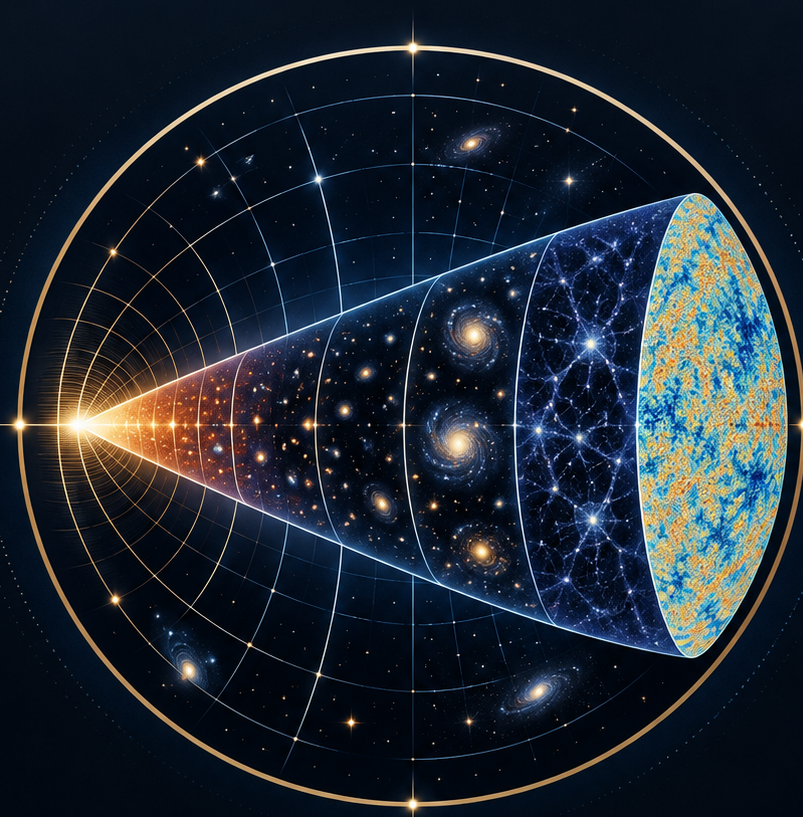
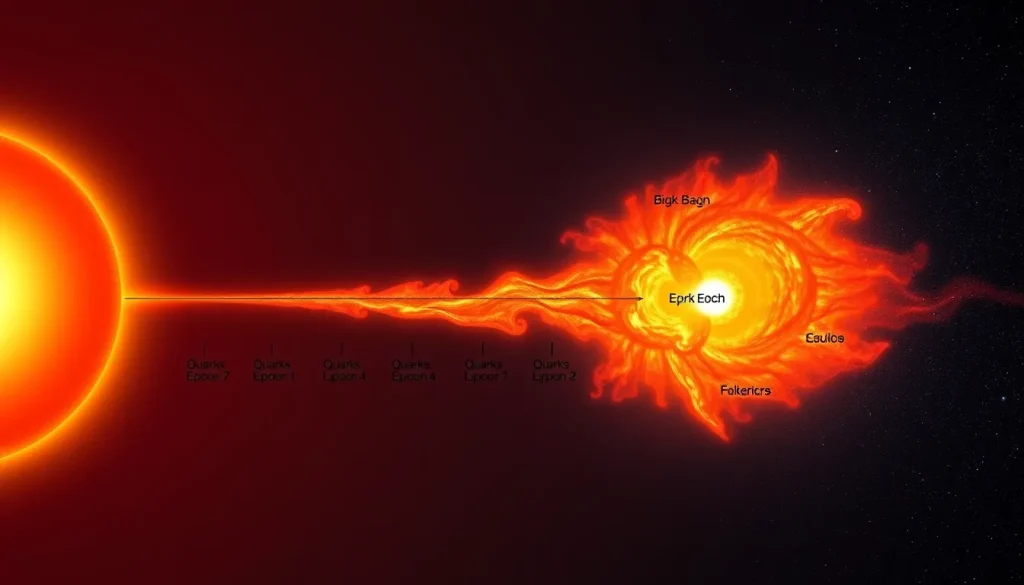
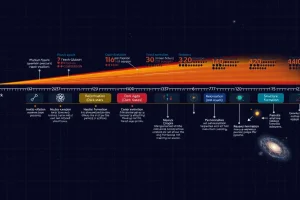
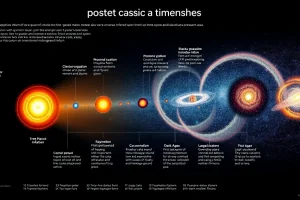
The quark epoch is a pivotal chapter in the standard Big Bang narrative. It sits between the electroweak epoch and the hadron epoch, a window of only about one microsecond, yet it set the stage for all matter that would later form. To understand it, we must place it within the full cosmic timeline—from the Planck epoch to the present day.
When It Happened
According to current cosmology, the quark epoch began approximately 10−12 seconds after the Big Bang, when the electroweak interaction separated into the weak force and electromagnetism. It ended at about 10−6 seconds, when the average energy of particle interactions fell below the binding energy of hadrons (protons and neutrons). This timeline is consistent with the standard model of particle physics and observations of the cosmic microwave background.
Temperature
During the quark epoch, the universe was unimaginably hot—temperatures ranged from roughly 1015 K at the start down to about 1012 K at the end. At these energies, the strong force was too weak to confine quarks into composite particles, so the universe existed as a quark–gluon plasma.
Approximate Redshift
Redshift is a measure of how much the universe has expanded since a given epoch. For the quark epoch, the redshift is extraordinarily high—on the order of 1012 or more. This means the universe was about a trillion times smaller than it is today. Because the epoch is so brief and extreme, precise redshift values are not directly observable, but they are inferred from the standard cosmological model.
Dominant Particles/Physics
The universe was a dense soup of quarks, gluons, leptons (electrons, muons, neutrinos), and their antiparticles. The four fundamental forces—gravity, electromagnetism, the weak force, and the strong force—had already taken their present forms, but the strong force was not yet confining quarks. This state is known as a quark–gluon plasma, a phase of matter that has been recreated in particle accelerators like the Large Hadron Collider.
What Happened
As the universe expanded and cooled, the energy density dropped. At the beginning of the quark epoch, the electroweak symmetry had just broken, giving particles mass. Quarks and gluons interacted violently, but they could not bind into hadrons because collisions were too energetic. Near the end of the epoch, when the temperature fell to about 1012 K, quarks began to combine into protons and neutrons—a process called hadronization. This transition is not instantaneous; it occurs over a range of temperatures, but the epoch is defined by the period when quarks were free.
What Came Before
Before the quark epoch was the electroweak epoch (10−36 to 10−12 s), during which the electromagnetic and weak forces were unified. Even earlier were the inflationary epoch (10−36 to 10−32 s), the grand unification epoch, and the Planck epoch (up to 10−43 s). The quark epoch began when the electroweak force split into the weak force and electromagnetism.
What Came Next
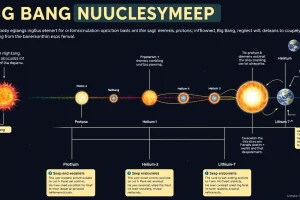
After the quark epoch came the hadron epoch (10−6 to 1 s), when quarks were confined into hadrons. This was followed by the lepton epoch, photon epoch, and then nucleosynthesis (around 3 minutes), recombination (380,000 years), the dark ages, reionization, and finally structure formation. The cosmic microwave background we observe today is a relic of recombination, but its properties are influenced by the physics of the quark epoch.
Evidence
Direct evidence for the quark epoch comes from particle physics experiments, particularly heavy-ion collisions at the Relativistic Heavy Ion Collider (RHIC) and the Large Hadron Collider (LHC), which recreate quark–gluon plasma. Cosmologically, the abundances of light elements (primordial nucleosynthesis) and the detailed spectrum of the cosmic microwave background are consistent with the standard model that includes the quark epoch. The observed matter–antimatter asymmetry also points to processes that occurred during this era.
Cosmic Epoch Timeline
| Epoch | Time after Big Bang | Key Events |
|---|---|---|
| Planck epoch | <10−43 s | Quantum gravity dominates; no known physics |
| Grand unification epoch | 10−43 – 10−36 s | Unified forces; inflation begins |
| Inflationary epoch | 10−36 – 10−32 s | Exponential expansion; seeds of structure |
| Electroweak epoch | 10−32 – 10−12 s | Electromagnetic and weak forces unify |
| Quark epoch | 10−12 – 10−6 s | Quark–gluon plasma; quarks free |
| Hadron epoch | 10−6 – 1 s | Protons and neutrons form |
| Lepton epoch | 1 – 10 s | Leptons dominate; neutrinos decouple |
| Photon epoch | 10 s – 380,000 yr | Photons dominate; nucleosynthesis |
| Recombination | ~380,000 yr | Atoms form; CMB released |
| Dark Ages | 380,000 yr – ~150 million yr | No stars; neutral hydrogen |
| Reionization | ~150 million – 1 billion yr | First stars and galaxies ionize gas |
| Structure formation | 1 billion yr – present | Galaxies, clusters, large-scale structure |
Why It Matters
The quark epoch is not just a historical curiosity—it is the crucible in which the fundamental constituents of matter were forged. The conditions during this microsecond determined the balance of matter and antimatter, the abundance of quarks that would later form protons and neutrons, and ultimately the composition of every atom in the universe. Understanding this epoch also tests our theories of particle physics at extreme energies, bridging the gap between quantum mechanics and gravity. Moreover, the quark–gluon plasma produced in laboratories today offers a window into the state of the universe when it was less than a microsecond old.
Evidence / Sources
The following sources provide authoritative information on the quark epoch and the cosmic timeline:
- Wikipedia: Quark epoch
- Wikipedia: Chronology of the universe
- Rafelski & Birrell, “Traveling Through the Universe: Back in Time to the Quark-Gluon Plasma Era” (arXiv:1311.0075)
Related Registry Entries
Explore other cosmic epochs and concepts in this registry:
FAQ
What happened during the quark epoch?
During the quark epoch, the universe was filled with a quark–gluon plasma—a hot, dense state where quarks and gluons moved freely. The strong force was too weak to bind them into hadrons. As the universe expanded and cooled, quarks eventually combined into protons and neutrons, ending the epoch.
How long did the quark epoch last?
The quark epoch lasted from about 10^-12 seconds to 10^-6 seconds after the Big Bang—a duration of roughly one microsecond. This is an extremely short period, but it was crucial for setting the stage for matter formation.
What evidence do we have for the quark epoch?
Evidence comes from particle accelerator experiments that recreate quark–gluon plasma, as well as cosmological observations. The abundances of light elements and the detailed spectrum of the cosmic microwave background are consistent with the standard model that includes the quark epoch.
How does the quark epoch relate to the cosmic microwave background?
The CMB is a relic of recombination, which occurred much later (380,000 years). However, the conditions during the quark epoch influenced the overall expansion history and the matter–antimatter asymmetry, which in turn affect the CMB's properties.
Leave a Reply