Short Answer
Main Explanation
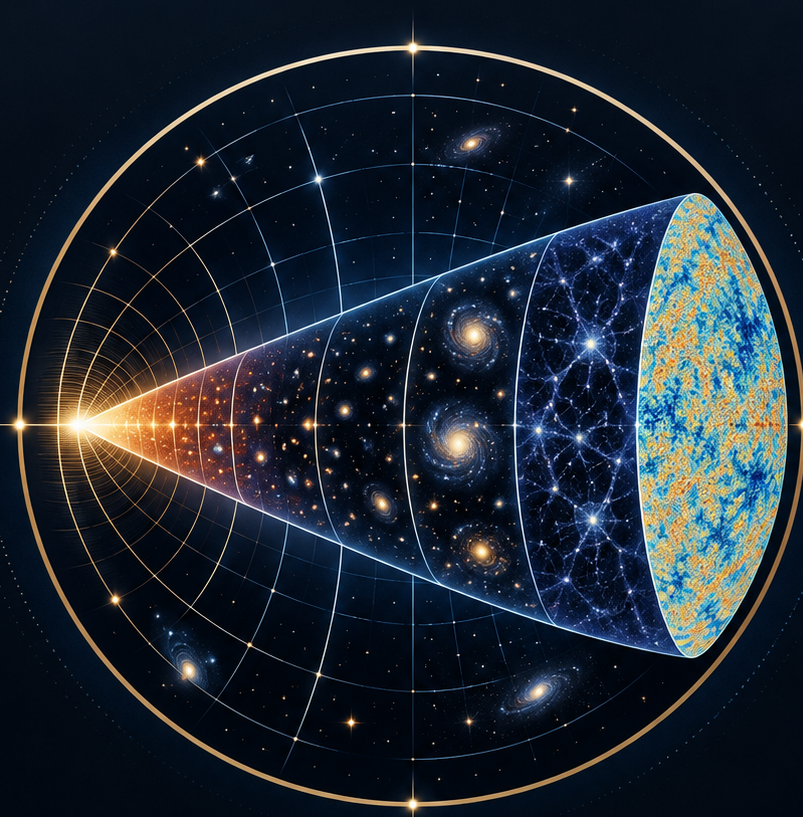
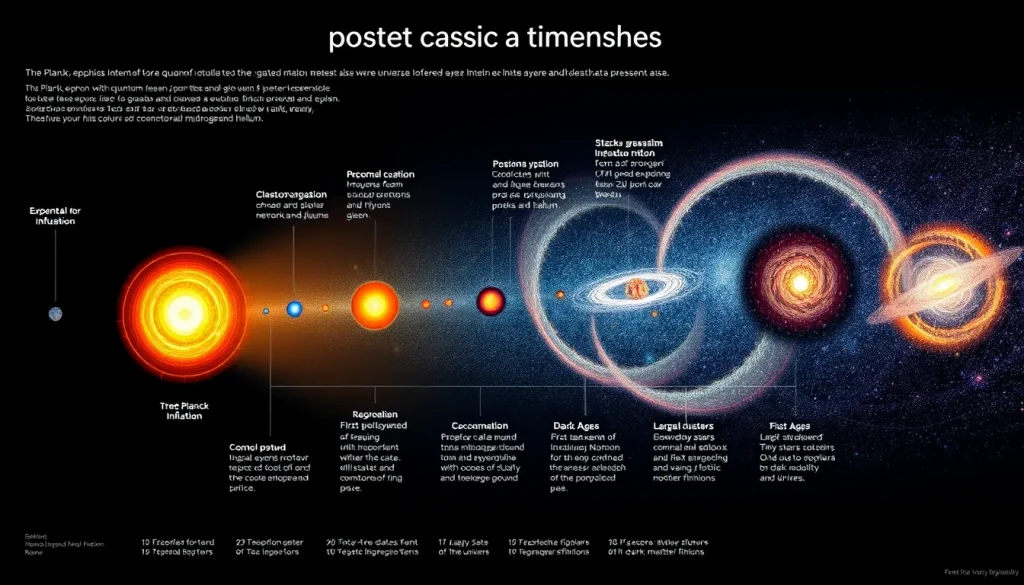
The history of the universe, according to Big Bang cosmology, begins 13.787 billion years ago with an extremely hot, dense state. The earliest stage is the Planck epoch, a fleeting moment so brief that it defies ordinary intuition. Understanding this era requires merging quantum mechanics with general relativity—a challenge that remains unsolved. Yet the Planck epoch sets the stage for everything that follows, from cosmic inflation to the formation of atoms, stars, and galaxies.
Planck Epoch (t < 10-43 s)
- When It Happened: From the Big Bang to 10-43 seconds (one Planck time).
- Temperature: ~1032 K (Planck temperature).
- Approximate Redshift: Not defined; the universe is in a quantum gravitational regime.
- Dominant Particles/Physics: All four fundamental forces (gravity, strong, weak, electromagnetic) are presumed unified into a single force. Quantum gravity effects dominate.
- What Happened: The universe expands from a singularity; space and time as we know them emerge. No coherent physical model exists for this period.
- What Came Before: Nothing is known; the initial singularity is a boundary of our current physics.
- What Came Next: Grand Unification Epoch.
- Evidence: No direct evidence; theoretical extrapolation from quantum gravity and particle physics.
Grand Unification Epoch (10-43 to 10-36 s)
- When It Happened: From 10-43 to 10-36 seconds.
- Temperature: Drops from ~1032 K to ~1028 K.
- Approximate Redshift: Extremely high, but not precisely defined.
- Dominant Particles/Physics: The strong force separates from the electroweak force; grand unified theories (GUTs) describe this era.
- What Happened: The strong nuclear force becomes distinct, and the universe undergoes a phase transition. Baryogenesis may have occurred, producing the matter–antimatter asymmetry.
- What Came Before: Planck epoch.
- What Came Next: Inflationary Epoch.
- Evidence: Indirect; supported by the observed matter–antimatter asymmetry and the existence of cosmic structures.
Inflationary Epoch (10-36 to 10-34 s)
- When It Happened: Between 10-36 and 10-34 seconds after the Big Bang.
- Temperature: ~1028 K, but rapidly cooling.
- Approximate Redshift: Not applicable; the universe expands exponentially.
- Dominant Particles/Physics: A scalar field (inflaton) drives exponential expansion; quantum fluctuations are stretched to cosmic scales.
- What Happened: The physical scale of the universe doubled more than 50 times, growing from subatomic to macroscopic size in a tiny fraction of a second. This inflation explains the uniformity of the cosmic microwave background and the large-scale structure.
- What Came Before: Grand Unification Epoch.
- What Came Next: Electroweak Epoch.
- Evidence: The flatness, homogeneity, and primordial density fluctuations observed in the CMB strongly support inflation.
Electroweak Epoch (10-34 to 10-12 s)
- When It Happened: From 10-34 to 10-12 seconds.
- Temperature: ~1028 K down to ~1015 K.
- Approximate Redshift: ~1015 and higher.
- Dominant Particles/Physics: The electromagnetic and weak forces are unified as the electroweak force; W and Z bosons are massless.
- What Happened: The Higgs mechanism breaks electroweak symmetry, giving mass to W and Z bosons and fermions. The universe becomes a quark–gluon plasma.
- What Came Before: Inflationary Epoch.
- What Came Next: Quark Epoch.
- Evidence: The discovery of the W and Z particles at CERN supports electroweak unification.
Quark Epoch (10-12 to 10-6 s)
- When It Happened: From 10-12 to 10-6 seconds.
- Temperature: ~1015 K to ~1012 K.
- Approximate Redshift: ~1012 to 109.
- Dominant Particles/Physics: Quarks, gluons, and leptons exist freely in a quark–gluon plasma; the strong force is still too energetic to confine quarks.
- What Happened: The universe is a dense soup of quarks and gluons. As it cools, quarks begin to combine into hadrons (protons and neutrons).
- What Came Before: Electroweak Epoch.
- What Came Next: Hadron Epoch.
- Evidence: Heavy-ion collisions at RHIC and LHC recreate similar conditions.
Hadron Epoch (10-6 to 1 s)
- When It Happened: From 10-6 to 1 second.
- Temperature: ~1012 K to ~1010 K.
- Approximate Redshift: ~109 to 108.
- Dominant Particles/Physics: Protons and neutrons form; hadrons and antihadrons annihilate, leaving a small excess of matter.
- What Happened: Quarks confine into hadrons. The matter–antimatter asymmetry becomes fixed, leaving about one proton for every billion antiprotons.
- What Came Before: Quark Epoch.
- What Came Next: Lepton Epoch.
- Evidence: The observed baryon density in the universe matches predictions from BBN.
Lepton Epoch (1 to 10 s)
- When It Happened: From 1 to 10 seconds.
- Temperature: ~1010 K to ~109 K.
- Approximate Redshift: ~108 to 107.
- Dominant Particles/Physics: Leptons (electrons, positrons, neutrinos) dominate; neutrinos decouple at ~1 second.
- What Happened: Neutrinos stop interacting with matter and stream freely (the cosmic neutrino background). Electron–positron pairs annihilate, adding energy to photons.
- What Came Before: Hadron Epoch.
- What Came Next: Photon Epoch (including nucleosynthesis).
- Evidence: The cosmic neutrino background is indirectly inferred from BBN and CMB.
Photon Epoch (10 s to 380,000 years)
- When It Happened: From 10 seconds to about 380,000 years.
- Temperature: ~109 K down to ~3000 K.
- Approximate Redshift: ~107 to ~1100.
- Dominant Particles/Physics: Photons, neutrinos, and a small amount of matter; the universe is radiation-dominated.
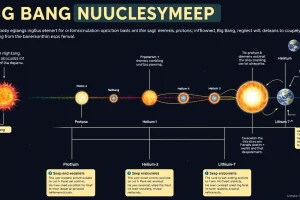
- What Happened: Big Bang nucleosynthesis forms the first elements: hydrogen, helium, and a trace of lithium. After about 6 seconds, electrons and positrons annihilate. The universe remains a hot plasma of nuclei and electrons.
- What Came Before: Lepton Epoch.
- What Came Next: Recombination and the release of the CMB.
- Evidence: The observed primordial abundances of hydrogen and helium match BBN predictions.
Recombination and the Cosmic Microwave Background (380,000 years)
- When It Happened: At ~380,000 years after the Big Bang.
- Temperature: ~3000 K.
- Approximate Redshift: z ≈ 1100.
- Dominant Particles/Physics: Electrons combine with protons to form neutral hydrogen; photons decouple from matter.
- What Happened: The universe becomes transparent; the photons released form the cosmic microwave background (CMB) we observe today. The CMB is a relic of this epoch, now cooled to 2.725 K.
- What Came Before: Photon Epoch.
- What Came Next: Dark Ages.
- Evidence: The CMB was discovered by Penzias and Wilson in 1965; missions like COBE, WMAP, and Planck have mapped its anisotropies in detail.
Dark Ages and Reionization (380,000 to ~1 billion years)
- When It Happened: From ~380,000 years to about 1 billion years.
- Temperature: Drops from ~3000 K to ~10 K.
- Approximate Redshift: z ≈ 1100 to z ≈ 6.
- Dominant Particles/Physics: Neutral hydrogen and helium; gravity begins to amplify density fluctuations.
- What Happened: The universe is dark and featureless. Over time, the first stars and galaxies form, emitting ultraviolet light that reionizes the intergalactic medium (Reionization).
- What Came Before: Recombination.
- What Came Next: Structure Formation.
- Evidence: Observations of the most distant quasars and galaxies (e.g., with JWST) probe this era.
Structure Formation (1 billion years to present)
- When It Happened: From ~1 billion years to today.
- Temperature: Continues to cool; today the CMB is 2.725 K.
- Approximate Redshift: z ≈ 6 to z = 0.
- Dominant Particles/Physics: Dark matter dominates gravitational collapse; baryonic matter follows.
- What Happened: Galaxies, clusters, and superclusters form under gravity. Dark energy accelerates expansion in the last few billion years.
- What Came Before: Dark Ages/Reionization.
- What Came Next: The present and future of the universe.
- Evidence: Large-scale structure surveys (e.g., SDSS, DES) and CMB measurements support the ΛCDM model.
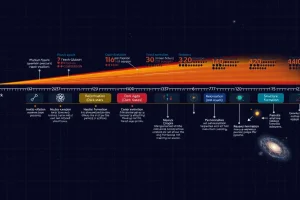
Timeline of Cosmic Epochs
| Epoch | Time | Temperature | Key Events |
|---|---|---|---|
| Planck | <10-43 s | ~1032 K | All forces unified; quantum gravity |
| Grand Unification | 10-43–10-36 s | 1032–1028 K | Strong force separates |
| Inflation | 10-36–10-34 s | ~1028 K | Exponential expansion |
| Electroweak | 10-34–10-12 s | 1028–1015 K | Electroweak symmetry breaking |
| Quark | 10-12–10-6 s | 1015–1012 K | Quark–gluon plasma |
| Hadron | 10-6–1 s | 1012–1010 K | Protons and neutrons form |
| Lepton | 1–10 s | 1010–109 K | Neutrino decoupling |
| Photon | 10 s–380,000 yr | 109–3000 K | Nucleosynthesis |
| Recombination | ~380,000 yr | ~3000 K | CMB released |
| Dark Ages | 380,000 yr–1 Gyr | 3000–10 K | First stars form |
| Reionization | ~1 Gyr | ~10 K | Intergalactic medium reionized |
| Structure Formation | 1 Gyr–present | 2.725 K (CMB) | Galaxies and clusters form |
Why It Matters
The Planck epoch is the ultimate frontier of physics, where our current theories break down. Understanding it requires a quantum theory of gravity—a goal that drives research in string theory, loop quantum gravity, and other approaches. The subsequent epochs, especially inflation and recombination, leave observable imprints: the cosmic microwave background, the distribution of galaxies, and the primordial abundances of elements. By studying these relics, cosmologists test the ΛCDM model and probe the physics of the very early universe. Missions like COBE, WMAP, Planck, and JWST have transformed our understanding, turning the Big Bang from a vague idea into a precision science.
Evidence / Sources
The standard model of cosmology (ΛCDM) is supported by multiple independent lines of evidence:
- Cosmic Microwave Background: The CMB’s near-perfect blackbody spectrum and tiny anisotropies match predictions from inflation and recombination. COBE, WMAP, and Planck have mapped these fluctuations with increasing precision.
- Big Bang Nucleosynthesis: The observed abundances of hydrogen, helium, and lithium agree with calculations based on the baryon density inferred from the CMB.
- Large-Scale Structure: Galaxy surveys reveal a web of structure consistent with the growth of primordial density fluctuations under gravity, with dark matter playing a central role.
- Accelerating Expansion: Supernova observations show the universe’s expansion is accelerating, attributed to dark energy, a key component of ΛCDM.
For the Planck epoch specifically, direct evidence is absent, but the framework of quantum gravity and grand unification provides a theoretical basis. The discovery of the Higgs boson and the W/Z particles supports the electroweak unification that occurred later.
Related Registry Entries
- Cosmic Inflation
- Cosmic Microwave Background
- Big Bang Nucleosynthesis
- Recombination
- Dark Ages and Reionization
- Large-Scale Structure
FAQ
What exactly is the Planck epoch?
The Planck epoch is the earliest period in the universe's history, from t=0 to t=10^-43 seconds (one Planck time). During this era, all four fundamental forces are thought to have been unified into a single force, and quantum gravitational effects dominated. No complete physical model exists for this period because it requires a theory of quantum gravity.
Why is the Planck epoch important?
The Planck epoch is the ultimate test of physics. It is the only time when quantum gravity was significant, and understanding it could reveal how space and time emerged. It also sets the initial conditions for inflation and the subsequent evolution of the universe.
How do we know about the Planck epoch if we can't observe it?
We don't have direct observations, but we infer its properties from theoretical frameworks like grand unified theories and quantum gravity. The success of the ΛCDM model, which relies on inflation (which occurs just after the Planck epoch), provides indirect support. Future advances in quantum gravity may offer more insights.
What came before the Planck epoch?
According to standard cosmology, nothing—or at least nothing we can describe. The Big Bang singularity is a boundary of our current theories. Some speculative models suggest a pre-Big Bang phase, but these are not part of the consensus ΛCDM model.

Leave a Reply