Short Answer
Short Answer: According to the standard Big Bang model, space and time began at the Big Bang. There was no “before” in any physical sense because time itself did not exist. However, some theoretical frameworks, such as string theory, suggest a pre-Bang state, but these remain speculative and untestable with current technology.
| Property | Value |
|---|---|
| Age of universe | 13.8 billion years |
| CMB temperature today | 2.725 K |
| Planck epoch duration | 0 to 10⁻⁴³ s |
| Inflation epoch | ~10⁻³⁶ to 10⁻³² s |
| Recombination | ~380,000 years |
| First stars | ~100–200 million years |
| Current expansion rate (H₀) | ~67–73 km/s/Mpc (tension) |
Main Explanation
The question “Did space exist before the Big Bang?” challenges our intuition. In everyday life, events happen in space and time, but the Big Bang was not an explosion in a pre-existing void. Rather, it was the origin of space and time themselves. As cosmologist Joel R. Primack explains, a common misconception is that the Big Bang occurred at a point in a static, pre-existing space—but this is not what the theory describes. Instead, space itself began expanding, and that expansion continues today.
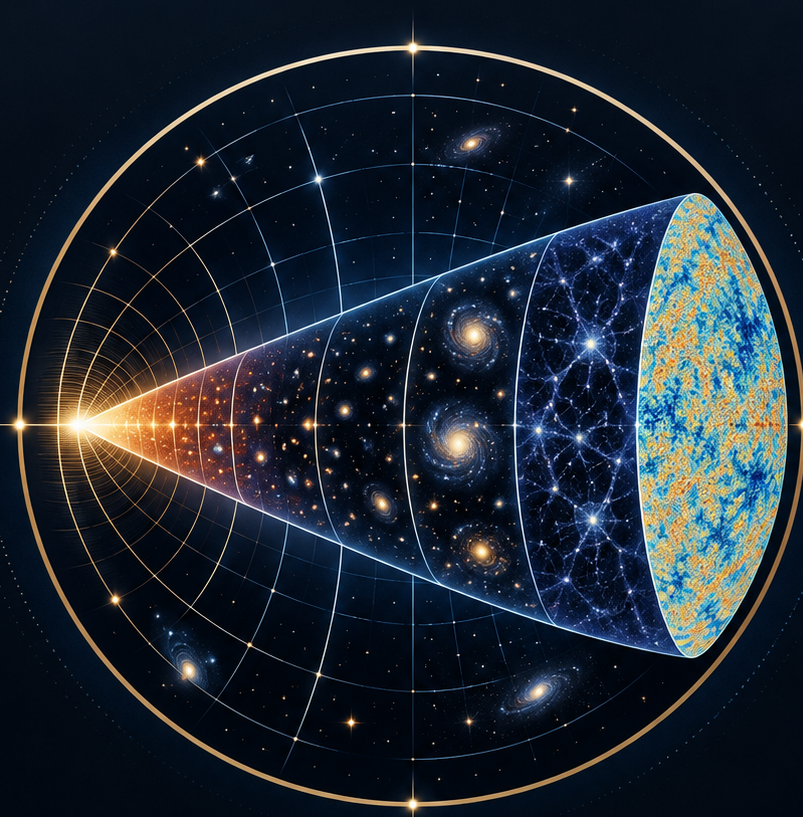
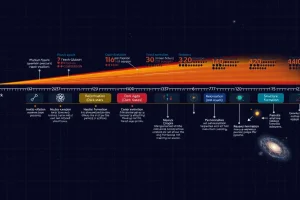
The standard model of cosmology, known as Lambda-CDM, describes a universe that began in an extraordinarily hot, dense state about 13.8 billion years ago. Since then, it has expanded, cooled, and evolved through distinct epochs. Each epoch is characterized by the dominant physical processes and particles. By studying relics like the cosmic microwave background (CMB) and the distribution of galaxies, astronomers have pieced together a remarkably detailed timeline.
The Cosmic Epochs
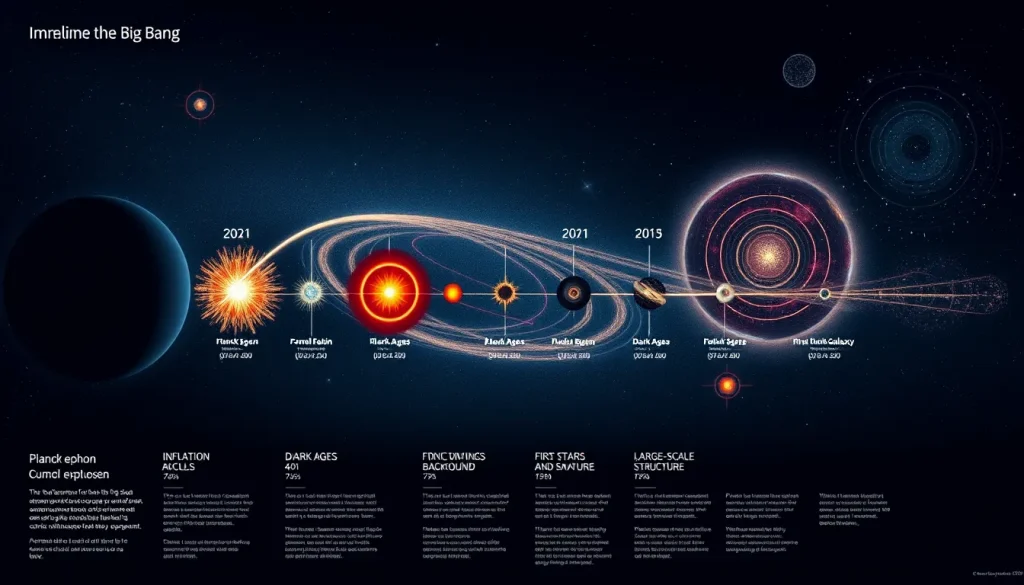
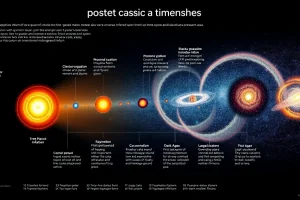
The history of the universe is often divided into a series of epochs, each with a specific time, temperature, and dominant physics. The table below summarizes the major milestones.
| Epoch | Time after Big Bang | Temperature | Key Events |
|---|---|---|---|
| Planck Epoch | <10⁻⁴³ s | >10³² K | Quantum gravity dominates; no current theory. |
| Grand Unification Epoch | 10⁻⁴³ to 10⁻³⁶ s | 10²⁷–10³² K | Strong and electroweak forces unified. |
| Inflationary Epoch | 10⁻³⁶ to 10⁻³² s | ~10²⁷ K | Exponential expansion; seeds of structure formed. |
| Electroweak Epoch | 10⁻³² to 10⁻¹² s | 10¹⁵–10²⁷ K | Electromagnetic and weak forces separate. |
| Quark Epoch | 10⁻¹² to 10⁻⁶ s | 10¹²–10¹⁵ K | Quarks and gluons exist in a quark-gluon plasma. |
| Hadron Epoch | 10⁻⁶ to 1 s | 10¹⁰–10¹² K | Protons and neutrons form; matter-antimatter asymmetry arises. |
| Lepton Epoch | 1 to 10 s | 10⁹–10¹⁰ K | Leptons dominate; neutrinos decouple. |
| Photon Epoch | 10 s to 380,000 yr | 3,000–10⁹ K | Photons dominate; nuclei form (BBN). |
| Recombination | ~380,000 yr | ~3,000 K | Electrons combine with nuclei; CMB released. |
| Dark Ages | 380,000 yr to ~150 million yr | ~3,000 K to ~60 K | No stars yet; universe filled with neutral hydrogen. |
| Reionization | ~150 million to ~1 billion yr | ~60 K to ~10 K | First stars and galaxies ionize hydrogen. |
| Structure Formation | ~1 billion yr to present | <10 K | Galaxies, clusters, and large-scale structure form. |
Planck Epoch
When It Happened: The first 10⁻⁴³ seconds (Planck time). Temperature: Above 10³² K. Dominant Physics: Quantum gravity—the four fundamental forces are unified. What Happened: Our current laws of physics break down; we have no complete theory to describe this era. What Came Before: Nothing—time itself begins here. What Came Next: Grand Unification Epoch. Evidence: Indirect—requires a theory of quantum gravity.
Grand Unification Epoch
When: 10⁻⁴³ to 10⁻³⁶ s. Temperature: 10²⁷–10³² K. Dominant Physics: Strong and electroweak forces are unified. What Happened: As the universe cooled, the strong force separated from the electroweak force. What Came Before: Planck epoch. What Came Next: Inflationary epoch.
Inflationary Epoch
When: 10⁻³⁶ to 10⁻³² s. Temperature: ~10²⁷ K. Dominant Physics: Scalar field (inflaton) drives exponential expansion. What Happened: The universe expanded by a factor of at least 10²⁶ in a tiny fraction of a second, smoothing out initial irregularities and producing quantum fluctuations that later seeded galaxies. What Came Before: Grand Unification. What Came Next: Electroweak epoch. Evidence: The flatness and homogeneity of the CMB, and the scale-invariant spectrum of density fluctuations.
Electroweak Epoch
When: 10⁻³² to 10⁻¹² s. Temperature: 10¹⁵–10²⁷ K. Dominant Physics: Electromagnetic and weak forces separate. What Happened: The Higgs mechanism gives mass to particles. What Came Before: Inflation. What Came Next: Quark epoch.
Quark Epoch
When: 10⁻¹² to 10⁻⁶ s. Temperature: 10¹²–10¹⁵ K. Dominant Physics: Quarks and gluons form a quark-gluon plasma. What Happened: The universe is a dense soup of quarks, antiquarks, and gluons. What Came Before: Electroweak. What Came Next: Hadron epoch.
Hadron Epoch
When: 10⁻⁶ to 1 s. Temperature: 10¹⁰–10¹² K. Dominant Physics: Quarks combine to form protons and neutrons. What Happened: Matter-antimatter asymmetry develops; most matter annihilates with antimatter, leaving a small excess of matter. What Came Before: Quark epoch. What Came Next: Lepton epoch.
Lepton Epoch
When: 1 to 10 s. Temperature: 10⁹–10¹⁰ K. Dominant Physics: Leptons (electrons, neutrinos) dominate. What Happened: Neutrinos decouple and stream freely; electron-positron annihilation occurs. What Came Before: Hadron epoch. What Came Next: Photon epoch.
Photon Epoch
When: 10 s to 380,000 years. Temperature: 3,000–10⁹ K. Dominant Physics: Photons dominate; nuclei form during Big Bang Nucleosynthesis (BBN). What Happened: Protons and neutrons fuse into helium, deuterium, and lithium. What Came Before: Lepton epoch. What Came Next: Recombination. Evidence: The predicted primordial abundances of light elements match observations.
Recombination
When: ~380,000 years. Temperature: ~3,000 K. Dominant Physics: Electrons combine with nuclei to form neutral atoms. What Happened: The universe becomes transparent; the cosmic microwave background (CMB) is released. What Came Before: Photon epoch. What Came Next: Dark Ages. Evidence: The CMB, first detected by Penzias and Wilson, and mapped precisely by COBE, WMAP, and Planck.
Dark Ages
When: 380,000 to ~150 million years. Temperature: ~3,000 K to ~60 K. Dominant Physics: Gravity; neutral hydrogen fills the universe. What Happened: No stars yet; the universe is dark and quiet. What Came Before: Recombination. What Came Next: Reionization.
Reionization
When: ~150 million to ~1 billion years. Temperature: ~60 K to ~10 K. Dominant Physics: First stars and galaxies form, emitting ultraviolet light that ionizes hydrogen. What Happened: The universe becomes reionized; structure formation accelerates. What Came Before: Dark Ages. What Came Next: Structure Formation. Evidence: Observations of distant quasars and the CMB polarization, and JWST’s deep field surveys.
Structure Formation
When: ~1 billion years to present. Temperature: <10 K. Dominant Physics: Gravity and dark energy. What Happened: Galaxies, clusters, and superclusters form; dark energy accelerates expansion. What Came Before: Reionization. What Came Next: The future—potentially endless expansion. Evidence: Large-scale structure surveys (e.g., SDSS, DESI) and supernova distance measurements.
The Cosmic Microwave Background: A Relic of the Early Universe
The CMB is the afterglow of the Big Bang, released at recombination. It provides a snapshot of the universe when it was just 380,000 years old. Missions like COBE (1989), WMAP (2001), and Planck (2009) have mapped its temperature and polarization, revealing tiny anisotropies that correspond to the seeds of galaxies. These measurements have pinned down cosmological parameters with remarkable precision, confirming the Lambda-CDM model.
How Space Itself Expands
The expansion of space is often misunderstood. Galaxies are not moving through a static void; rather, the fabric of space itself stretches, carrying galaxies apart. This is why distant galaxies recede at speeds proportional to their distance—the Hubble–Lemaître law. The expansion is not “into” anything; it is the expansion of space itself, as Primack emphasizes.
Why It Matters
Understanding the cosmic timeline is not just about satisfying curiosity. It reveals the profound interconnectedness of fundamental physics and cosmology. The universe’s history is a laboratory for testing particle physics at energies far beyond any accelerator. Moreover, the question of what preceded the Big Bang challenges our notions of causality and time. As physicist Gabriele Veneziano notes, string theory suggests the Big Bang might have been a “prequel” to a pre-existing state, but such ideas remain speculative. Studying the universe’s origin also informs our search for life and our place in the cosmos.
Evidence / Sources
The standard model of cosmology is supported by multiple independent observations: the CMB (COBE, WMAP, Planck), the distribution of galaxies (BAO), the primordial abundances of light elements (BBN), and the accelerating expansion (Type Ia supernovae). The sources below provide authoritative discussions of the pre-Big Bang question and the expansion of space.
- Scientific American – What Came Before the Big Bang?
- BBC Future – What Existed Before the Big Bang?
- Scientific American – If Space Is Expanding, Into What Is It Expanding?
- Scientific American – String Theory Predicts a Time before the Big Bang
Related Registry Entries
Explore more detailed entries on specific epochs and phenomena:
- Planck Epoch
- Inflation
- Recombination
- Cosmic Microwave Background
- First Stars & Galaxies
{
“@context”: “https://schema.org”,
“@type”: “FAQPage”,
“mainEntity”: [
{
“@type”: “Question”,
“name”: “Did space exist before the Big Bang?”,
“acceptedAnswer”: {
“@type”: “Answer”,
“text”: “According to the standard Big Bang model, space and time began at the Big Bang. There was no ‘before’ in any physical sense because time itself did not exist. Some theoretical models suggest a pre-Bang state, but these are speculative.”
}
},
{
“@type”: “Question”,
“name”: “What is the cosmic microwave background?”,
“acceptedAnswer”: {
“@type”: “Answer”,
“text”: “The CMB is the afterglow of the Big Bang, released about 380,000 years after the start. It is a faint microwave radiation filling the universe, mapped by COBE, WMAP, and Planck.”
}
},
{
“@type”: “Question”,
“name”: “How do we know the universe began with a Big Bang?”,
“acceptedAnswer”: {
“@type”: “Answer”,
“text”: “Evidence includes the expansion of the universe (Hubble–Lemaître law), the existence of the CMB, the abundances of light elements, and the large-scale structure of galaxies.”
}
},
{
“@type”: “Question”,
“name”: “What is cosmic inflation?”,
“acceptedAnswer”: {
“@type”: “Answer”,
“text”: “Inflation is a period of exponential expansion that occurred about 10⁻³⁶ seconds after the Big Bang, explaining the uniformity of the CMB and the seeds of galaxy formation.”
}
}
]
}
{
“@context”: “https://schema.org”,
“@type”: “CreativeWork”,
“name”: “Did Space Exist Before the Big Bang?”,
“citation”: [
“https://www.scientificamerican.com/article/what-came-before-the-big-bang-cosmology/”,
“https://www.bbc.com/future/article/20220105-what-existed-before-the-big-bang”,
“https://www.scientificamerican.com/article/according-to-the-big-bang-1999-10-21/”,
“https://www.scientificamerican.com/article/string-theory-predicts-a-time-before-the-big-bang/”
]
}
Last Reviewed: September 4, 2026
FAQ
Did space exist before the Big Bang?
According to the standard Big Bang model, space and time began at the Big Bang. There was no 'before' in any physical sense because time itself did not exist. Some theoretical models suggest a pre-Bang state, but these are speculative and not yet testable.
What is the cosmic microwave background?
The CMB is the afterglow of the Big Bang, released about 380,000 years after the start. It is a faint microwave radiation filling the universe, mapped by COBE, WMAP, and Planck, and provides a snapshot of the early universe.
How do we know the universe began with a Big Bang?
Evidence includes the expansion of the universe (Hubble–Lemaître law), the existence of the CMB, the primordial abundances of light elements, and the large-scale structure of galaxies, all consistent with the Lambda-CDM model.
What is cosmic inflation?
Inflation is a period of exponential expansion that occurred about 10⁻³⁶ seconds after the Big Bang, explaining the uniformity of the CMB and providing the seeds for galaxy formation via quantum fluctuations.
Leave a Reply