Short Answer
Main Explanation
The electroweak epoch is a pivotal phase in the early universe’s history, occurring roughly between 10-36 and 10-12 seconds after the Big Bang, depending on the exact definition. During this period, the universe was so hot and dense that the electromagnetic force and the weak nuclear force were merged into a single electroweak force, mediated by W and Z bosons and the photon. This epoch ended when the universe cooled enough for electroweak symmetry breaking to occur, giving mass to the W and Z bosons and separating the two forces.
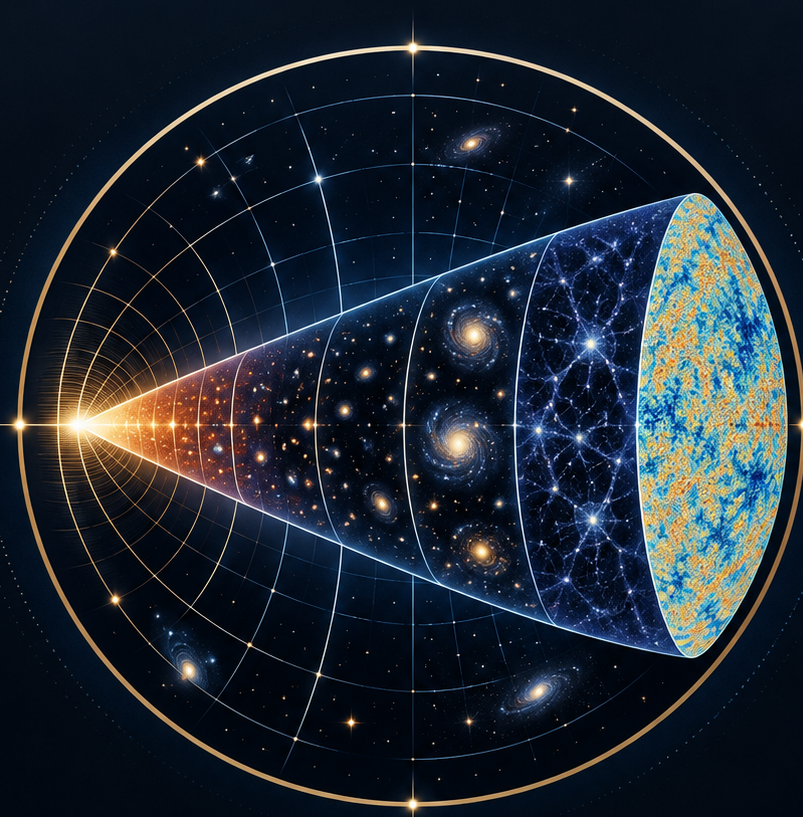
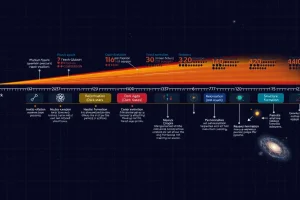
To understand the electroweak epoch, we must place it within the broader cosmic timeline. The universe began with the Planck epoch, followed by the Grand Unification epoch, then the inflationary epoch, and then the electroweak epoch. After the electroweak epoch came the quark epoch, hadron epoch, lepton epoch, photon epoch, recombination, dark ages, reionization, and structure formation. This article focuses on the electroweak epoch while providing a comprehensive overview of the entire evolution of the cosmos.
The table below summarizes the major cosmic epochs, their timing, temperature, and key events. This interactive reference helps visualize how the electroweak epoch fits into the grand narrative of the universe.
| Epoch | Time After Big Bang | Approximate Temperature | Key Events |
|---|---|---|---|
| Planck epoch | 0 to 10-43 s | >1032 K | All four fundamental forces unified; quantum gravity effects dominate. |
| Grand Unification epoch | 10-43 to 10-36 s | 1028–1032 K | Strong force separates from electroweak interaction. |
| Inflationary epoch | 10-36 to 10-32 s | Varies; rapid expansion | Exponential expansion; seeds for large-scale structure. |
| Electroweak epoch | 10-36 to 10-12 s | >1015 K (~159.5 GeV) | Electromagnetic and weak forces unified; W, Z, Higgs bosons abundant. |
| Quark epoch | 10-12 to 10-6 s | 1012–1015 K | Quarks, gluons, leptons in a quark-gluon plasma. |
| Hadron epoch | 10-6 to 1 s | 1010–1012 K | Quarks combine into protons, neutrons; matter-antimatter annihilation. |
| Lepton epoch | 1 to 10 s | 109–1010 K | Leptons dominate; neutrinos decouple. |
| Photon epoch | 10 s to 380,000 years | 104–109 K | Photons dominate; nucleosynthesis; universe becomes transparent. |
| Recombination | ~380,000 years | ~3,000 K | Electrons combine with protons to form neutral hydrogen; CMB released. |
| Dark Ages | 380,000 to ~150 million years | ~10–100 K | No stars; universe dark and neutral. |
| Reionization | ~150 million to 1 billion years | ~10–1000 K | First stars and galaxies ionize hydrogen. |
| Structure Formation | ~1 billion years to present | 2.7 K (today) | Galaxies, clusters, and large-scale structure form. |
When It Happened
Cosmologists place the electroweak epoch at different starting points depending on their definition of inflation. Some set its beginning at approximately 10-36 seconds after the Big Bang, when the strong force separated from the electroweak interaction, triggering cosmic inflation. Others place it at about 10-32 seconds, when the inflaton field’s potential energy was released, filling the universe with a hot, dense quark-gluon plasma. The epoch ended when the universe was about 10-12 seconds old, when the temperature fell below the critical threshold for electroweak symmetry breaking.
Temperature
During the electroweak epoch, the universe’s temperature exceeded 159.5 ± 1.5 GeV, equivalent to roughly 1015 K (about a quadrillion degrees). This energy scale is the critical temperature for electroweak symmetry breaking in the Standard Model. Above this temperature, electromagnetism and the weak force are indistinguishable; below it, they separate.
Approximate Redshift
Redshift is not directly observable for such early times, but based on the temperature scaling (T ∝ 1+z), the redshift would be enormous—far beyond 1012. No astronomical observations probe this epoch directly; instead, we rely on particle physics experiments and theoretical models.
Dominant Particles/Physics
The universe was filled with a dense, hot plasma of quarks, gluons, leptons, and force carriers. The electroweak force was mediated by the W± and Z0 bosons, which were massless at these energies, along with the photon. Higgs bosons were also abundant, and their interactions with the W and Z bosons would later give mass to these particles via spontaneous symmetry breaking.
What Happened
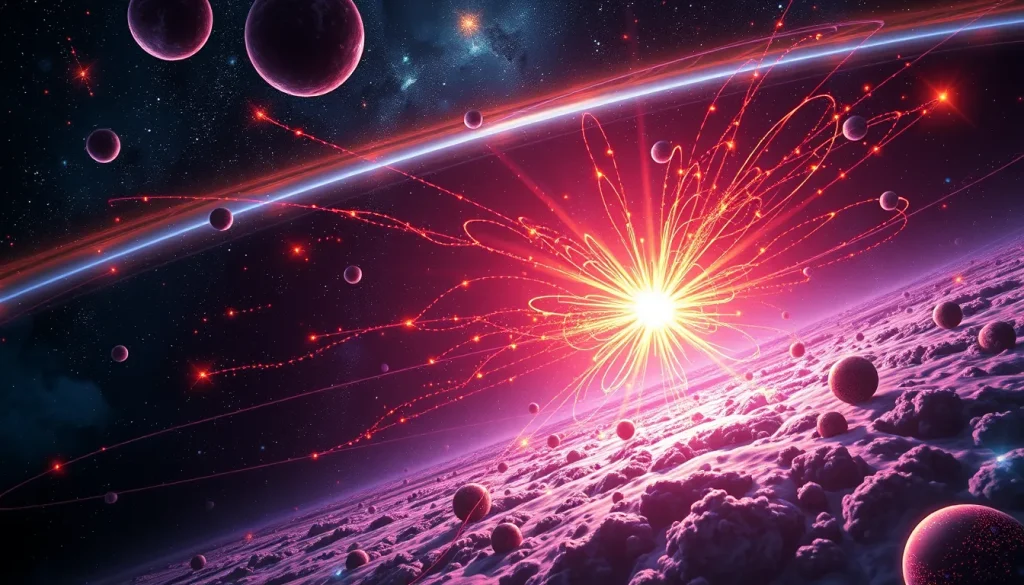
As the universe expanded and cooled, the electroweak symmetry broke. This phase transition caused the W and Z bosons to acquire mass through the Higgs mechanism, while the photon remained massless. Consequently, the electromagnetic and weak forces became distinct. This symmetry breaking is a key example of how fundamental forces emerge from a unified state at high energies.
What Came Before
Before the electroweak epoch, the universe underwent inflation, a period of exponential expansion driven by the inflaton field. During inflation, the strong force had already separated from the electroweak interaction (at the Grand Unification epoch). The electroweak epoch began as inflation ended, releasing enormous energy and reheating the universe.
What Came Next
After electroweak symmetry breaking, the universe entered the quark epoch. Here, quarks and gluons existed as a quark-gluon plasma, but the forces were now distinct. As temperatures dropped further, quarks combined into hadrons (protons and neutrons) during the hadron epoch, leading eventually to nucleosynthesis and the formation of light elements.
Evidence
Direct evidence for the electroweak epoch is unavailable, but its physics is tested in particle accelerators like the Large Hadron Collider (LHC). The discovery of the Higgs boson in 2012 confirmed the mechanism of electroweak symmetry breaking. Additionally, the cosmic microwave background (CMB) provides indirect evidence for the early universe’s high-energy conditions, though it originates from recombination, much later. The standard model of cosmology (ΛCDM) incorporates the electroweak epoch as a necessary step, and its predictions align with observed cosmic structure and primordial abundances.
Why It Matters
The electroweak epoch is a crucial testbed for the Standard Model of particle physics. It demonstrates how fundamental forces unify at high energies and how symmetry breaking gives mass to particles. Understanding this epoch also helps cosmologists model the early universe’s thermal history, influencing predictions for primordial gravitational waves, baryogenesis, and dark matter production. Moreover, it connects particle physics to cosmology, showing that the laws of physics we observe today are the result of a series of symmetry-breaking events in the first moments after the Big Bang.
Evidence / Sources
The information in this article is based on authoritative sources in cosmology and particle physics. Key references include the Wikipedia articles on the electroweak epoch and electroweak interaction, as well as educational resources from Fiveable and ScientificLib. These sources provide detailed explanations of the timing, temperature, and physics of this epoch. The Standard Model’s critical temperature for electroweak symmetry breaking is 159.5 ± 1.5 GeV, as cited in the literature. The timeline of cosmic epochs follows the standard ΛCDM model.
Related Registry Entries
Explore other cosmic epochs and fundamental concepts:
FAQ
What is the electroweak epoch?
The electroweak epoch was a period in the early universe when the electromagnetic and weak nuclear forces were unified as a single electroweak force. It occurred roughly between 10⁻³⁶ and 10⁻¹² seconds after the Big Bang, ending with electroweak symmetry breaking.
How long did the electroweak epoch last?
Depending on the definition, it lasted from about 10⁻³⁶ seconds (or 10⁻³² seconds after inflation) until approximately 10⁻¹² seconds after the Big Bang—a very brief but crucial interval.
What evidence do we have for the electroweak epoch?
Direct observational evidence is impossible, but particle accelerators like the LHC test the physics of electroweak symmetry breaking. The discovery of the Higgs boson and the success of the Standard Model support this epoch's existence in cosmic history.
Why is the electroweak epoch important?
It demonstrates how fundamental forces unify at high energies and explains the origin of mass for W and Z bosons. It also connects particle physics to cosmology, helping us understand the universe's thermal history and the conditions that shaped later structure.

Leave a Reply