Short Answer
Main Explanation
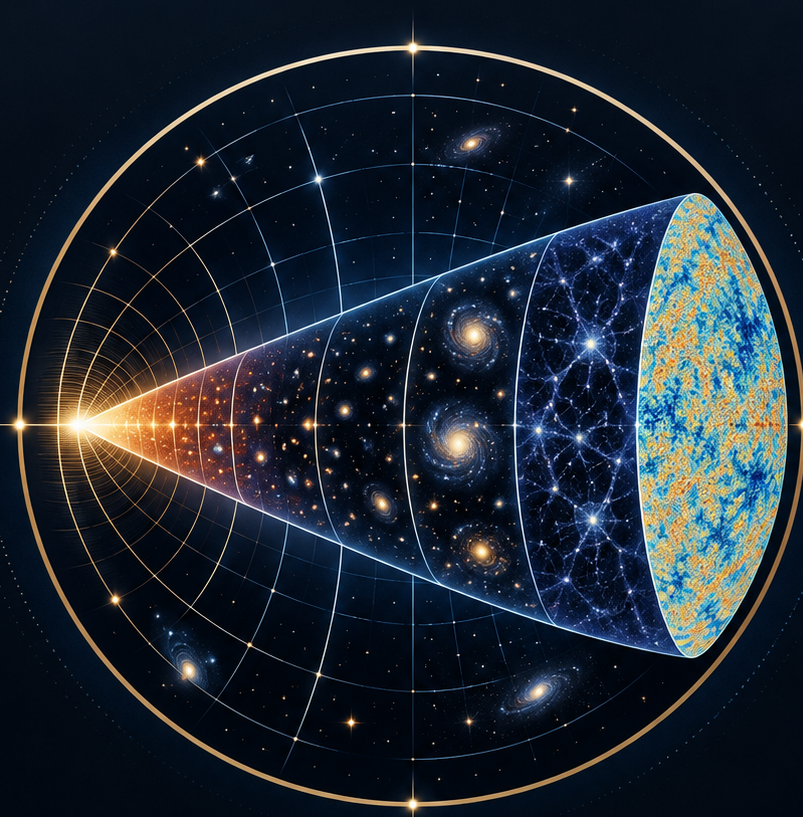
The last scattering surface is not a physical surface in space but a conceptual boundary in time. It marks the moment, roughly 380,000 years after the Big Bang, when the universe cooled enough for free electrons and protons to combine into neutral hydrogen atoms. Before this epoch, the universe was filled with a hot, dense plasma that scattered photons continuously, making it opaque. After recombination, photons could travel freely, and those photons are what we now detect as the cosmic microwave background (CMB).
According to the standard Big Bang model, the early universe was so hot that all matter was fully ionized. Electromagnetic radiation interacted strongly with this plasma, keeping the universe in thermal equilibrium. As the universe expanded and cooled, electrons and protons recombined, dramatically reducing photon scattering. At that point, the universe became transparent, and the photons—now redshifted to microwave wavelengths—have been streaming toward us ever since. The spherical shell from which these photons originate is the last scattering surface.
Definition
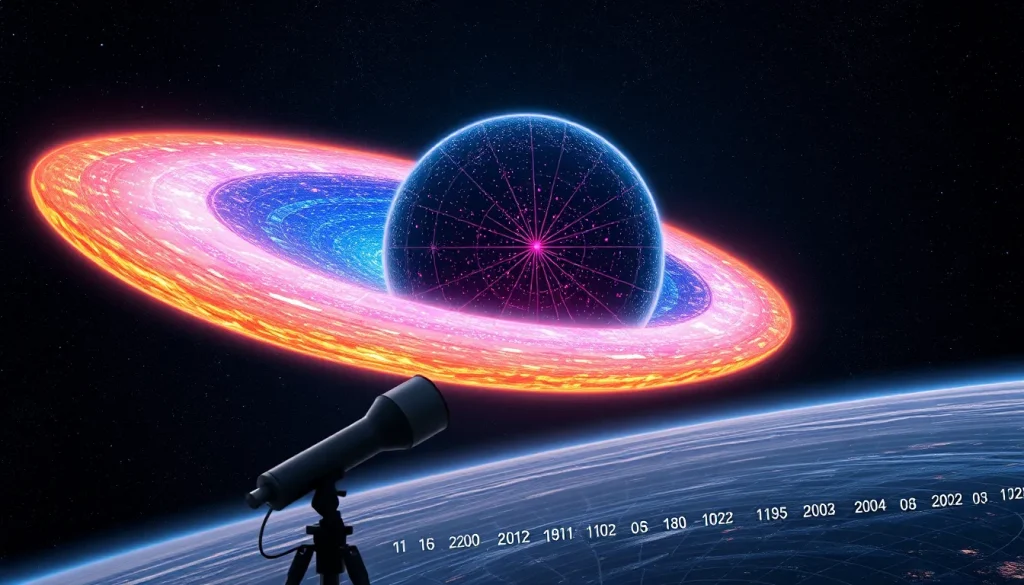
The last scattering surface is the imaginary spherical surface centered on an observer, from which the cosmic microwave background photons we detect today were last scattered by matter. It corresponds to the epoch of recombination, when the universe transitioned from an opaque plasma to a transparent neutral gas. The CMB we observe is essentially a photograph of this surface, taken when the universe was only about 380,000 years old.
How It Works
In the hot early universe, photons and matter were tightly coupled through scattering. As the universe expanded, it cooled. When the temperature dropped to about 3,000 K (approximately 0.3 eV), protons and electrons combined to form neutral hydrogen. This process, called recombination, drastically reduced the number of free charged particles, so photons ceased to scatter and began to propagate freely. The photons that last scattered at this moment have been traveling ever since, their wavelengths stretched by cosmic expansion—a phenomenon known as cosmological redshift. Today, they appear as microwaves with a temperature of about 2.725 K.
Equation
The redshift of the last scattering surface is approximately z ≈ 1100, meaning the universe has expanded by a factor of about 1100 since that epoch. The temperature of the CMB today is related to the temperature at decoupling by T0 = Tdec / (1 + z) ≈ 3000 K / 1100 ≈ 2.7 K.
Example
Imagine looking at a distant fog bank. The fog scatters light, so you cannot see through it. As the fog clears, you see a sharp boundary—the last scattering surface. In cosmology, that boundary is the CMB. The patterns we see in the CMB (temperature anisotropies) are the seeds of structure that later grew into galaxies and clusters under the influence of gravity.
Observable Consequences
The CMB is the most direct observable consequence of the last scattering surface. It is nearly isotropic, with tiny fluctuations at the level of about 1 part in 100,000. These fluctuations, first measured by COBE and later mapped in detail by WMAP and Planck, encode information about the composition, geometry, and evolution of the universe. The CMB also provides the oldest light we can detect, offering a window into the physical conditions of the infant cosmos.
Common Misconceptions
One common misconception is that the last scattering surface is a physical shell in space. In reality, it is a time boundary—we see it in all directions because we look back in time. Another misconception is that recombination happened instantly; it actually took about 100,000 years to complete. Also, the CMB is not radiation from the Big Bang itself, but radiation that last interacted with matter when the universe was about 380,000 years old.
Cosmic Epochs: A Timeline
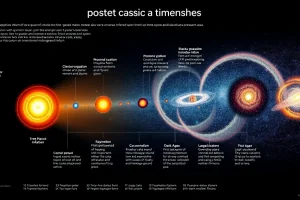
The last scattering surface is a pivotal moment in the cosmic timeline. Below is a table of the major epochs from the Planck era to the present day, based on the standard Lambda-CDM model.
| Epoch | Time after Big Bang | Temperature | Redshift | Key Events |
|---|---|---|---|---|
| Planck epoch | < 10−43 s | > 1032 K | — | Quantum gravity effects dominate; no current theory |
| Grand Unification epoch | 10−43 – 10−36 s | 1028 – 1032 K | — | Strong and electroweak forces unify; symmetry breaking |
| Inflationary epoch | 10−36 – 10−32 s | ~1027 K | — | Exponential expansion; quantum fluctuations seeded structures |
| Electroweak epoch | 10−32 – 10−12 s | 1015 – 1028 K | — | Electromagnetic and weak forces separate; particles gain mass |
| Quark epoch | 10−12 – 10−6 s | 1012 – 1015 K | — | Quarks and gluons form quark-gluon plasma |
| Hadron epoch | 10−6 – 1 s | 1010 – 1012 K | — | Protons and neutrons form; matter-antimatter asymmetry emerges |
| Lepton epoch | 1 – 10 s | 109 – 1010 K | — | Leptons dominate; neutrinos decouple |
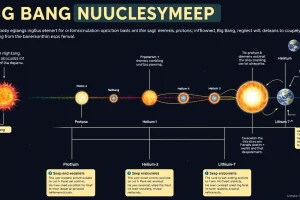
| Photon epoch | 10 s – 380,000 yr | 3,000 – 109 K | z ~ 3400 – 1100 | Photons dominate; primordial nucleosynthesis occurs |
| Recombination | ~380,000 yr | ~3,000 K | z ~ 1100 | Electrons and protons combine; universe becomes transparent; CMB released |
| Dark Ages | 380,000 – 150 million yr | ~60 – 3,000 K | z ~ 20 – 1100 | No stars yet; neutral hydrogen fills space |
| Reionization | 150 million – 1 billion yr | ~20 – 60 K | z ~ 6 – 20 | First stars and quasars ionize intergalactic medium |
| Structure Formation | 1 billion yr – present | 2.7 K – 20 K | z < 6 | Galaxies, clusters, and large-scale structure form; dark energy accelerates expansion |
Why It Matters
The last scattering surface is the ultimate backlight for the universe’s history. It provides a pristine snapshot of the density fluctuations that grew into all cosmic structure. By mapping the CMB, missions like COBE, WMAP, and Planck have measured the universe’s age, geometry, and composition with remarkable precision, confirming the Lambda-CDM model. The CMB also tests theories of inflation, constrains neutrino physics, and probes the nature of dark matter and dark energy.
Moreover, the last scattering surface is the boundary between the observable and the hidden: we cannot see beyond it with photons, but it sets the stage for the cosmic dawn—the formation of the first stars and galaxies that ended the Dark Ages. Understanding this surface is therefore essential to connecting the earliest moments of the universe to the cosmos we observe today.
Evidence / Sources
The existence and properties of the last scattering surface are supported by multiple lines of evidence:
- The near-perfect blackbody spectrum of the CMB, measured by COBE’s FIRAS instrument, confirms that photons decoupled during thermal equilibrium.
- The tiny anisotropies detected by COBE, WMAP, and Planck match predictions from inflationary models and the Lambda-CDM framework.
- The observed redshift of the CMB (z ≈ 1100) aligns with the predicted temperature of recombination.
- The acoustic peaks in the CMB power spectrum, measured by WMAP and Planck, provide precise cosmological parameters.
Key missions include COBE (1989), WMAP (2001), and Planck (2009), each mapping the CMB with increasing sensitivity. The James Webb Space Telescope (JWST) extends this by observing the era of reionization and first galaxies, complementing the CMB picture.
Related Registry Entries
Explore related concepts in our cosmology reference:
FAQ
How is the last scattering surface different from the edge of the observable universe?
The last scattering surface is a specific time boundary (at z ≈ 1100) from which the CMB photons originate. The edge of the observable universe is defined by the maximum distance light could have traveled since the Big Bang, which is farther than the last scattering surface. The CMB is the most distant light we can see, but the observable universe extends beyond it in terms of distance—though we cannot see past the CMB with photons.
Why is the CMB so uniform if the universe has structure?
The CMB is highly uniform because it originated from a region that was in thermal equilibrium. The tiny anisotropies (about 1 part in 100,000) are the seeds of cosmic structure, magnified by gravitational growth over billions of years. Inflation explains how these quantum fluctuations were stretched to cosmic scales.
Can we see beyond the last scattering surface?
No, not with electromagnetic radiation. Before recombination, the universe was opaque to photons. However, neutrinos and gravitational waves can probe earlier epochs, and future detectors may observe the cosmic neutrino background or primordial gravitational waves, but no photon-based telescope can see past the last scattering surface.
Leave a Reply