Short Answer
Main Explanation
The cosmic microwave background (CMB) is the oldest light in the universe, a faint glow that fills all of space. It is the cooled remnant of the first light that could travel freely after the Big Bang, released about 380,000 years later. This “baby picture” of the universe carries information about its origin, composition, and evolution. As the ESA explains, the CMB is the “fossil” radiation, the furthest that any telescope can see, released soon after the Big Bang [1]. Scientists consider it an echo or “shockwave” of the Big Bang [1].
The CMB was discovered by chance in 1965 by Arno Penzias and Robert Wilson, two radio astronomers who registered a signal in their radio telescope that could not be attributed to any precise source in the sky. It came from everywhere with the same intensity, day or night, summer or winter, leading them to conclude it originated outside our Galaxy [1]. This discovery provided key experimental evidence for the Big Bang theory [3].
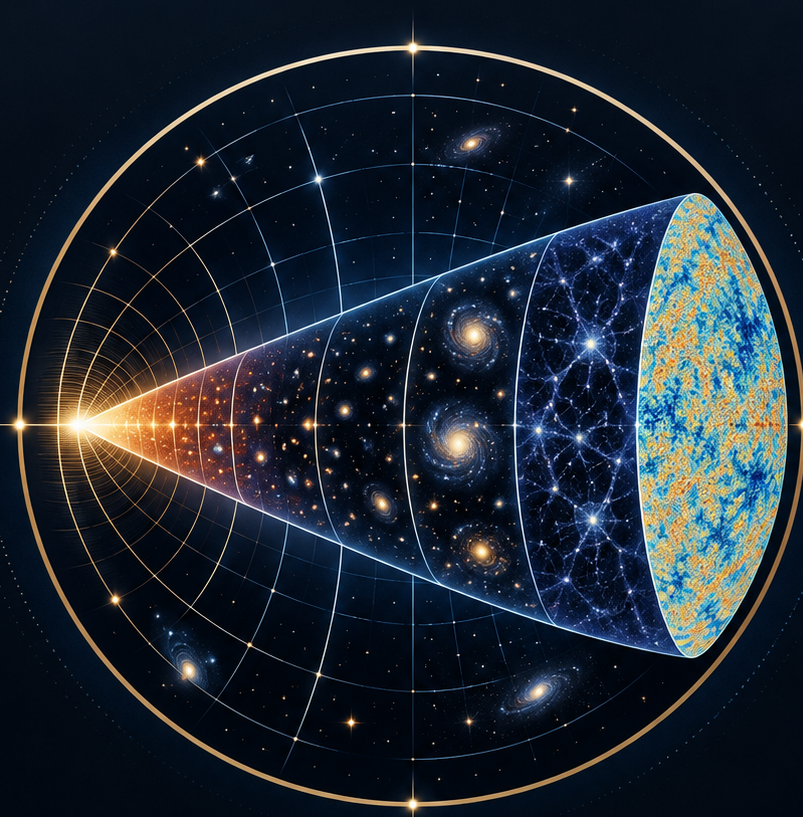
The CMB is cold—really cold. The average temperature is around minus 455 degrees Fahrenheit (2.725 Kelvin) [2]. It is almost uniform, but tiny fluctuations in temperature (shown as color differences in maps) correspond to the seeds that grew to become galaxies [2]. These fluctuations, first mapped precisely by NASA’s WMAP mission, reveal the universe’s composition and geometry [2].
The CMB is not just a relic; it is a powerful tool. Astronomers use the patterns in CMB light to determine the total contents of the universe, understand the origins of galaxies, and look for signs of the very first moments after the Big Bang [4]. The Center for Astrophysics notes that for the first 380,000 years or so after the Big Bang, the entire universe was a hot soup of particles and photons, too dense for light to travel very far. As the cosmos expanded, it cooled and became transparent, and light from that transition could now travel freely—we see a lot of it today as the CMB [4].
Cosmic Epochs: From Planck to Structure Formation
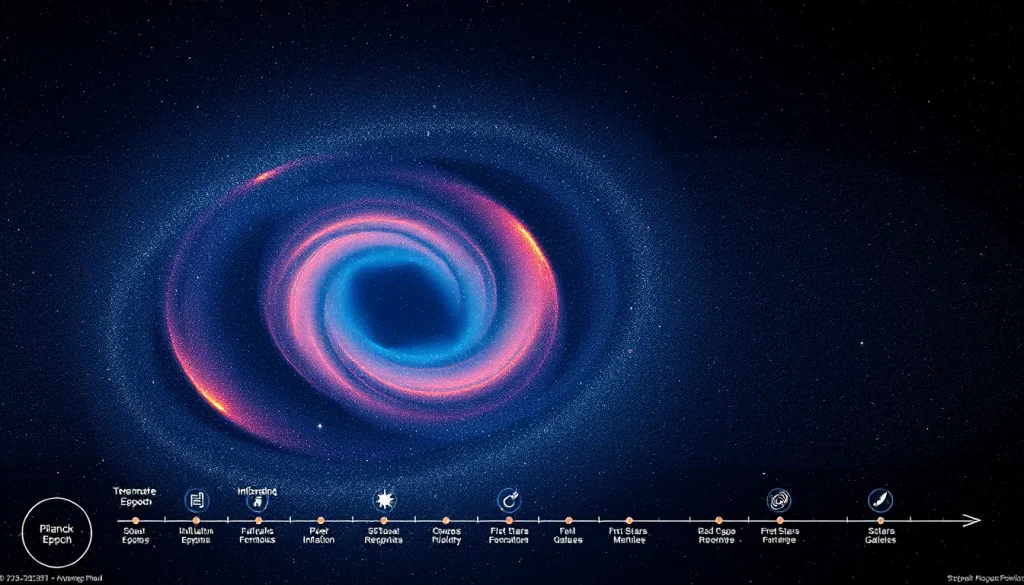
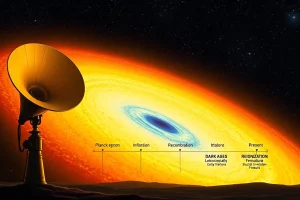
The history of the universe is divided into distinct epochs, each characterized by the dominant physical processes and particles. The CMB provides a direct window into the epoch of recombination, but the entire sequence—from the Planck epoch to the formation of large-scale structure—is governed by the same cosmological model: the Lambda-CDM model, which is the current consensus. Below is a timeline of the major epochs, followed by detailed descriptions.
| Epoch | Time after Big Bang | Temperature | Redshift | Key Events |
|---|---|---|---|---|
| Planck Epoch | 0 to 10⁻⁴³ s | >10³² K | >10³² | Quantum gravity era; all forces unified |
| Grand Unification Epoch | 10⁻⁴³ to 10⁻³⁶ s | 10²⁷–10³² K | 10²⁷–10³² | Strong force separates from electroweak |
| Inflationary Epoch | 10⁻³⁶ to 10⁻³² s | Dropping rapidly | Huge expansion | Exponential expansion; seeds of structure |
| Electroweak Epoch | 10⁻³² to 10⁻¹² s | 10¹⁵–10²⁷ K | 10¹⁵–10²⁷ | Electromagnetic and weak forces separate |
| Quark Epoch | 10⁻¹² to 10⁻⁶ s | 10¹²–10¹⁵ K | 10¹²–10¹⁵ | Quarks and gluons form quark-gluon plasma |
| Hadron Epoch | 10⁻⁶ to 1 s | 10¹⁰–10¹² K | 10¹⁰–10¹² | Protons and neutrons form; matter-antimatter annihilation |
| Lepton Epoch | 1 s to 10 s | 10⁹–10¹⁰ K | 10⁹–10¹⁰ | Leptons dominate; neutrinos decouple |
| Photon Epoch | 10 s to 380,000 yr | 3,000–10⁹ K | 3,000–10⁹ | Photons dominate; nucleosynthesis occurs |
| Recombination | ~380,000 yr | ~3,000 K | ~1100 | Electrons combine with protons to form neutral hydrogen; CMB released |
| Dark Ages | 380,000 yr to ~150 million yr | ~3,000 K to ~50 K | 1100 to ~20 | No stars; universe dark and neutral |
| Reionization | ~150 million yr to ~1 billion yr | ~50 K to ~10 K | 20 to ~6 | First stars and galaxies ionize hydrogen |
| Structure Formation | ~1 billion yr to present | ~10 K to 2.7 K | 6 to 0 | Galaxies, clusters, and large-scale structure form |
Planck Epoch
When It Happened: 0 to 10⁻⁴³ seconds after the Big Bang.
Temperature: >10³² K (the Planck temperature).
Approximate Redshift: >10³².
Dominant Particles/Physics: Quantum gravity effects dominate; all four fundamental forces (gravity, strong, weak, electromagnetic) are unified.
What Happened: The universe is in a state of extreme density and temperature, where the laws of physics as we know them break down. General relativity and quantum mechanics must be combined, but a complete theory of quantum gravity is still lacking.
What Came Before: Nothing—this is the beginning of time as we understand it.
What Came Next: The Grand Unification Epoch, as the universe expands and cools.
Evidence: Direct evidence is impossible, but the CMB and the large-scale structure are consistent with this epoch’s predictions.
Grand Unification Epoch
When It Happened: 10⁻⁴³ to 10⁻³⁶ seconds.
Temperature: 10²⁷–10³² K.
Approximate Redshift: 10²⁷–10³².
Dominant Particles/Physics: The strong force separates from the electroweak force; grand unified theories (GUTs) describe this era.
What Happened: The universe cools enough for the strong force to become distinct, but the weak and electromagnetic forces remain unified. This is also the era when cosmic inflation may have begun.
What Came Before: Planck Epoch.
What Came Next: Inflationary Epoch.
Evidence: Indirect—the observed flatness and homogeneity of the universe are explained by inflation, which likely started in this epoch.
Inflationary Epoch
When It Happened: 10⁻³⁶ to 10⁻³² seconds.
Temperature: Dropping rapidly as space expands exponentially.
Approximate Redshift: Huge expansion factor (at least 10²⁶).
Dominant Particles/Physics: A scalar field (inflaton) drives exponential expansion; quantum fluctuations are stretched to cosmic scales.
What Happened: The universe expands by a factor of at least 10²⁶ in a tiny fraction of a second, smoothing out any initial irregularities and flattening space. Quantum fluctuations become the seeds for galaxy formation.
What Came Before: Grand Unification Epoch.
What Came Next: Electroweak Epoch.
Evidence: The CMB’s near-uniformity and the observed flat geometry of the universe strongly support inflation. The detailed pattern of CMB fluctuations matches inflation’s predictions.
Electroweak Epoch
When It Happened: 10⁻³² to 10⁻¹² seconds.
Temperature: 10¹⁵–10²⁷ K.
Approximate Redshift: 10¹⁵–10²⁷.
Dominant Particles/Physics: The electromagnetic and weak forces separate; the Higgs mechanism gives mass to particles.
What Happened: As the universe cools, the electroweak symmetry breaks, and the weak force becomes short-range. The Higgs boson acquires a vacuum expectation value, giving mass to W and Z bosons and fermions.
What Came Before: Inflationary Epoch.
What Came Next: Quark Epoch.
Evidence: Particle physics experiments at the LHC reproduce conditions of this epoch, confirming the electroweak theory.
Quark Epoch
When It Happened: 10⁻¹² to 10⁻⁶ seconds.
Temperature: 10¹²–10¹⁵ K.
Approximate Redshift: 10¹²–10¹⁵.
Dominant Particles/Physics: Quarks, gluons, and leptons exist in a quark-gluon plasma; no hadrons yet.
What Happened: The universe is a hot, dense soup of quarks and gluons. As it expands and cools, quarks begin to combine into hadrons (protons and neutrons) near the end of this epoch.
What Came Before: Electroweak Epoch.
What Came Next: Hadron Epoch.
Evidence: Relativistic heavy-ion collisions at the LHC and RHIC create quark-gluon plasmas, confirming this state of matter.
Hadron Epoch
When It Happened: 10⁻⁶ to 1 second.
Temperature: 10¹⁰–10¹² K.
Approximate Redshift: 10¹⁰–10¹².
Dominant Particles/Physics: Hadrons (protons, neutrons) and their antiparticles; matter-antimatter annihilation.
What Happened: Quarks combine into hadrons. A slight excess of matter over antimatter (baryon asymmetry) leads to a small surplus of protons and neutrons after annihilation. This is also the era of baryogenesis.
What Came Before: Quark Epoch.
What Came Next: Lepton Epoch.
Evidence: The observed matter-antimatter asymmetry in the universe is a key clue; particle physics experiments probe CP violation.
Lepton Epoch
When It Happened: 1 to 10 seconds.
Temperature: 10⁹–10¹⁰ K.
Approximate Redshift: 10⁹–10¹⁰.
Dominant Particles/Physics: Leptons (electrons, neutrinos) and their antiparticles; neutrinos decouple.
What Happened: After hadrons annihilate, leptons and photons dominate. Neutrinos decouple from the thermal bath, creating a cosmic neutrino background. Electron-positron annihilation occurs near the end.
What Came Before: Hadron Epoch.
What Came Next: Photon Epoch.
Evidence: The cosmic neutrino background is predicted but not yet directly detected; the CMB temperature and helium abundance are consistent.
Photon Epoch
When It Happened: 10 seconds to 380,000 years.
Temperature: 3,000–10⁹ K.
Approximate Redshift: 3,000–10⁹.
Dominant Particles/Physics: Photons dominate the energy density; nucleosynthesis occurs in the first few minutes.
What Happened: During the first ~20 minutes, protons and neutrons fuse into light elements (helium, deuterium, lithium) in a process called Big Bang nucleosynthesis. After that, the universe is a hot plasma of photons, electrons, and nuclei, opaque to light.
What Came Before: Lepton Epoch.
What Came Next: Recombination.
Evidence: The observed abundances of light elements match BBN predictions; the CMB is the direct remnant of this epoch.
Recombination
When It Happened: ~380,000 years after the Big Bang.
Temperature: ~3,000 K.
Approximate Redshift: z ≈ 1100.
Dominant Particles/Physics: Electrons combine with protons to form neutral hydrogen; photons decouple.
What Happened: As the universe cools to about 3,000 K, electrons and protons combine to form neutral hydrogen. The universe becomes transparent to light, and the photons that were trapped in the plasma are released. This is the origin of the CMB.
What Came Before: Photon Epoch.
What Came Next: Dark Ages.
Evidence: The CMB is observed as a nearly perfect blackbody at 2.725 K, with tiny anisotropies that match predictions.
Dark Ages
When It Happened: 380,000 years to ~150 million years.
Temperature: ~3,000 K to ~50 K.
Approximate Redshift: 1100 to ~20.
Dominant Particles/Physics: Neutral hydrogen and helium; no stars or galaxies yet.
What Happened: The universe is dark and filled with neutral gas. Gravity slowly amplifies the tiny density fluctuations seen in the CMB, pulling matter into clumps. This is the era before the first stars ignite.
What Came Before: Recombination.
What Came Next: Reionization.
Evidence: Observations of the CMB and the 21-cm hydrogen line are used to probe this era; JWST is beginning to reveal the first galaxies.
Reionization
When It Happened: ~150 million to ~1 billion years.
Temperature: ~50 K to ~10 K.
Approximate Redshift: 20 to ~6.
Dominant Particles/Physics: First stars and galaxies emit ultraviolet radiation, ionizing the neutral hydrogen.
What Happened: The first stars (Population III) and galaxies form and emit intense UV light, which reionizes the intergalactic medium. This marks the end of the Dark Ages and the beginning of the era of structure formation.
What Came Before: Dark Ages.
What Came Next: Structure Formation.
Evidence: The CMB’s polarization and the Gunn-Peterson trough in quasar spectra provide evidence for reionization.
Structure Formation
When It Happened: ~1 billion years to present.
Temperature: ~10 K to 2.7 K.
Approximate Redshift: 6 to 0.
Dominant Particles/Physics: Dark matter and baryons; gravity drives the formation of galaxies, clusters, and large-scale structure.
What Happened: Over billions of years, the initial density fluctuations grow into the cosmic web of galaxies and clusters we see today. Dark energy becomes dominant in the last few billion years, accelerating expansion.
What Came Before: Reionization.
What Came Next: The present and future.
Evidence: Galaxy surveys, CMB measurements, and supernova observations all support the Lambda-CDM model.
Why It Matters
The cosmic microwave background is not just a relic; it is the most important observational tool in cosmology. It provides a direct image of the universe at 380,000 years old, revealing the seeds of all structure. By studying the CMB, scientists have determined the universe’s age (13.77 billion years), its composition (about 5% ordinary matter, 27% dark matter, 68% dark energy), and its geometry (nearly flat) [2]. The CMB also confirms the Big Bang theory and supports the inflationary paradigm. Missions like COBE, WMAP, and Planck have mapped the CMB with increasing precision, and future experiments like the Simons Observatory and CMB-S4 will probe the earliest moments of inflation through polarization patterns. The CMB is a cornerstone of modern physics, linking the quantum world of the early universe to the large-scale structure we observe today.
Evidence / Sources
The existence and properties of the CMB are supported by multiple lines of evidence:
- Discovery: Penzias and Wilson’s 1965 detection of a uniform microwave background [1][3].
- Blackbody spectrum: COBE’s FIRAS instrument measured the CMB spectrum as a near-perfect blackbody at 2.725 K, confirming its thermal origin.
- Anisotropies: WMAP and Planck mapped temperature fluctuations at the level of one part in 100,000, matching predictions from inflation and providing the seeds for galaxies [2].
- Polarization: BICEP and other experiments are searching for B-mode polarization, which would confirm inflation.
- Consistency with BBN: The CMB temperature and the observed light element abundances agree with Big Bang nucleosynthesis.
These sources are authoritative and up-to-date as of September 2026:
[1] ESA – Cosmic Microwave Background (CMB) radiation: https://www.esa.int/Science_Exploration/Space_Science/Cosmic_Microwave_Background_CMB_radiation
[2] NASA – What Can We Learn from the Universe’s Baby Picture?: https://science.nasa.gov/universe/stories/quick-reads/what-can-we-learn-from-the-universes-baby-picture/
[3] Wikipedia – Cosmic microwave background: https://en.wikipedia.org/wiki/Cosmic_microwave_background
[4] Center for Astrophysics – Cosmic Microwave Background: https://www.cfa.harvard.edu/research/topic/cosmic-microwave-background
Related Registry Entries
This article is part of a series on cosmology. Related entries include:
- Big Bang Nucleosynthesis
- Inflation and the Early Universe
- Large-Scale Structure
- Dark Matter and Dark Energy
FAQ
What is the cosmic microwave background?
The cosmic microwave background (CMB) is the oldest light in the universe, a faint glow of microwave radiation that fills all of space. It is the cooled remnant of the first light that could travel freely after the Big Bang, released about 380,000 years later.
How was the CMB discovered?
The CMB was discovered by accident in 1965 by Arno Penzias and Robert Wilson, who detected a uniform microwave signal coming from all directions. They later won the Nobel Prize for this discovery, which provided strong evidence for the Big Bang theory.
What does the CMB tell us about the universe?
The CMB reveals the universe's age, composition, geometry, and the seeds of galaxy formation. Its tiny temperature fluctuations correspond to density variations that grew into galaxies and clusters. It also supports the theory of cosmic inflation.
Leave a Reply