
Short Answer
Main Explanation
The cosmic microwave background (CMB) is the oldest light in the universe, a relic of the hot, dense state that existed shortly after the Big Bang. Discovered in 1965, it is observed as a near-perfect blackbody with a temperature of 2.7255 K. The CMB provides a snapshot of the universe when it was just 380,000 years old, at the moment of recombination when electrons and protons first formed neutral hydrogen atoms and photons decoupled from matter.
One of the most prominent features of the CMB is its dipole anisotropy—a temperature difference of about one part in a thousand between opposite directions in the sky. This pattern is not intrinsic to the early universe but is caused by the motion of our Solar System relative to the cosmic rest frame. As we move through space, the CMB appears slightly hotter in the direction of motion (blue-shifted) and slightly cooler in the opposite direction (red-shifted). This Doppler effect produces a dipole pattern that dominates all other CMB anisotropies by a factor of about 100.
The dipole was recognized immediately after the CMB’s discovery, and by 1971 the velocity of the Solar System was already in textbooks. The first precise all-sky measurement came from NASA’s COBE satellite, whose Differential Microwave Radiometers (DMR) mapped the dipole in 1993. Subsequent missions, including WMAP and Planck, have refined the measurement, confirming the Solar System’s velocity of 370 km/s relative to the CMB rest frame.
The dipole is not just a curiosity; it is a crucial calibration for all CMB studies. Any map of the primordial temperature fluctuations must first subtract the dipole to reveal the much smaller intrinsic anisotropies—fluctuations of about 18 microkelvin that seeded the large-scale structure of the universe. Understanding the dipole also allows astronomers to determine the peculiar velocity of the Local Group and to probe the large-scale distribution of matter that gravitationally attracts our galaxy.
The Cosmic Timeline
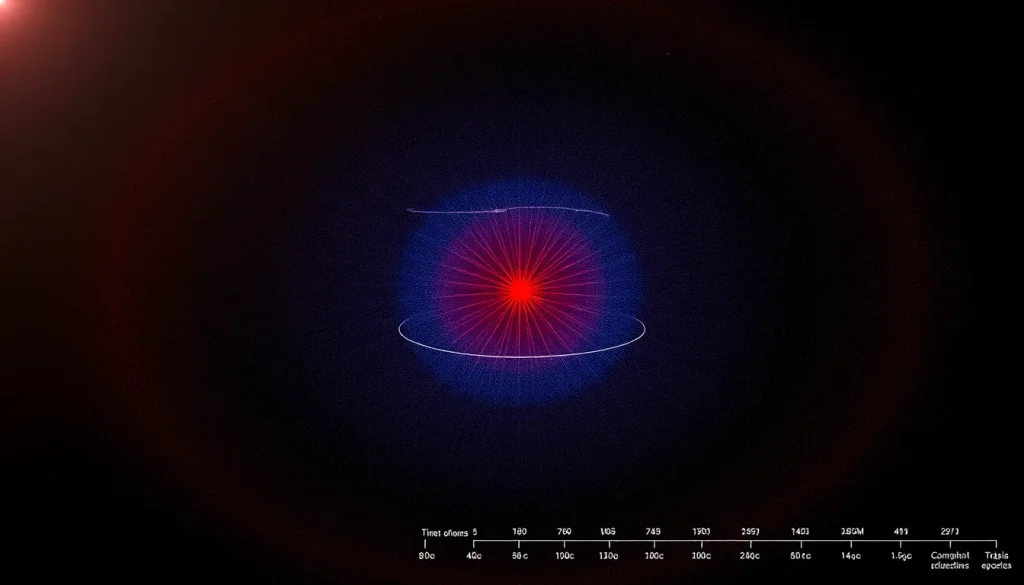
The CMB itself is a product of the universe’s evolution. To appreciate its significance, it helps to review the major epochs of cosmic history, from the Planck epoch to the present day.
| Epoch | Time After Big Bang | Redshift | Key Events |
|---|---|---|---|
| Planck epoch | < 10⁻⁴³ s | > 10³² | Quantum gravity effects dominate; all fundamental forces unified. |
| Grand Unification epoch | 10⁻⁴³ – 10⁻³⁶ s | ~10²⁸ – 10³² | Strong force separates from electroweak force. |
| Inflationary epoch | 10⁻³⁶ – 10⁻³² s | ~10²⁵ – 10²⁸ | Exponential expansion; quantum fluctuations stretched to cosmic scales. |
| Electroweak epoch | 10⁻³² – 10⁻¹² s | ~10¹⁵ – 10²⁵ | Electromagnetic and weak forces separate; W and Z bosons acquire mass. |
| Quark epoch | 10⁻¹² – 10⁻⁶ s | ~10¹² – 10¹⁵ | Quarks and gluons form quark-gluon plasma. |
| Hadron epoch | 10⁻⁶ – 1 s | ~10¹⁰ – 10¹² | Protons and neutrons form; matter-antimatter annihilation. |
| Lepton epoch | 1 – 10 s | ~10⁹ – 10¹⁰ | Leptons dominate; neutrinos decouple. |
| Photon epoch | 10 s – 380,000 yr | ~10⁹ → 1100 | Photons dominate; nucleosynthesis creates light elements. |
| Recombination | 380,000 yr | ~1100 | Electrons combine with protons; CMB released. |
| Dark Ages | 380,000 – 150 million yr | 1100 → 20 | No stars; universe filled with neutral hydrogen. |
| Reionization | 150 million – 1 billion yr | 20 → 6 | First stars and galaxies ionize hydrogen. |
| Structure Formation | 1 billion yr – present | 6 → 0 | Galaxies cluster; dark energy accelerates expansion. |
The CMB we observe today is the relic of recombination. Its near-perfect blackbody spectrum and tiny anisotropies encode vast information about the composition, geometry, and evolution of the universe. The dipole, though not primordial, is a necessary correction and a direct measure of our own motion.
Measurement of the CMB Dipole
Value
The dipole anisotropy has a peak amplitude of 3.372 ± 0.002 mK, which is about 0.12% of the mean CMB temperature of 2.7255 K.
Units
The dipole is measured in millikelvin (mK) or microkelvin (μK) as a temperature difference, and equivalently as a velocity in km/s via the Doppler formula.
Instrument
The most precise measurements come from space-based observatories: COBE (1993), WMAP (2003–2013), and Planck (2013–2018). Ground-based and balloon experiments have also contributed, but space missions provide full-sky coverage without atmospheric contamination.
Method
By scanning the sky at multiple microwave frequencies, instruments measure the intensity of the CMB in every direction. The dipole is extracted by fitting a cosine function to the temperature map: T(θ) = T₀ + T₁ cos θ, where θ is the angle from the direction of motion. The amplitude T₁ gives the dipole, and the direction of maximum temperature gives the velocity direction.
Uncertainty
The current uncertainty in the dipole amplitude is about 0.002 mK, limited by systematic effects such as beam asymmetry and stray light. The velocity is known to about 1 km/s.
Dataset
Planck’s 2018 release provides the most accurate full-sky CMB temperature maps, from which the dipole is determined with high precision. The COBE DMR first-year maps (1993) gave the first all-sky dipole measurement.
Latest/Reference Measurement
Planck Collaboration (2020) reports a dipole amplitude of 3.372 ± 0.002 mK, corresponding to a Solar System velocity of 370 ± 1 km/s toward galactic longitude 264°, latitude 48° (equatorial RA 11.2h, Dec -7°).
Why Measurements Differ
Small variations between experiments arise from different frequency coverage, calibration methods, and treatment of foreground emission (e.g., synchrotron and dust). However, all modern measurements agree within quoted uncertainties.
Why It Matters
The CMB dipole anisotropy matters for several reasons. First, it provides a direct measurement of our peculiar velocity relative to the cosmic rest frame, which is essential for understanding the large-scale gravitational field and the motion of the Local Group. Second, it is a necessary calibration step: without subtracting the dipole, the tiny primordial anisotropies that reveal the seeds of cosmic structure would be swamped. Third, the dipole serves as a consistency check for the standard cosmological model—any deviation from the expected Doppler pattern could hint at new physics. Finally, the dipole connects the CMB to our place in the universe, reminding us that we are not stationary observers but participants in a cosmic flow.
Evidence / Sources
- Scott, D. & Smoot, G.F. (2011). Cosmic Microwave Background. Particle Data Group review. https://pdg.lbl.gov/2013/reviews/rpp2012-rev-cosmic-microwave-background.pdf
- Wright, E.L. History of the CMB Dipole Anisotropy. UCLA Astronomy. https://astro.ucla.edu/~wright/CMB-dipole-history.html
- Kogut, A. et al. (1993). Dipole Anisotropy in the COBE Differential Microwave Radiometers First-Year Sky Maps. The Astrophysical Journal. https://doi.org/10.1086/173453
- Euclid Collaboration (2024). Euclid preparation. Astronomy & Astrophysics. https://doi.org/10.1051/0004-6361/202449385
Related Registry Entries
- Cosmic Microwave Background (CMB)
- COBE Mission
- Planck Mission
- Recombination
- Doppler Effect
FAQ
What causes the CMB dipole anisotropy?
The dipole is caused by the Doppler effect due to the Solar System's motion relative to the rest frame of the cosmic microwave background. As we move, the CMB appears slightly hotter in the direction of motion and slightly cooler in the opposite direction.
How fast is the Solar System moving relative to the CMB?
The Solar System moves at about 370 km/s toward the constellation Leo, as measured by COBE, WMAP, and Planck.
Is the dipole anisotropy a primordial feature of the universe?
No, it is not intrinsic to the early universe. It is a local effect caused by our motion. The intrinsic anisotropies are much smaller, about 18 microkelvin, and are what cosmologists study to understand the universe's structure.
Why must the dipole be subtracted from CMB maps?
The dipole is about 100 times larger than the primordial fluctuations. Subtracting it allows astronomers to see the tiny temperature variations that seeded galaxy formation and to test cosmological models.
References
- https://pdg.lbl.gov/2013/reviews/rpp2012-rev-cosmic-microwave-background.pdf
- https://astro.ucla.edu/~wright/CMB-dipole-history.html
- https://doi.org/10.1086/173453
- https://doi.org/10.1051/0004-6361/202449385
Related Articles
Leave a Reply