
Short Answer
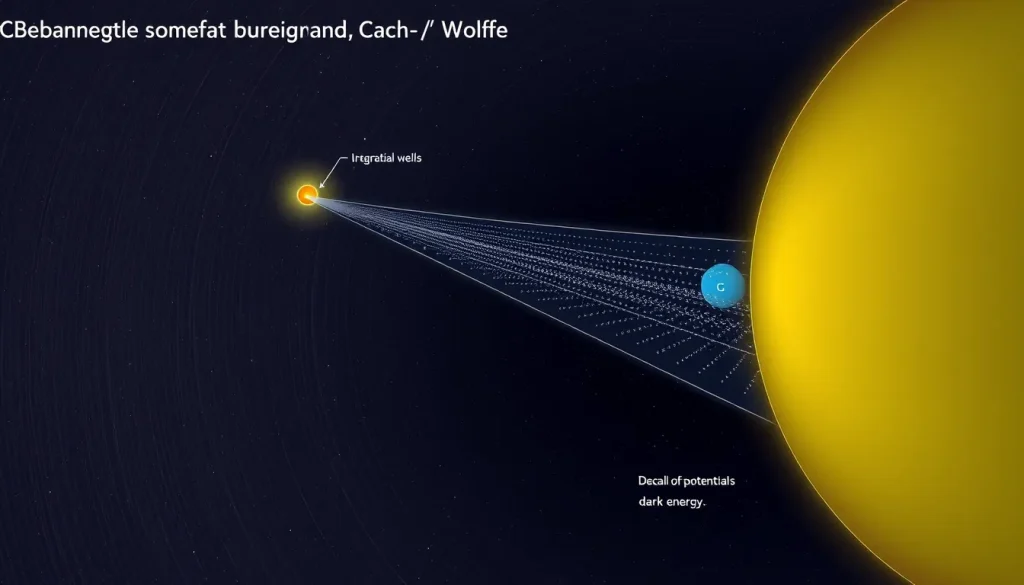
The Integrated Sachs–Wolfe (ISW) effect is a subtle change in the temperature of the cosmic microwave background (CMB) caused by the time-varying gravitational potentials of large-scale structure as CMB photons travel through the universe. In a universe dominated by dark energy, these potentials decay, leaving a net blueshift or redshift imprint on the CMB. This effect is a key observational probe of dark energy and the accelerating expansion of the universe.
| Property | Detail |
|---|---|
| Full Name | Integrated Sachs–Wolfe effect |
| Type | Secondary CMB anisotropy |
| Named After | Rainer K. Sachs and Arthur M. Wolfe |
| First Predicted | 1967 (Sachs & Wolfe paper) |
| First Detected | Early 2000s via cross-correlation with galaxy surveys |
| Primary Cause | Decaying gravitational potentials due to dark energy |
| Observable In | CMB temperature maps and large-scale structure surveys |
| Significance | Independent evidence for dark energy; tests of cosmological models |
Main Explanation
The cosmic microwave background is the oldest light in the universe, a relic of the hot, dense state that existed just 380,000 years after the Big Bang. As this ancient radiation travels toward us, it passes through the evolving cosmic web of matter and dark energy. The Integrated Sachs–Wolfe effect is one of the ways this journey imprints itself on the CMB’s temperature.
To understand the ISW effect, we first need to distinguish it from the ordinary (non-integrated) Sachs–Wolfe effect. The non-integrated effect occurs at the surface of last scattering, where photons are gravitationally redshifted or blueshifted depending on the local matter density. That effect is constant for a given line of sight and is part of the primordial CMB anisotropy. The integrated effect, by contrast, accumulates along the entire path from the last scattering surface to us. It arises because the gravitational potential wells and hills that photons traverse are not static—they evolve over cosmic time.
In a universe dominated by matter, gravitational potentials are roughly constant because the expansion is decelerating and structures grow slowly. But if the universe is dominated by dark energy (or radiation), the expansion accelerates, causing potential wells to flatten as photons pass through them. A photon falling into a well and climbing out will gain and lose energy symmetrically if the well is static. If the well decays while the photon is inside, the photon emerges with a net energy change—a blueshift if the well is filling in, a redshift if it is draining. This net effect, integrated over all the structures along the line of sight, is the ISW effect.
The ISW effect is strongest on angular scales larger than about ten degrees, where the CMB fluctuations are dominated by the Sachs–Wolfe contribution. It is a secondary anisotropy, meaning it is not part of the primordial CMB but is added later. Because it depends on the rate of growth of structure, it is a sensitive probe of the expansion history and the nature of dark energy.
Cosmic Epochs and the CMB
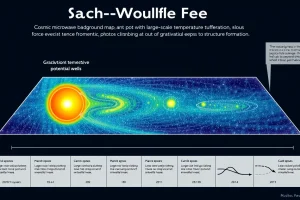
The CMB itself is a product of the early universe, and its properties encode the sequence of cosmic epochs. The standard cosmological model (ΛCDM) describes a universe that began with a hot Big Bang, underwent a period of rapid inflation, and then passed through a series of particle and nuclear epochs before recombination and the formation of structure. The table below summarizes the major epochs and their key features.
| Epoch | Time After Big Bang | Temperature | Key Events |
|---|---|---|---|
| Planck epoch | < 10⁻⁴³ s | > 10³² K | Quantum gravity effects dominate; no known physics |
| Grand Unification epoch | 10⁻⁴³ – 10⁻³⁶ s | 10²⁷ – 10³² K | Unified forces begin to separate |
| Inflationary epoch | 10⁻³⁶ – 10⁻³² s | ~10²⁷ K | Exponential expansion; seeds of structure formed |
| Electroweak epoch | 10⁻³² – 10⁻¹² s | 10¹⁵ – 10²⁷ K | Electromagnetic and weak forces separate |
| Quark epoch | 10⁻¹² – 10⁻⁶ s | 10¹² – 10¹⁵ K | Quarks and gluons form a quark–gluon plasma |
| Hadron epoch | 10⁻⁶ – 1 s | 10¹⁰ – 10¹² K | Protons and neutrons form; matter–antimatter annihilation |
| Lepton epoch | 1 – 10 s | 10⁹ – 10¹⁰ K | Leptons dominate; neutrinos decouple |
| Photon epoch | 10 s – 380,000 yr | 10⁴ – 10⁹ K | Photons dominate; nucleosynthesis occurs |
| Recombination | ~380,000 yr | ~3000 K | Electrons combine with protons to form neutral hydrogen; CMB released |
| Dark Ages | 380,000 yr – ~150 million yr | ~3000 K – ~50 K | No stars yet; universe is dark and neutral |
| Reionization | ~150 million – 1 billion yr | ~50 K – ~10 K | First stars and galaxies ionize the intergalactic medium |
| Structure Formation | 1 billion yr – present | ~10 K – 2.7 K | Galaxies, clusters, and large-scale structure grow |
Missions like COBE, WMAP, and Planck have mapped the CMB with increasing precision, revealing the tiny temperature fluctuations that grew into the cosmic web. The James Webb Space Telescope (JWST) is now probing the era of reionization and the first galaxies, complementing CMB studies.
Concept
Definition
The Integrated Sachs–Wolfe effect is the net gravitational redshift or blueshift of CMB photons caused by the time evolution of gravitational potentials along the line of sight. It is distinct from the non-integrated Sachs–Wolfe effect, which occurs at the last scattering surface.
How It Works
As a CMB photon travels through the universe, it encounters regions of overdense matter (potential wells) and underdense regions (potential hills). If the potentials are static, the photon’s energy gain on entering a well is exactly canceled by the loss on leaving. But if the potential changes while the photon is inside—for example, if a well becomes shallower due to accelerated expansion—the photon emerges with a net energy change. The total effect is the integral of the time derivative of the gravitational potential along the photon’s path.
Equation
The ISW temperature perturbation is given by:
ΔT/T = −2 ∫ (∂Φ/∂t) dt
where Φ is the gravitational potential, t is cosmic time, and the integral is along the photon’s trajectory. In a matter-dominated universe, ∂Φ/∂t ≈ 0, so the effect vanishes. In a dark-energy-dominated universe, ∂Φ/∂t > 0 for potential wells (they become shallower), leading to a net blueshift (ΔT > 0) for photons passing through them.
Example
Consider a CMB photon passing through a large cosmic void. In a universe with dark energy, the void expands faster than the surrounding matter, causing the potential hill to decay. The photon gains energy as it enters the hill and loses less energy as it leaves, resulting in a net blueshift. Conversely, a photon passing through a galaxy cluster experiences a net redshift. These small temperature shifts (on the order of microkelvins) are superimposed on the primordial CMB fluctuations.
Observable Consequences
The ISW effect is too small to detect directly in CMB maps alone, but it can be extracted by cross-correlating CMB temperature maps with large-scale structure surveys. Because the ISW signal is correlated with the distribution of matter (galaxies, clusters, voids), the cross-correlation reveals a characteristic signature. This technique has been used with data from WMAP, Planck, and galaxy surveys like SDSS and DES, providing independent evidence for dark energy.
Common Misconceptions
One misconception is that the ISW effect is the same as the ordinary Sachs–Wolfe effect. They are distinct: the ordinary effect is a primary anisotropy from the last scattering surface, while the ISW is a secondary effect accumulated along the line of sight. Another misconception is that the ISW effect is caused by the expansion of the universe itself; rather, it is caused by the change in gravitational potentials due to that expansion. Finally, some think the ISW effect is negligible, but on large angular scales it is a significant contributor to CMB anisotropy and a crucial test of dark energy.
Why It Matters
The ISW effect is one of the few direct probes of the accelerating expansion of the universe. It provides a consistency check for dark energy that is independent of supernova distances and baryon acoustic oscillations. By measuring the ISW signal, cosmologists can test whether the growth of structure matches the predictions of ΛCDM. Discrepancies could indicate new physics, such as dynamical dark energy or modified gravity. The effect also helps constrain the equation of state of dark energy and may shed light on the Hubble tension and the σ₈ tension.
Evidence / Sources
The ISW effect was first predicted by Sachs and Wolfe in 1967 [1]. It was first detected observationally in the early 2000s through cross-correlation of CMB maps with galaxy surveys [3]. Subsequent analyses with WMAP and Planck data have confirmed the effect at high significance. The astrobites article [2] discusses how dynamical dark energy scenarios would alter the ISW signal, and a 2026 article [4] explains the effect in accessible terms. These sources provide the basis for the current understanding.
Related Registry Entries
FAQ
What is the difference between the Sachs–Wolfe effect and the Integrated Sachs–Wolfe effect?
The Sachs–Wolfe effect (non-integrated) occurs at the surface of last scattering and is caused by gravitational redshift at that epoch. The Integrated Sachs–Wolfe effect accumulates along the entire path of the photon and is caused by the time evolution of gravitational potentials.
How is the ISW effect detected?
It is detected by cross-correlating CMB temperature maps with large-scale structure surveys. The correlation signal is small but statistically significant when averaged over many lines of sight.
Why is the ISW effect important for dark energy?
In a universe with dark energy, gravitational potentials decay over time, producing a measurable ISW signal. The amplitude and scale dependence of this signal depend on the nature of dark energy, making it a powerful probe.
Does the ISW effect affect the CMB power spectrum?
Yes, it contributes to the CMB temperature power spectrum on large angular scales (low multipoles). However, it is degenerate with other effects, so cross-correlation is needed to isolate it.
Leave a Reply