
Short Answer
Main Explanation
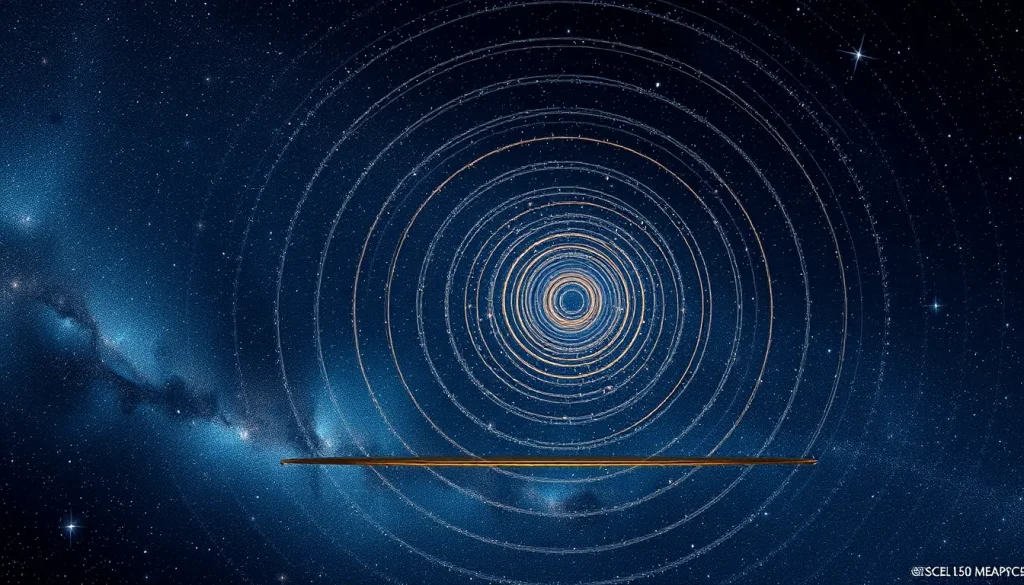
Baryon acoustic oscillations (BAO) are the frozen echoes of sound waves that traveled through the dense, hot plasma of the early universe. These oscillations left a characteristic pattern in the distribution of galaxies—a slight preference for pairs of galaxies to be separated by a specific distance, roughly 150 megaparsecs (about 490 million light-years). This pattern acts as a standard ruler embedded in the cosmic web, allowing astronomers to measure how the universe has expanded over time and to place constraints on the nature of dark energy.
Definition
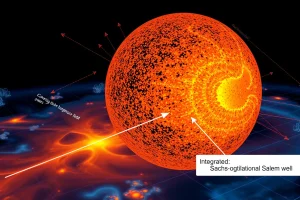
Baryon acoustic oscillations refer to the regular, periodic fluctuations in the density of baryonic matter (protons and neutrons) that were imprinted when the universe was a hot, ionized plasma. These fluctuations originated from quantum noise amplified during cosmic inflation and evolved as acoustic waves in the photon-baryon fluid before recombination. After recombination, the waves froze, leaving a spherical shell of excess matter around the original density peaks. This shell is observable today as a subtle bump in the two-point correlation function of galaxies.
How It Works
In the first 380,000 years after the Big Bang, the universe was filled with a hot plasma of photons, electrons, and baryons. Gravity pulled matter toward overdense regions, while radiation pressure from photons pushed it outward, creating oscillations—similar to sound waves. These waves propagated at about half the speed of light. When electrons and protons combined to form neutral hydrogen during recombination, the photons decoupled and streamed freely (becoming the cosmic microwave background, CMB), while the baryons were left behind. The compression peaks of the waves became shells of enhanced matter density. Over billions of years, galaxies preferentially formed in these denser shells, preserving the characteristic scale of the original oscillations.
Equation
The characteristic scale of BAO is set by the sound horizon at recombination, denoted rs. It is calculated by integrating the sound speed in the early plasma over cosmic time:
rs = ∫0trec cs(t) / a(t) dt
where cs is the sound speed, a is the scale factor, and trec is the time of recombination. In practice, this scale is measured from the CMB power spectrum and used as a standard ruler to calibrate distance measurements at different redshifts.
Example
A helpful analogy: imagine dropping a stone into a pond. A ripple expands outward at a constant speed. If you freeze the water at a fixed moment, you see a ring. In the early universe, each overdensity acted like a stone, and BAO are the frozen rings. Because the speed of sound and the time of recombination are known from physics, the physical size of the rings is fixed. By observing how large these rings appear at different cosmic epochs, astronomers can determine the expansion rate of the universe.
Observable Consequences
The primary observable is a peak in the galaxy correlation function at a separation of about 150 Mpc. This peak has been detected in galaxy surveys such as the Sloan Digital Sky Survey (SDSS), the 2dF Galaxy Redshift Survey, and more recently in the Dark Energy Spectroscopic Instrument (DESI) and the Euclid mission. BAO measurements provide a geometric probe of the universe’s expansion, complementing supernova distances and CMB data. They are a key piece of evidence for the accelerating expansion driven by dark energy.
Common Misconceptions
Misconception 1: BAO are sound waves in the current universe. In reality, they are fossilized imprints from the early universe; the actual waves stopped when matter and radiation decoupled.
Misconception 2: BAO cause the large-scale structure of galaxies. They only modulate the density on a specific scale; the overall structure is seeded by primordial fluctuations from inflation.
Misconception 3: BAO are the same as the acoustic peaks in the CMB. While both arise from the same oscillations, CMB peaks are temperature anisotropies, while BAO refer to the matter distribution.
Cosmic Epochs and the BAO Timeline
BAO are intimately connected to the major epochs of cosmic evolution. The following table summarizes the key eras from the Planck epoch to structure formation, highlighting where BAO originate.
| Epoch | Time After Big Bang | Approximate Redshift | Key Events |
|---|---|---|---|
| Planck Epoch | < 10-43 s | > 1032 | Quantum gravity era; laws of physics as we know them break down. |
| Grand Unification Epoch | 10-43 to 10-36 s | 1028 – 1032 | Strong and electroweak forces unify; inflation begins. |
| Inflationary Epoch | 10-36 to 10-32 s | Drops by factor ~1026 | Exponential expansion stretches quantum fluctuations to cosmic scales. |
| Electroweak Epoch | 10-32 to 10-12 s | 1015 – 1028 | Electromagnetic and weak forces separate; W/Z bosons gain mass. |
| Quark Epoch | 10-12 to 10-6 s | 1012 – 1015 | Quarks and gluons exist in a quark-gluon plasma. |
| Hadron Epoch | 10-6 to 1 s | 1010 – 1012 | Protons and neutrons form; matter-antimatter annihilation. |
| Lepton Epoch | 1 s to 10 s | 109 – 1010 | Leptons dominate; neutrinos decouple. |
| Photon Epoch | 10 s to 380,000 yr | 103 – 109 | Photons coupled to baryons; BAO acoustic waves propagate. |
| Recombination | ~380,000 yr | ~1100 | Electrons combine with protons; photons decouple, releasing the CMB; BAO freeze. |
| Dark Ages | 380,000 yr to ~100 million yr | ~20 – 1100 | No stars yet; neutral hydrogen fills the universe. |
| Reionization | ~100 million to ~1 billion yr | ~6 – 20 | First stars and galaxies ionize hydrogen. |
| Structure Formation | ~1 billion yr to present | 0 – 6 | Galaxies cluster along BAO-imprinted filaments; dark energy accelerates expansion. |
The BAO signal is most directly visible in the distribution of galaxies at redshifts less than 2, where surveys like DESI and Euclid map millions of galaxies to measure the scale of the frozen acoustic waves.
Why It Matters
BAO provide a robust, model-independent way to measure the expansion history of the universe. Because the sound horizon scale is known from CMB physics, comparing its apparent size at different redshifts yields the Hubble parameter and angular diameter distance. This constrains dark energy parameters, including the equation of state, and helps distinguish between the cosmological constant and dynamical dark energy models. BAO also complement other probes like supernovae and weak lensing, breaking degeneracies and improving precision. Future surveys, including Euclid, DESI, and the Vera C. Rubin Observatory, will measure BAO with unprecedented accuracy, potentially revealing new physics if deviations from ΛCDM appear.
Evidence / Sources
The existence of BAO was predicted from the theory of acoustic oscillations in the early plasma, confirmed by the detection of acoustic peaks in the CMB by COBE, WMAP, and Planck. The first direct detection of the BAO peak in galaxy clustering was reported by the Sloan Digital Sky Survey and the 2dF Galaxy Redshift Survey in 2005. Subsequent measurements by BOSS, eBOSS, and DESI have refined the standard ruler. Key sources include:
- Wikipedia: Baryon acoustic oscillations
- ESA Science & Technology: What are baryonic acoustic oscillations?
- Physics Today: Baryon acoustic oscillations: A cosmological ruler
- Scholarpedia: Cosmological constraints from baryonic acoustic oscillation measurements
Related Registry Entries
FAQ
What exactly are baryon acoustic oscillations?
They are the frozen remnants of sound waves that traveled through the hot plasma of the early universe. These waves created spherical shells of matter around overdense regions, and after recombination, those shells left a characteristic scale in the distribution of galaxies.
How do BAO act as a standard ruler?
The physical size of the BAO scale (the sound horizon) is known from CMB physics. By measuring the apparent size of this scale in galaxy clustering at different redshifts, astronomers can determine the expansion rate and distances in the universe.
Why are BAO important for dark energy research?
BAO provide precise distance measurements at various cosmic epochs, which trace the expansion history. Comparing this with the expected expansion in different dark energy models allows scientists to constrain the equation of state of dark energy.
How do BAO relate to the cosmic microwave background?
Both arise from the same acoustic oscillations. The CMB shows the temperature fluctuations of the photon-baryon fluid at recombination, while BAO are the matter density imprints left after the photons decoupled.

Leave a Reply