Short Answer
COBE, WMAP, and Planck were three successive space missions that measured the cosmic microwave background (CMB) — the oldest light in the universe — with increasing resolution and sensitivity. Together they transformed cosmology from a largely theoretical discipline into a precision science, establishing the ΛCDM model, the age of the universe, and the seeds of all cosmic structure.
| Mission | Launch | Key contribution |
|---|---|---|
| COBE | 1989 | First full-sky CMB map; detected blackbody spectrum and primordial anisotropies |
| WMAP | 2001 | High-resolution all-sky map; established ΛCDM and precise age of 13.8 billion years |
| Planck | 2009 | Highest-resolution CMB map; refined cosmological parameters and measured CMB lensing |
Main Explanation
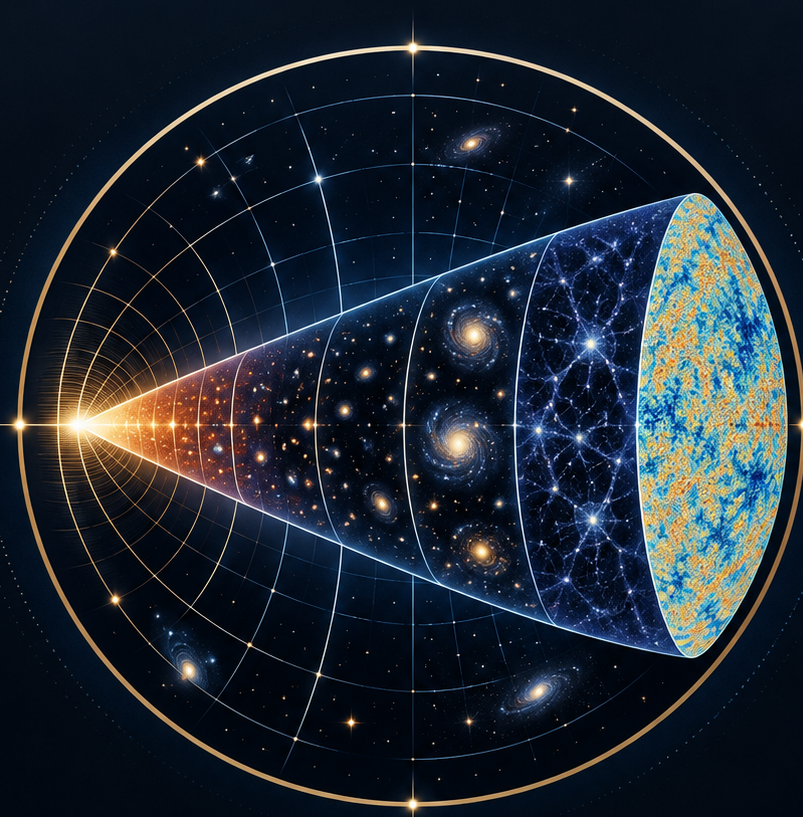
The cosmic microwave background is the afterglow of the Big Bang. Discovered by Penzias and Wilson in 1964–1965, it appears as an almost perfectly uniform glow at 2.725 K across the entire sky. Yet hidden within that uniformity are tiny temperature fluctuations — about one part in 100,000 — that encode the conditions of the universe when it was only 380,000 years old. COBE, WMAP, and Planck were built to read those fluctuations with ever-increasing precision.
The Cosmic Microwave Background as a Time Machine
Before the CMB was released, the universe was a hot, dense plasma of protons, electrons, and photons. Light could not travel freely because it constantly scattered off free electrons. When the universe cooled enough for protons and electrons to combine into neutral hydrogen — an event called recombination — photons decoupled and streamed across space. As the universe expanded, those photons stretched to microwave wavelengths, shifting from a temperature of about 3000 K to the 2.725 K we observe today. The CMB is therefore a direct snapshot of the universe at recombination, redshifted by a factor of about 1100.
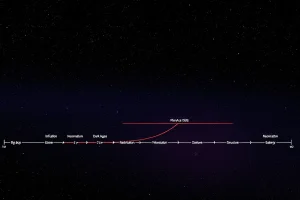
From Planck Epoch to Recombination: A Timeline of the Early Universe
| Epoch | Time after Big Bang | Approximate temperature | Key events |
|---|---|---|---|
| Planck epoch | <10⁻⁴³ s | >10³² K | Quantum gravity dominates; known physics breaks down |
| Grand Unification epoch | 10⁻⁴³–10⁻³⁶ s | 10³²–10²⁷ K | Strong, weak, and electromagnetic forces may unify |
| Inflationary epoch | 10⁻³⁶–10⁻³² s | ~10²⁷ K | Exponential expansion stretches quantum fluctuations to cosmic scales |
| Electroweak epoch | 10⁻³²–10⁻¹² s | 10²⁷–10¹⁵ K | Electromagnetic and weak forces separate |
| Quark epoch | 10⁻¹²–10⁻⁶ s | 10¹⁵–10¹² K | Quarks, leptons, and gluons form a hot soup |
| Hadron epoch | 10⁻⁶–1 s | 10¹²–10¹⁰ K | Quarks bind into protons and neutrons |
| Lepton epoch | 1–10 s | 10¹⁰–10⁹ K | Leptons and antileptons annihilate; neutrinos decouple |
| Photon epoch | 10 s–380,000 yr | 10⁹–3000 K | Nucleosynthesis creates light elements; plasma remains opaque |
| Recombination | ~380,000 yr | ~3000 K | First atoms form; CMB released |
| Dark Ages | 380,000–~150 million yr | 3000–~60 K | Neutral hydrogen fills the universe; no stars yet |
| Reionization | ~150 million–1 billion yr | ~60–20 K | First stars and galaxies ionize hydrogen |
| Structure formation | ~1 billion yr–present | ~20–2.725 K | Galaxies, clusters, and large-scale structure grow |
Inflation and the Seeds of Structure
Inflation is the leading explanation for why the universe is so uniform on large scales yet contains the tiny fluctuations that later grew into galaxies. During a brief period of exponential expansion, quantum fluctuations were stretched to cosmic sizes. These became density perturbations — regions of slightly higher and lower density — that are imprinted on the CMB as temperature anisotropies. Without inflation, the observed uniformity of the CMB across regions that were never in causal contact would be difficult to explain.
First Atoms, Dark Ages, and First Light
Recombination produced the first stable atoms, mostly hydrogen and helium. With free electrons removed, the universe became transparent, but no stars had yet formed. This period is called the Dark Ages. Over hundreds of millions of years, gravity amplified the tiny density fluctuations, pulling gas into the first stars and galaxies. Their ultraviolet light reionized the surrounding hydrogen, ending the Dark Ages. Modern observatories such as JWST are now directly observing some of these earliest galaxies, complementing the CMB’s indirect view.
How COBE, WMAP, and Planck Read the CMB
COBE, launched in 1989, made two landmark measurements. Its FIRAS instrument showed that the CMB spectrum is an almost perfect blackbody at 2.725 K, confirming the Big Bang origin. Its DMR instrument detected the first tiny temperature anisotropies — the seeds of cosmic structure. Two of COBE’s principal scientists received the 2006 Nobel Prize in Physics for this work. WMAP, launched in 2001, mapped the full sky with much higher resolution, revealing the characteristic acoustic peaks in the CMB power spectrum. These peaks allowed cosmologists to determine the universe’s age (13.8 billion years), its composition (about 5% ordinary matter, 27% dark matter, and 68% dark energy), and its geometry (nearly flat). Planck, launched in 2009 by ESA, improved the resolution and sensitivity further, using nine frequency channels to separate the CMB from foreground emission. Planck’s maps refined the ΛCDM parameters, measured the CMB gravitational lensing potential, and provided the most precise constraints on inflation and the sum of neutrino masses.
COBE vs WMAP vs Planck: A Mission Comparison
Quick Comparison
All three missions were space-based, full-sky CMB mappers. COBE opened the field, WMAP turned it into precision cosmology, and Planck pushed it to the limits allowed by the CMB’s own cosmic variance on large scales.
Table
| Feature | COBE | WMAP | Planck |
|---|---|---|---|
| Launch year | 1989 | 2001 | 2009 |
| Angular resolution | ~7° | ~0.3° | ~5 arcminutes |
| Frequency coverage | 31.5, 53, 90 GHz (DMR) | 23–94 GHz | 30–857 GHz (nine channels) |
| Key result | Blackbody spectrum; first anisotropies | ΛCDM parameters; age of universe | Highest-resolution CMB map; lensing; refined parameters |
Similarities
- All were space-based missions designed to avoid atmospheric absorption and emission.
- All mapped the entire sky in multiple microwave frequency bands.
- All measured both the CMB temperature and its tiny anisotropies.
- All contributed to establishing the Big Bang model and the ΛCDM framework.
Differences
- COBE had coarse angular resolution but was first to detect the CMB spectrum and anisotropies.
- WMAP had much higher resolution and sensitivity, enabling the first precise measurement of the acoustic peaks.
- Planck had the highest resolution and widest frequency coverage, allowing superior foreground removal and measurement of CMB polarization and lensing.
Historical Context
COBE was a NASA mission launched in 1989 and operated until 1993. Its DMR instrument mapped the CMB at 31.5, 53, and 90 GHz. WMAP, also a NASA mission, launched in 2001 and observed until 2010. Planck was an ESA mission with significant NASA participation, launched in 2009 and observing until 2013. The Planck collaboration released its final full-mission data in 2018, which remains the reference for many cosmological parameters.
Which Model Is Accepted Today?
The standard model of cosmology is ΛCDM — a universe dominated by dark energy (Λ) and cold dark matter (CDM), with ordinary matter making up only about 5% of the total energy density. Planck’s measurements are the most precise to date and are consistent with ΛCDM. However, some tensions exist, such as the Hubble constant discrepancy between CMB-derived and local measurements, and the search for primordial B-mode polarization from inflation remains an active area of research.
Why It Matters
The CMB is the most important observational tool in modern cosmology. It connects the physics of the very early universe — quantum fluctuations, inflation, and particle interactions — to the large-scale structure we see today. COBE, WMAP, and Planck turned the CMB from a faint, almost uniform glow into a high-resolution map that encodes the universe’s age, composition, geometry, and history. Their results underpin our understanding of dark matter, dark energy, and the origin of galaxies. Future missions and ground-based experiments, such as the Simons Observatory and SPHEREx, will build on this legacy by probing CMB polarization and spectral distortions with even greater precision.
Evidence / Sources
- NASA: The Universe Comes into Sharper Focus — describes COBE, WMAP, and Planck evolution and the 13.8 billion year age.
- NASA LAMBDA: CMB Discovery History — details Penzias & Wilson, COBE/DMR frequencies, and CMB maps.
- Status of CMB Observations in 2015 — reviews CMB history, current status, and future challenges including B modes and spectral distortions.
- ESA Science & Technology: Planck and WMAP CMB — compares Planck and WMAP maps and notes Planck’s nine frequency channels and higher resolution.
Related Registry Entries
- Cosmic Microwave Background
- COBE Mission
- WMAP Mission
- Planck Mission
- Inflation
- Recombination
- Dark Ages
- Reionization
- First Stars & Galaxies
- Large-scale structure
- ΛCDM
- Anisotropies
- Power Spectrum
- Temperature of CMB
- Redshift
- Big Bang
- Nucleosynthesis
- Photon Epoch
- Quark Epoch
- Hadron Epoch
- Lepton Epoch
- Planck Epoch
- JWST
- Evidence & Observations
- Cosmology Concepts
- Expansion
- Hubble–Lemaître law
- Dark matter
- Dark energy
- Baryogenesis
- Primordial abundance
- Polarization
- Acoustic Peaks
- BAO
- Critical density
- Curvature
- Cosmological principle
- Observable universe
- General relativity
- Particle Physics
- Theory
- History
- Discovery of CMB
- Missions & Experiments
- CMB Maps
Last reviewed / updated: September 8, 2026
FAQ
What is the cosmic microwave background?
The cosmic microwave background is the oldest light in the universe, released about 380,000 years after the Big Bang when the universe cooled enough for protons and electrons to form neutral hydrogen. It now appears as a nearly uniform glow at 2.725 K.
How did COBE, WMAP, and Planck differ?
COBE (1989) first detected the CMB blackbody spectrum and its tiny temperature fluctuations. WMAP (2001) mapped the full sky with much higher resolution and established the ΛCDM model. Planck (2009) provided the highest-resolution maps and refined cosmological parameters using nine frequency channels.
Why are the tiny temperature fluctuations in the CMB important?
The fluctuations, about one part in 100,000, are the seeds of all cosmic structure. They reflect density perturbations from inflation that later grew into galaxies, clusters, and the large-scale structure of the universe.
What happened during the Dark Ages?
After recombination, the universe was filled with neutral hydrogen and no stars. This period lasted roughly from 380,000 years to about 150 million years after the Big Bang, until the first stars and galaxies formed and began reionizing the gas.
Leave a Reply