Short Answer
Main Explanation
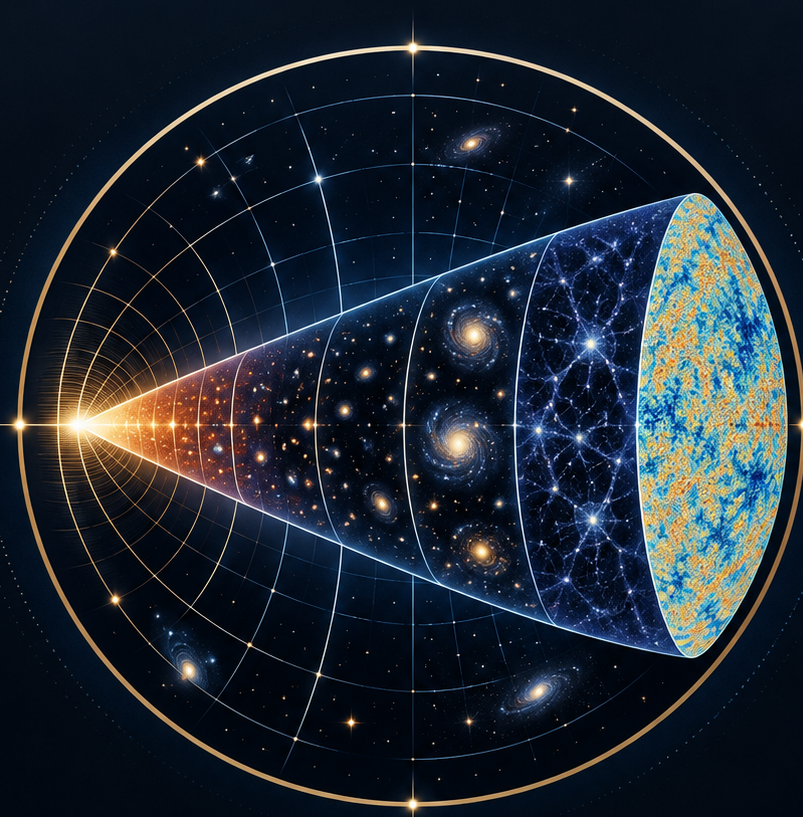
The question “Was there a singularity?” lies at the heart of modern cosmology. The Big Bang model describes a universe that began in an extremely hot, dense state approximately 13.8 billion years ago. In the standard framework, the observable universe expanded from a point of infinite density and temperature—a gravitational singularity. However, this singularity is not a physical object but a boundary of our current physical theories. At the Planck epoch (t < 10⁻⁴³ seconds), quantum gravitational effects become dominant, and our understanding breaks down. The Lambda-CDM model, the consensus cosmology, treats the singularity as a limit, not a moment in time. This article provides an interactive reference to the cosmic epochs that followed, from the Planck epoch to the formation of large-scale structure.
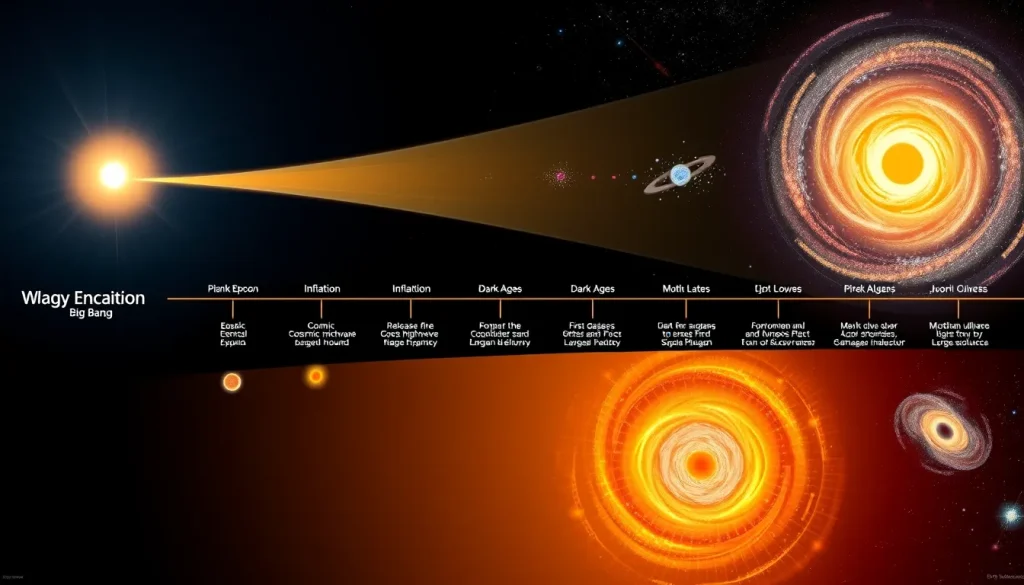
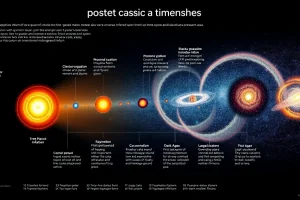
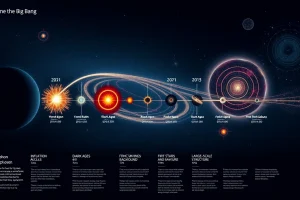
The history of the universe is divided into distinct epochs, each characterized by the dominant particles and physical processes. The timeline below summarizes these eras, and the following sections detail each one.
| Epoch | Time After Big Bang | Temperature | Key Events |
|---|---|---|---|
| Planck Epoch | < 10⁻⁴³ s | > 10³² K | Quantum gravity dominates; no known physics |
| Grand Unification Epoch | 10⁻⁴³ – 10⁻³⁶ s | 10²⁷ – 10³² K | Unified forces begin to separate |
| Inflationary Epoch | 10⁻³⁶ – 10⁻³² s | ~10²⁷ K | Exponential expansion; seeds of structure |
| Electroweak Epoch | 10⁻³² – 10⁻¹² s | 10¹⁵ – 10²⁷ K | Electromagnetic and weak forces separate |
| Quark Epoch | 10⁻¹² – 10⁻⁶ s | 10¹² – 10¹⁵ K | Quarks and gluons form quark-gluon plasma |
| Hadron Epoch | 10⁻⁶ – 1 s | 10¹⁰ – 10¹² K | Protons and neutrons form; matter-antimatter asymmetry |
| Lepton Epoch | 1 – 10 s | 10⁹ – 10¹⁰ K | Leptons dominate; neutrinos decouple |
| Photon Epoch | 10 s – 380,000 yr | 10⁴ – 10⁹ K | Photons dominate; nucleosynthesis occurs |
| Recombination | ~380,000 yr | ~3000 K | Atoms form; CMB released |
| Dark Ages | 380,000 yr – ~150 million yr | ~3000 K – ~60 K | No stars; neutral hydrogen fills space |
| Reionization | ~150 million – 1 billion yr | ~60 K – ~20 K | First stars and galaxies ionize hydrogen |
| Structure Formation | 1 billion yr – present | ~20 K – 2.7 K | Galaxies, clusters, and large-scale structure form |
Planck Epoch
When It Happened
From t = 0 to t ≈ 10⁻⁴³ seconds (the Planck time).
Temperature
Above 10³² K, corresponding to energies beyond the Planck scale (~10¹⁹ GeV).
Approximate Redshift
Effectively infinite; the scale factor approaches zero.
Dominant Particles/Physics
Quantum gravity is required. The four fundamental forces (gravity, strong, weak, electromagnetic) are unified. No known theory describes this regime.
What Happened
The universe is in a state of extreme density and temperature. Spacetime itself is subject to quantum fluctuations. The singularity is a mathematical boundary; physical predictions break down.
What Came Before
Nothing—time itself begins at the Big Bang. The concept of “before” is not defined.
What Came Next
The Grand Unification Epoch, as gravity separates from the other forces.
Evidence
Direct evidence is impossible. The existence of the CMB and the expansion of the universe support the Big Bang model, but the Planck epoch remains speculative.
Grand Unification Epoch
When It Happened
From 10⁻⁴³ to 10⁻³⁶ seconds.
Temperature
10²⁷ – 10³² K.
Approximate Redshift
Extremely high, >10³⁰.
Dominant Particles/Physics
The strong force separates from the electroweak force. Grand Unified Theories (GUTs) describe this era, but they are not yet confirmed.
What Happened
As the universe cools, the strong force becomes distinct. This may have produced a period of rapid expansion (inflation) at the end of this epoch.
What Came Before
Planck Epoch.
What Came Next
Inflationary Epoch.
Evidence
No direct evidence. GUTs predict proton decay, which has not been observed.
Inflationary Epoch
When It Happened
From 10⁻³⁶ to 10⁻³² seconds (or possibly longer).
Temperature
~10²⁷ K, dropping as space expands.
Approximate Redshift
Huge, but the scale factor increases by a factor of at least 10²⁶.
Dominant Particles/Physics
A scalar field (inflaton) drives exponential expansion. Quantum fluctuations are stretched to cosmic scales.
What Happened
The universe expands exponentially, smoothing out any initial irregularities and flattening spacetime. Quantum fluctuations become the seeds for large-scale structure.
What Came Before
Grand Unification Epoch.
What Came Next
Electroweak Epoch, after inflation ends and the inflaton decays, reheating the universe.
Evidence
Inflation explains the observed flatness, homogeneity, and the spectrum of CMB fluctuations. The BICEP/Planck measurements of B-mode polarization are consistent with inflation, though not definitive.
Electroweak Epoch
When It Happened
From 10⁻³² to 10⁻¹² seconds.
Temperature
10¹⁵ – 10²⁷ K.
Approximate Redshift
~10²⁵.
Dominant Particles/Physics
Electromagnetic and weak forces are unified. Particles acquire mass via the Higgs mechanism as the universe cools.
What Happened
The electroweak symmetry breaks, separating the electromagnetic and weak forces. The Higgs boson gives mass to elementary particles.
What Came Before
Inflationary Epoch.
What Came Next
Quark Epoch.
Evidence
Particle physics experiments (e.g., LHC) confirm the electroweak unification at high energies.
Quark Epoch
When It Happened
From 10⁻¹² to 10⁻⁶ seconds.
Temperature
10¹² – 10¹⁵ K.
Approximate Redshift
~10¹⁵.
Dominant Particles/Physics
Quarks, gluons, and leptons exist in a quark-gluon plasma. The strong force is still symmetric.
What Happened
The universe is a hot soup of free quarks and gluons. As it cools, quarks begin to combine into hadrons.
What Came Before
Electroweak Epoch.
What Came Next
Hadron Epoch.
Evidence
Relativistic heavy-ion collisions (e.g., RHIC, LHC) recreate quark-gluon plasma.
Hadron Epoch
When It Happened
From 10⁻⁶ to 1 second.
Temperature
10¹⁰ – 10¹² K.
Approximate Redshift
~10¹².
Dominant Particles/Physics
Quarks combine into protons and neutrons. Matter-antimatter annihilation occurs, leaving a slight excess of matter.
What Happened
Hadrons form. Baryogenesis produces the matter-antimatter asymmetry. Neutrons and protons are in thermal equilibrium.
What Came Before
Quark Epoch.
What Came Next
Lepton Epoch.
Evidence
The observed baryon-to-photon ratio (~6×10⁻¹⁰) is consistent with baryogenesis models.
Lepton Epoch
When It Happened
From 1 to 10 seconds.
Temperature
10⁹ – 10¹⁰ K.
Approximate Redshift
~10¹⁰.
Dominant Particles/Physics
Leptons (electrons, muons, neutrinos) dominate. Neutrinos decouple from the thermal bath.
What Happened
Neutrinos stop interacting with matter, creating the cosmic neutrino background. Electron-positron annihilation heats the photon gas.
What Came Before
Hadron Epoch.
What Came Next
Photon Epoch.
Evidence
The cosmic neutrino background has not been directly detected, but its effect on the CMB and nucleosynthesis is inferred.
Photon Epoch
When It Happened
From 10 seconds to 380,000 years.
Temperature
10⁴ – 10⁹ K.
Approximate Redshift
~10⁹ down to ~1100.
Dominant Particles/Physics
Photons dominate the energy density. Nucleosynthesis occurs in the first few minutes.
What Happened
Big Bang nucleosynthesis produces light elements (H, He, Li). The universe is a hot plasma of nuclei, electrons, and photons.
What Came Before
Lepton Epoch.
What Came Next
Recombination.
Evidence
The observed primordial abundances of helium and deuterium match BBN predictions.
Recombination
When It Happened
~380,000 years after the Big Bang.
Temperature
~3000 K.
Approximate Redshift
z ≈ 1100.
Dominant Particles/Physics
Electrons combine with protons to form neutral hydrogen. Photons decouple, creating the cosmic microwave background (CMB).
What Happened
The universe becomes transparent. The CMB is the relic radiation from this epoch, now observed at 2.725 K.
What Came Before
Photon Epoch.
What Came Next
Dark Ages.
Evidence
The CMB was discovered by Penzias and Wilson in 1965. Missions like COBE, WMAP, and Planck have mapped its anisotropies in detail.
Dark Ages
When It Happened
From 380,000 years to ~150 million years.
Temperature
~3000 K down to ~60 K.
Approximate Redshift
z ≈ 1100 to z ≈ 20.
Dominant Particles/Physics
Neutral hydrogen and helium fill the universe. No stars or galaxies yet.
What Happened
The universe is dark. Gravity slowly amplifies density fluctuations, setting the stage for star formation.
What Came Before
Recombination.
What Came Next
Reionization.
Evidence
Observations of the 21-cm hydrogen line are ongoing (e.g., EDGES, HERA). The James Webb Space Telescope (JWST) is probing the end of this era.
Reionization
When It Happened
From ~150 million to ~1 billion years.
Temperature
~60 K to ~20 K.
Approximate Redshift
z ≈ 20 to z ≈ 6.
Dominant Particles/Physics
First stars (Population III) and galaxies form. Their ultraviolet radiation ionizes the neutral hydrogen.
What Happened
The universe transitions from neutral to ionized. This epoch marks the end of the Dark Ages and the beginning of cosmic dawn.
What Came Before
Dark Ages.
What Came Next
Structure Formation.
Evidence
JWST has discovered galaxies at z > 10, and quasar spectra show the reionization history.
Structure Formation
When It Happened
From ~1 billion years to present.
Temperature
~20 K down to 2.7 K.
Approximate Redshift
z ≈ 6 to z = 0.
Dominant Particles/Physics
Dark matter halos attract baryonic matter, forming galaxies, clusters, and superclusters. Dark energy accelerates expansion.
What Happened
Galaxies evolve, stars form and die, heavy elements are produced. The large-scale structure of the universe emerges, shaped by dark matter and dark energy.
What Came Before
Reionization.
What Came Next
The future is uncertain, but the Lambda-CDM model predicts continued expansion and eventual heat death.
Evidence
Galaxy surveys (e.g., SDSS, DESI) map the cosmic web. CMB measurements constrain cosmological parameters.
Why It Matters
Understanding the cosmic timeline is not just an academic exercise. It addresses fundamental questions about our origins: How did the universe begin? What are the laws of nature at extreme energies? How did the structures we see today form? The study of the early universe connects particle physics, astrophysics, and cosmology. It also informs our search for life beyond Earth, as the conditions for habitability depend on the cosmic history of star formation and element production. Moreover, the cosmic microwave background is a treasure trove of information about the universe’s composition, age, and geometry, providing the strongest evidence for the Big Bang model.
Evidence / Sources
The standard model of cosmology, Lambda-CDM, is supported by multiple independent observations:
- Cosmic Microwave Background: COBE (1989), WMAP (2001), and Planck (2009) have measured the CMB temperature and anisotropies with increasing precision, confirming the predictions of inflation and recombination.
- Big Bang Nucleosynthesis: The observed abundances of helium-4, deuterium, and lithium match theoretical predictions for a hot, dense early universe.
- Large-Scale Structure: Galaxy surveys reveal a web of filaments and voids consistent with gravitational growth from initial density fluctuations.
- Expansion History: Type Ia supernovae and baryon acoustic oscillations show the accelerating expansion driven by dark energy.
- James Webb Space Telescope: JWST is probing the era of reionization and the first galaxies, providing direct observations of cosmic dawn.
Related Registry Entries
This article is part of a series on cosmology. Related entries include:
- The Big Bang Model
- Cosmic Inflation
- The Cosmic Microwave Background
- Nucleosynthesis and the First Elements
- Dark Matter and Dark Energy
FAQ
What exactly is the singularity in the Big Bang model?
In the standard Big Bang model, the singularity is a point of infinite density and temperature at t=0. However, it is not a physical object but a boundary where our current theories (general relativity and quantum mechanics) break down. The Planck epoch marks the limit of known physics.
How do we know the universe began with a Big Bang?
Key evidence includes the expansion of the universe (Hubble's law), the cosmic microwave background radiation, the primordial abundances of light elements, and the large-scale structure of galaxies. These observations are consistent with a hot, dense early state.
What is the cosmic microwave background and why is it important?
The CMB is the oldest light in the universe, emitted about 380,000 years after the Big Bang when atoms formed and photons decoupled. It provides a snapshot of the universe at that time and contains tiny temperature fluctuations that seeded the formation of galaxies and clusters.
Did the universe expand faster than light during inflation?
Inflation caused the universe to expand exponentially, with the scale factor increasing by at least 10²⁶. This does not violate special relativity because it is the expansion of space itself, not motion through space. No information travels faster than light locally.

Leave a Reply